


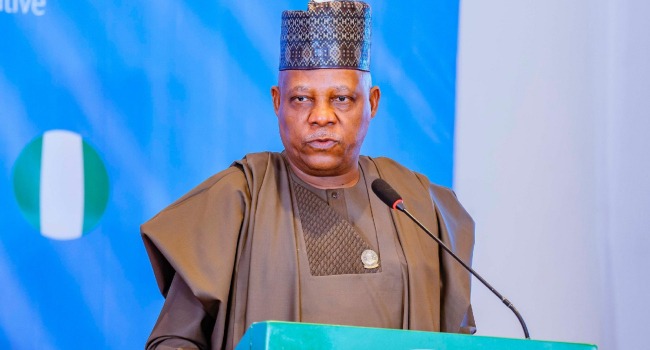
The Federal Government has announced new incentives to strengthen agricultural investment under President Bola Tinubu’s Renewed Hope Agenda.
The reforms aim to unlock Nigeria’s food production potential through policies designed to attract investment in agriculture and infrastructure.
Vice President Kashim Shettima disclosed the initiatives on Tuesday in Abuja during the Food and Agriculture Organization of the United Nations (FAO) National and Sub-regional Hand-in-Hand Investment Forum.
He emphasized that hunger is a global security issue, calling on Nigeria to mobilize its strengths for a future of abundance.

“Nothing unifies humanity as much as hunger. It is the great equalizer that reveals our vulnerabilities and the shared fragility of our existence. Food is not merely a matter of survival; it is a matter of global security,” Shettima said.
The announced measures include single-window platforms for land registration, strengthened agricultural credit systems, large-scale mechanization, and strategic irrigation projects. Nigeria currently uses less than 10 percent of its irrigation capacity, despite having river basins and aquifers capable of covering more than three million hectares. Shettima noted that strategic investment in irrigation could triple yields, reduce seasonal dependency, and improve resilience against climate shocks.
The Vice President further stated that the 2021–2025 National Development Plan aims to lift 35 million Nigerians out of poverty, create 21 million rural jobs, and ensure food and nutrition sufficiency.
Shettima assured investors that regulatory reforms, public-private partnerships, and agri-tech innovations would make Nigeria “open for business.”
Minister of Agriculture and Food Security Abubakar Kyari highlighted Nigeria’s large arable land, domestic market, favorable weather, and growing digital economy as key opportunities for agribusiness investment. Minister of Budget and Economic Planning Senator Atiku Bagudu added that agriculture and irrigation remain crucial for economic diversification and the Renewed Hope Agenda’s success.
