


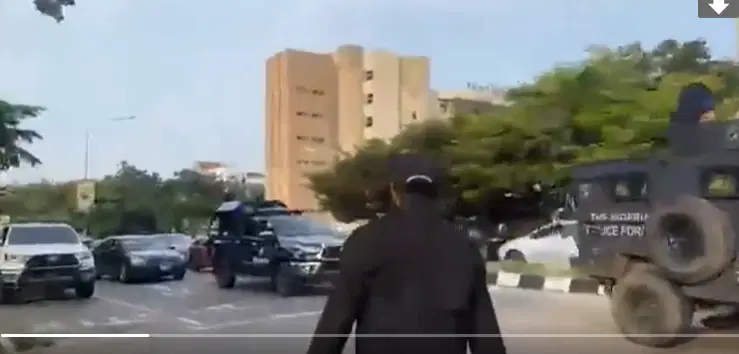
On Monday morning, residents of Abuja voiced their anger as security forces erected barricades at key locations across the city, leading to significant traffic congestion.
Commuters from areas such as Bwari, Ushafa, Dutse, and parts of Kubwa found themselves stranded en route to the city center, with many unable to reach their destinations on time. The unexpected checkpoints disrupted the usual flow of traffic, causing widespread inconvenience for daily commuters.
The gridlock was attributed to a planned protest organized by Omoyele Sowore, the publisher of Sahara Reporters, and other activists advocating for the release of Nnamdi Kanu, the leader of the Indigenous People of Biafra (IPOB). The protesters intended to march to the State House, the official residence of President Bola Tinubu, to demand Kanu’s release. In anticipation of the demonstration, security agencies preemptively set up barricades to control movement and prevent potential disruptions.
Motorists along major routes, including the Nyanya-Mararaba road, reported being stuck in traffic for extended periods due to the security checkpoints. In the Sokale area, one motorist, Usman Jibrin, expressed his frustration, stating that he had been stationary for over an hour. He questioned the necessity of such measures, wondering if the authorities feared that protesters might be brought in from other areas. Jibrin described the situation as “punishment,” highlighting the challenges faced by ordinary citizens during such events.

The planned protest had garnered attention both locally and internationally. The United States Embassy in Abuja issued a security alert to American citizens, advising them to avoid areas around Eagle Square and the Central Business District due to potential disruptions and confrontations between police and protesters. The embassy recommended limiting movement throughout the city and exercising caution in the vicinity of large gatherings.
Despite the security measures, the protest proceeded as planned. Activists, including Sowore, marched towards the State House, demanding the release of Nnamdi Kanu. The demonstration aimed to draw attention to Kanu’s continued detention and to press for his release. While the protest remained largely peaceful, the heavy security presence and the earlier traffic disruptions underscored the tensions surrounding the event.
In the aftermath, residents and commuters expressed a mix of relief and continued frustration. While the immediate disruptions had been addressed, many questioned the necessity and timing of the security measures. The events of the day highlighted the delicate balance between ensuring security and maintaining the daily routines of citizens, prompting discussions on how such situations can be better managed in the future.
