


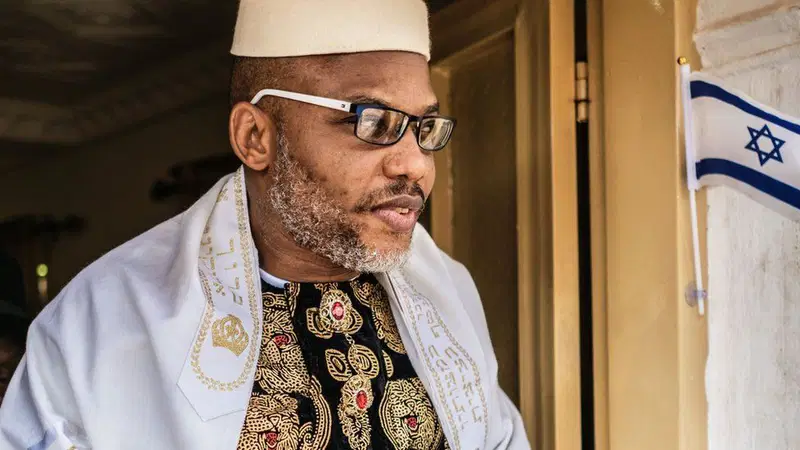
Renowned journalist and political commentator, Dele Momodu, has said that the continued marginalisation of the Igbo people is a major reason behind the renewed agitation for Biafra championed by Nnamdi Kanu and the Indigenous People of Biafra (IPOB).
Momodu described the issue as one that has deep historical and emotional roots in the Nigerian political system.
Speaking in a recent interview, Momodu noted that many people who criticise Kanu’s movement fail to understand the real cause of the agitation. According to him, “most of them only jumped to conclusions without proper analysis of why agitation for Biafra became reignited, attractive, and fanciful after the pogrom that wasted millions of lives and destroyed unimaginable properties in the 1960s and 1970s.”
He explained that the resurgence of the Biafra cause is not a product of hate or rebellion but a reaction to years of perceived exclusion of the South East from national development. Momodu stressed that the sense of deprivation and injustice among the Igbo has given rise to renewed calls for self-determination.

The Ovation International publisher further stated that the agitation is being driven by the frustration of young people who feel that their region has been denied fair representation in politics, governance, and key national appointments. “The deprivation of some of the most energetic and vibrant brains in Africa has contributed to the appeal of the Biafra struggle,” he said.
Momodu also warned that if the grievances of the Igbo people continue to be ignored, the movement may attract more sympathy and support from across the region. He advised the Nigerian government to address these issues through dialogue, fairness, and inclusion instead of suppression or neglect.
He concluded by calling for unity and national introspection, urging leaders to recognise that understanding the Igbo perspective is essential to building a peaceful and united Nigeria. “Recognising legitimate concerns about marginalisation is not the same as endorsing secession, but a step toward national cohesion,” Momodu added.
