


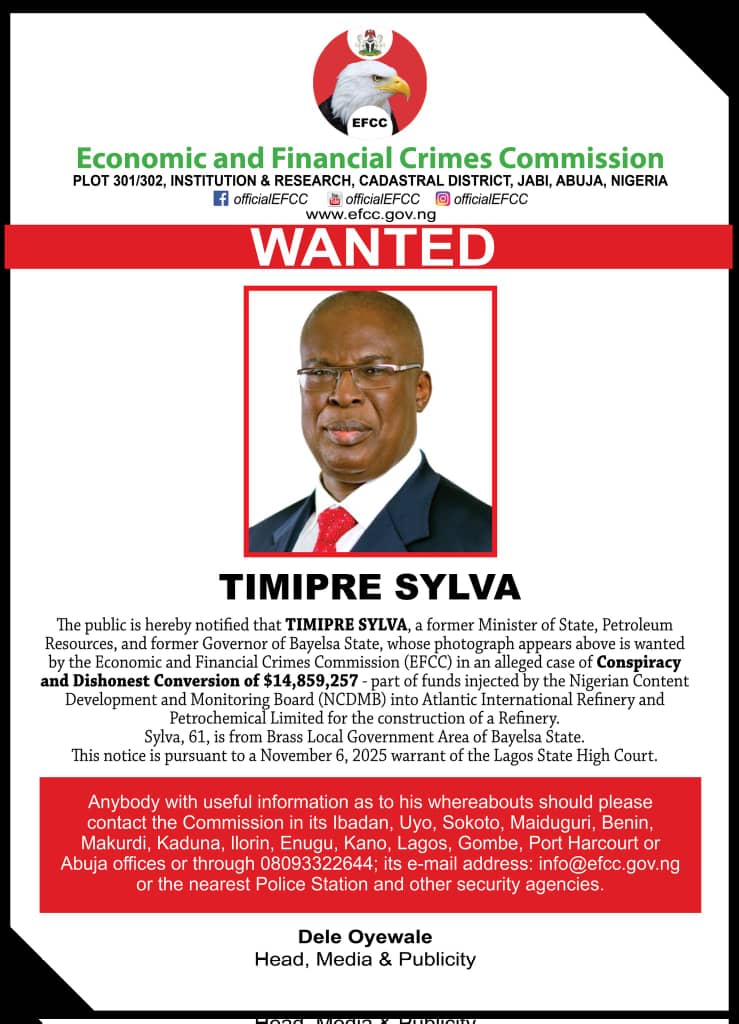
In a new development in anti-corruption fight, the Economic and Financial Crimes Commission (EFCC) has reportedly declared former Governor of Bayelsa State, Timipre Sylva, wanted in connection with alleged fraudulent transactions totaling approximately US$14.8 million.
Timipre Sylva served as the Governor of Bayelsa State from 2007 to 2012. During his tenure and thereafter he has been under investigation by the EFCC for a number of alleged financial mis-dealings and money-laundering offences.
-
In May 2015 the EFCC re-arraigned him on a six-count charge alleging the conversion of about N2.45 billion belonging to the state between October 2009 and February 2010.
-
The EFCC also brought a fresh charge in June 2015 alleging that Sylva and associates used three companies to siphon about N19.2 billion from the state coffers between 2009-2012.

-
He was even arrested by the EFCC in May 2013 at his Abuja residence in connection with alleged fresh money-laundering investigations.
Thus Sylva has long been a subject of corruption probes. However, the figure of US$14.8 million as the alleged fraud amount appears to be a more recent figure reported in the current “wanted” declaration by the EFCC.
What Does the Wanted Declaration Mean?
When the EFCC declares someone “wanted”, it signifies that:
-
The individual is actively sought by the anti-graft agency, often because they have failed to appear for investigations or court proceedings, or have evaded arrest.
-
The EFCC may seek to have the person arrested, charged and brought before court.
-
It may trigger cooperation with other domestic agencies (police, immigration) or international law-enforcement (if there’s cross-border dimension) to apprehend the suspect.
-
It increases public and media scrutiny, and can often mean assets may be targeted, frozen or forfeited under recovery laws.
In this case, Sylva’s being declared wanted over “US$14.8 million” suggests the EFCC believes there is credible evidence of that amount being misappropriated, potentially across borders or currencies, which may elevate the complexity of the investigation.
Key Questions & Gaps
There are several important unknowns at this stage:
-
Exact source of the US$14.8 m figure: The EFCC announcement reportedly uses this sum, but detailed public documentation (charge-sheets, breakdowns) for that exact amount are not readily available in open domain at the time of this report.
-
Nature of the alleged fraud: Is it a single transaction, a series of transactions across years, money-laundering of proceeds of crime, mis-appropriation of public funds, or a combination?
-
Jurisdiction/location: Did the alleged offence occur wholly within Nigeria, or did it involve foreign banks, offshore accounts, or currency conversion that triggered the dollar figure?
-
Status of legal proceedings: Has the EFCC already charged Sylva in relation to this specific US$14.8m, or is the “wanted” status a prelude to formal charging?
-
Sylva’s response: Whether Sylva has made public his reaction (denial, rebuttal, explanation) is unclear as of now.
Implications
• For the Anti-corruption Fight: This declaration underscores the EFCC’s resolve to pursue high-profile officials and large sums, potentially enhancing deterrence.
• For Governance and Public Trust: When a former governor is declared wanted over such amounts, it undermines confidence in public finances, especially in states like Bayelsa which are oil revenue-rich and yet face infrastructural and service delivery deficits.
• For Sylva Personally: He risks arrest, asset seizure, forfeiture proceedings, and prosecution. His mobility and financial assets may come under significant constraint.
• For Bayelsa State and Nigeria: Recovery of looted funds is slow and difficult. If the EFCC is able to realise significant recoveries in this case, it could be a win for the public interest.
Conclusion
The EFCC’s declaration that Timipre Sylva is “wanted” over an alleged US$14.8 million fraud marks a significant step in one of Nigeria’s many prominent anti-corruption cases.
While the public may not yet have full clarity on all the details behind the figure, the action speaks to the seriousness of the allegations and the effort to hold senior public officials accountable. How this case unfolds—whether it results in prosecution, recovery of funds, or gets tied up in legal and political delays—will be closely watched.
Source: EFCC
