


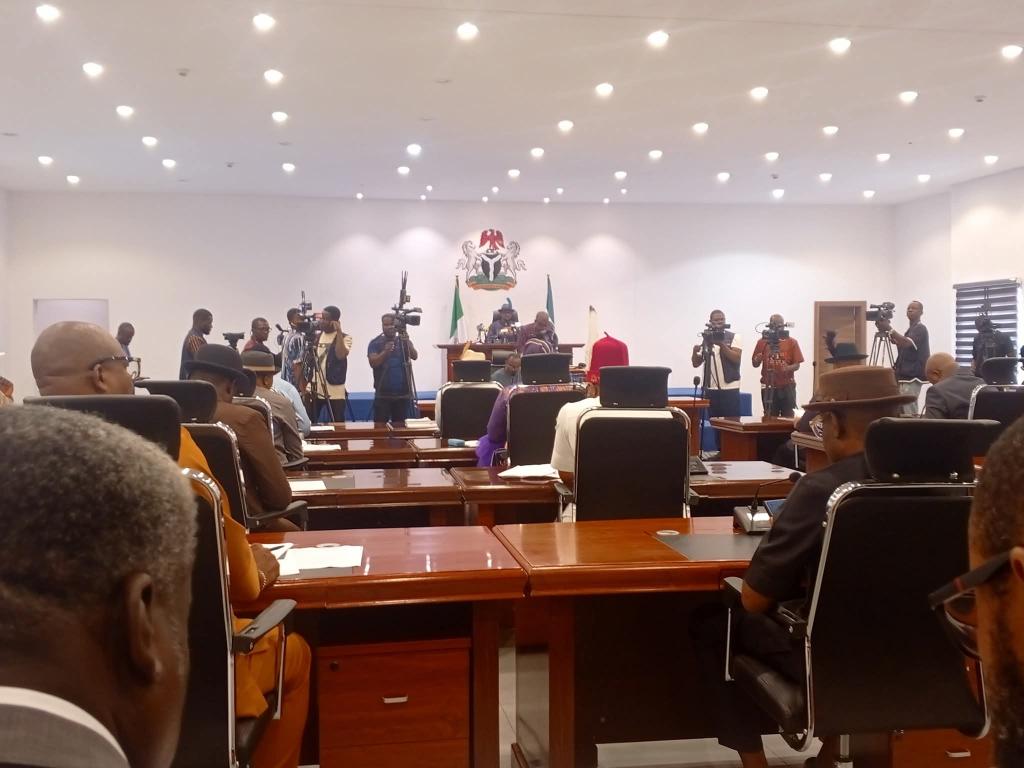
Sixteen members of the Rivers State House of Assembly — led by the Speaker, Martin Amaewhule — have defected from the Peoples Democratic Party (PDP), to the All Progressives Congress (APC).
Amaewhule announced the lawmakers’ decision during plenary on Friday, citing what he described as a “clear division” within the PDP as the reason for their defection.
This abrupt shift deepens the ongoing political turbulence in Rivers — a state already grappling with repeated defections, legal battles, and competing claims to legitimacy.
Background: Remnants of Earlier Defections & Institutional Rift
-
This defection comes after a previous wave in December 2023 when 27 lawmakers under Amaewhule’s leadership left PDP for APC.

-
The 2023 defection triggered intense constitutional and legal disputes: some argued the lawmakers lost their seats under Section 109(1)(g) of the 1999 Constitution (the clause dealing with party-based mandates).
-
Courts and rival factions tossed judgments back and forth. For instance, one High Court initially refused to declare seats vacant because mere media reports of decampment were deemed insufficient proof of defection.
-
The controversy created a split within the Assembly — one faction claimed legitimacy under Amaewhule, another under Victor Oko-Jumbo, each accusing the other of being illegal.
Thus, the latest defection — of 16 lawmakers — is not an isolated move; it’s another installment in a protracted struggle over who rightfully controls the state legislature.
Legal and Constitutional Stakes: What’s at Issue
-
Under Nigeria’s 1999 Constitution, lawmakers who defect from the party under which they were elected typically lose their seats — unless a recognised division within the original party justifies it.
-
According to critics of past defections, the earlier 27 lawmakers lost their seats immediately after crossing to APC.
-
But defenders — including the Amaewhule camp — argue that there was indeed a legitimate “division” in the PDP that warranted the switch, and that constitutional conditions for defection were met.
-
Courts have been split. While some rulings favour the defectors, others say crossing the floor doesn’t automatically confer legislative legitimacy.
Given this, the 16-member defection may soon face fresh legal scrutiny: will their seats be recognised — or challenged on grounds of constitutional forfeiture?
Implications: Governance, Power Balance & 2027 Elections
-
Legislative control: If the defecting 16 members are recognised, APC could consolidate dominance in the Rivers State Assembly, influencing legislation, budgets, oversight, and political appointments.
-
Political realignments ahead of 2027: The defection may signal shifting allegiances as parties reposition for upcoming general elections. Politicians might defect for power, influence, or to ride the wave of the ruling party at the centre.
-
Erosion of party stability: The repeated defections underscore internal fragility within the PDP in Rivers and highlight a broader trend of political opportunism — weakening long-term party identity.
-
Constitutional precedent: How courts rule on these defections could set precedent for future party-switch episodes across Nigeria — especially as similar defections occur in other states.
Media & Public Reaction
As I source this headline from Punch and do justice with my critique — the announcement came during plenary and appears genuine, rather than rumours.
On social media and among political watchers, reactions are mixed: some view it as a calculated move to stay relevant, while others warn it undermines democratic representation and stability.
Critics argue this kind of floor-crossing erodes the trust between voters and their elected representatives — since people voted the defectors as PDP candidates, not APC.
Meanwhile, supporters claim the move reflects shifting political realities and the need for unity under a party seen as better positioned for governance.
What’s Next: Watch Points
-
Legal challenges: Expect lawsuits or constitutional petitions. Opponents may press for declarations that the defectors have forfeited their seats.
-
By-election calls: If courts deem seats vacant, fresh elections may be required in affected constituencies.
-
Further defections or reversals: More lawmakers might defect — or some may attempt to return to their original party depending on incentives or pressure.
-
Impact on governance: Key state decisions — budget, oversight, legislation — may get reshaped depending on which faction wins recognition.
The defection of 16 lawmakers and Speaker Amaewhule from PDP to APC is more than just another political maneuver — it’s a flash-point in a broader tussle over legitimacy, representation, party loyalty and power in Rivers State.
As the courts, civil society, and the public weigh in, the ripple effects may influence not only state politics but also set precedents for our national democratic trajectory ahead of the 2027 general elections.
