


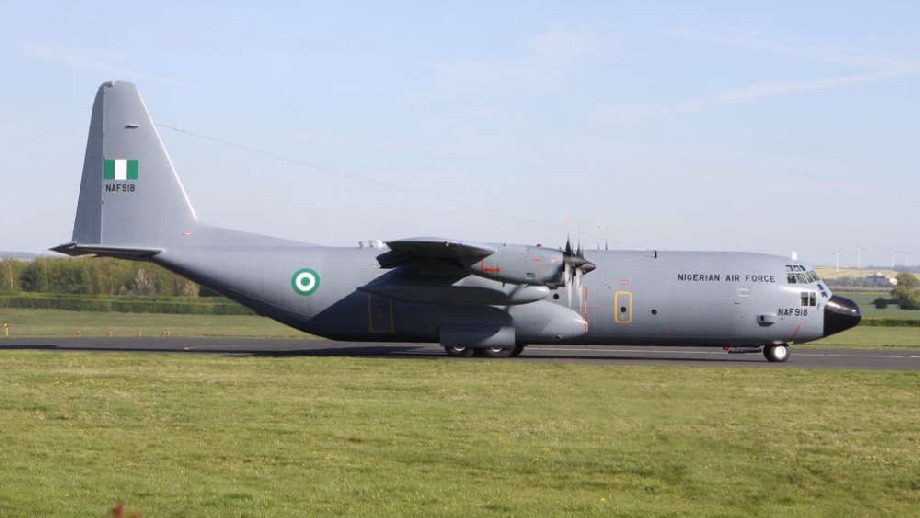
The Nigerian Air Force (NAF), has issued a detailed clarification regarding reports about the diversion and landing of one of its C-130 Hercules aircraft in Burkina Faso, stressing that the decision was a precautionary safety measure fully aligned with standard aviation procedures and international protocols.
According to NAF, the aircraft—on a scheduled ferry mission to Portugal—was compelled to divert to the nearest suitable airfield after its crew detected a technical concern shortly after takeoff from Lagos on 8 December 2025.
In a statement released on Tuesday by the Director of Public Relations and Information, Air Commodore Ehimen Ejodame, the Air Force emphasized that the diversion to Bobo-Dioulasso, Burkina Faso, was a routine safety action that any crew would take under similar circumstances.
“Following takeoff from Lagos, the crew observed a technical concern which necessitated a precautionary landing in Bobo-Dioulasso, Burkina Faso, the nearest airfield, in accordance with standard safety procedures and international aviation protocols,” the statement read.
Ejodame further confirmed that all NAF personnel onboard are safe and have been receiving cordial treatment from Burkinabè authorities, dispelling speculations about hostile handling or detention.

He added that arrangements were already underway to resume the ferry mission as scheduled, once the aircraft is cleared to continue its journey.
“The Nigerian Air Force appreciates the support received during this period and assures the public that NAF remains professionally committed to strict compliance with operational procedures and safety standards, ensuring the protection of its personnel while fulfilling its constitutional mandate.”
Burkina Faso’s Position
Despite NAF’s explanation, Burkina Faso’s government earlier issued a statement alleging that the Nigerian aircraft had violated its airspace. The report, published by the state-run Agence d’Information du Burkina (AIB), cited a declaration from the Confederation of Sahel States (AES)—a regional alliance comprising Burkina Faso, Mali, and Niger.
The AES statement claimed the aircraft was forced to land after entering Burkinabè airspace without proper authorisation. This assertion, however, sharply contrasts with the NAF’s account that the landing was purely precautionary.
Broader Context
The incident comes at a time of heightened sensitivity between Nigeria and members of the AES bloc, whose military governments have reconfigured regional alliances and remain wary of foreign military movements across their airspace.
Nevertheless, NAF’s firm clarification seeks to calm public concerns and reinforce the narrative that the diversion was technical, not political.
