

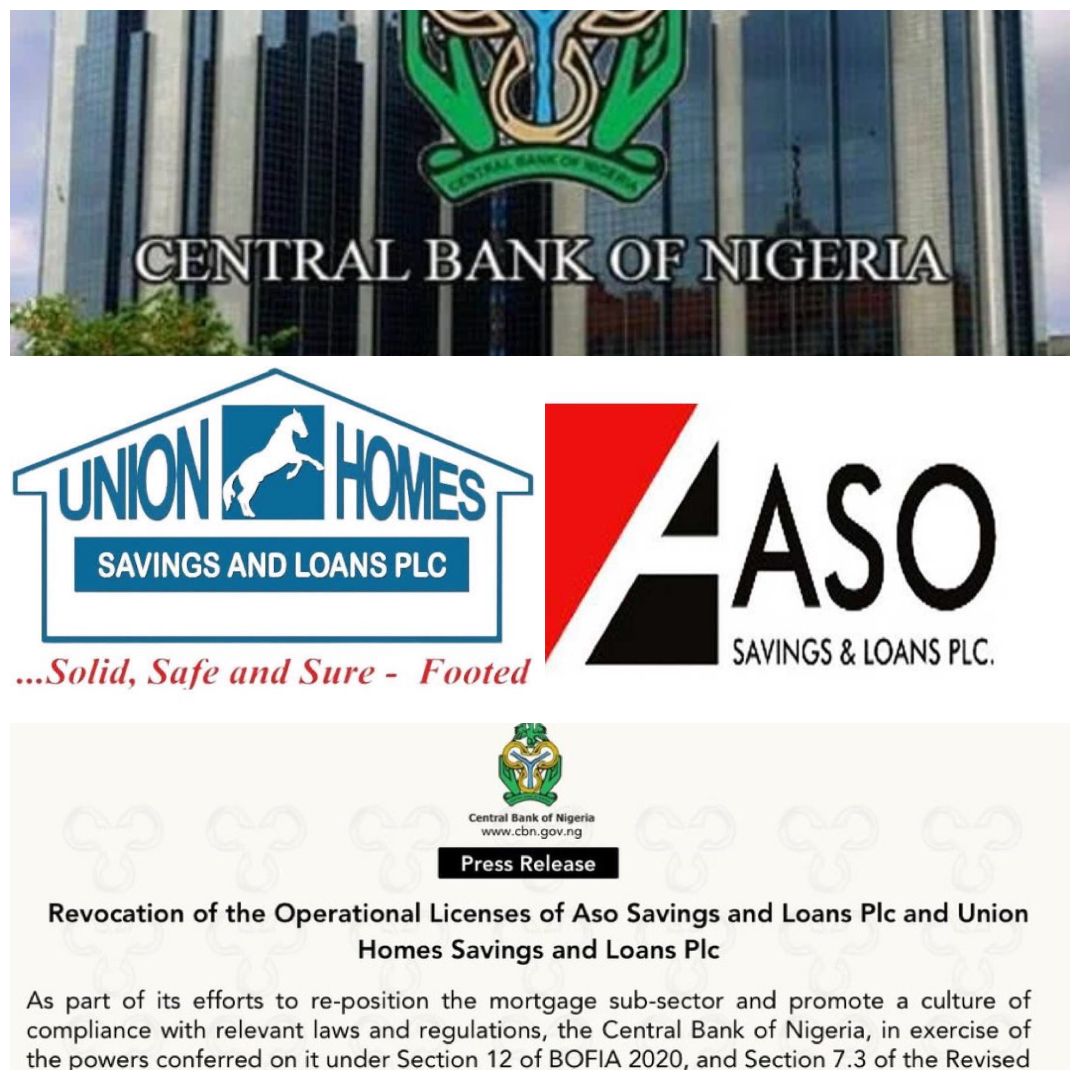
The Central Bank of Nigeria (CBN), has taken decisive regulatory action by revoking the operating licences of Aso Savings and Loans Plc & Union Homes Savings and Loans Plc, two mortgage finance institutions that have struggled with prolonged financial and regulatory challenges.
What Happened?
On Monday, December 15, 2025, CBN withdrew the licences of both institutions — effectively shutting down their ability to operate as licensed primary mortgage banks in Nigeria. The move is part of the apex bank’s broader enforcement of prudential standards and its efforts to shore up confidence in the financial system.
Reasons for Licences Revocation
According to the CBN’s official statement signed by Hakama Sidi Ali, Acting Director of Corporate Communications, the regulatory action was taken because both Aso Savings and Union Homes repeatedly failed to meet essential legal and financial requirements, including:
-
Failure to meet minimum paid-up capital requirements for their licence category;

-
Insufficient assets to cover liabilities;
-
Critical under-capitalisation, with capital adequacy ratios below regulatory minimums;
-
Persistent non-compliance with supervisory directives from the CBN.

The action was taken under the powers granted to the CBN under Section 12 of the Banks and Other Financial Institutions Act (BOFIA) 2020 and the Revised Guidelines for Mortgage Banks in Nigeria.
Impact on Depositors and Liquidation Process
Following the revocation, the Nigeria Deposit Insurance Corporation (NDIC), has begun the process of liquidating the two institutions. The NDIC has commenced payment of insured deposits — up to ₦2 million per account — to eligible customers, as guaranteed under Nigeria’s deposit insurance framework.
Debtors with outstanding loans at the defunct institutions are expected to settle their obligations with the NDIC’s Asset Management Department as part of the winding-up process.
The NDIC and CBN have both issued assurances to the public that deposits in other licensed banks remain safe, and Nigerians are encouraged to continue their regular banking activities without undue concern.
Broader Context: Strengthening Financial Sector Oversight
The revocation is consistent with the CBN’s ongoing efforts to enforce regulatory discipline across the banking and financial system — following previous actions in other segments of the sector, such as bureau de change reforms and enforcement of new licensing requirements.
For the mortgage sub-sector specifically, authorities have emphasized the need for robust capital positions and compliance with regulatory standards to ensure the growth and stability of housing finance in Nigeria.
Market and Investor Implications
Both Aso Savings and Union Homes have faced long-standing financial difficulties. Union Homes, for example, was delisted from the Nigerian Exchange (NGX), earlier in 2025 after failing to meet exchange-related requirements — reflecting deeper structural issues in its operations prior to the licence revocation.
The revocations may prompt increased scrutiny of other lenders in the mortgage space, pushing them to strengthen capital buffers and regulatory compliance or face similar regulatory actions.
What This Means for Stakeholders
-
Depositors: Insured amounts (up to ₦2 million) will be paid by the NDIC; uninsured deposits may be recovered through the liquidation process depending on asset realisations.
-
Employees: Staff of the affected institutions will likely be impacted as operations cease and liquidation begins.
-
Regulators and Investors: The move reinforces CBN’s stance on strict adherence to prudential standards and may influence future supervision and risk management practices in the mortgage and broader banking sectors.
The development marks another significant step by the CBN in tightening oversight of the financial services industry, particularly within the mortgage banking space, where capital adequacy and corporate governance have remained longstanding challenges.
