

In a significant disciplinary ruling that’s reverberated across African football, the Confederation of African Football (CAF), has banned Cameroonian Football Federation (FECAFOOT), President, Samuel Eto’o for four matches and fined him $20,000 following alleged misconduct during Cameroon’s 2–0 defeat to host nation Morocco at the 2025 Africa Cup of Nations (AFCON).
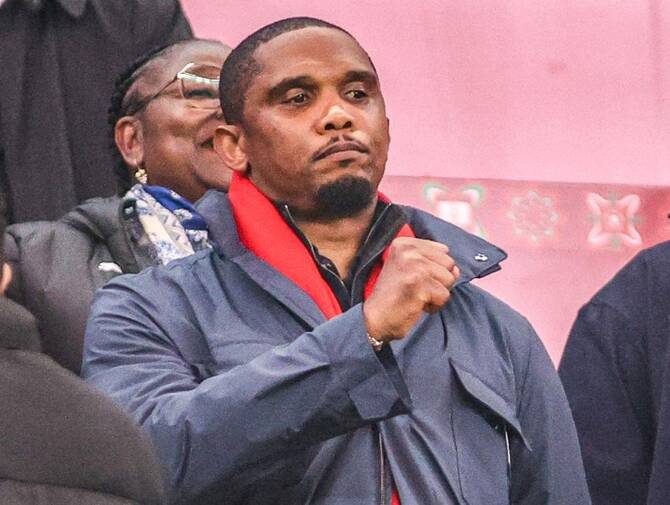
The incident occurred on January 9, 2026, during the quarter‑final clash in Rabat, where watching from the executive stand, Eto’o was seen making visible gestures of protest toward match officials and leaders of participating federations — actions CAF deemed unacceptable for a senior football administrator.
What Happened on the Day?
Morocco, the tournament hosts, beat Cameroon 2–0 to advance to the semi‑finals. While on the pitch, Brahim Díaz and Ismael Saibari delivered the goals that sealed the result, off‑field drama unfolded in the stands.
Eto’o — widely respected as one of Africa’s greatest-ever players and a former captain of the national team — was photographed and filmed reacting angrily to perceived contentious refereeing decisions. The gestures were reportedly directed toward Fouzi Lekjaa, President of the Moroccan Football Federation, and occurred in the presence of CAF President Patrice Motsepe.

CAF’s disciplinary board found that this behaviour violated the Confederation’s statutes on sportsmanship and integrity, specifically citing breaches under Article 2(3) of the CAF Statutes and Article 82 of the CAF Disciplinary Code.
CAF’s Disciplinary Ruling
After reviewing the case, CAF’s Disciplinary Board announced:
-
A four‑match ban on Eto’o from participating in or attending CAF‑sanctioned matches.
-
A $20,000 fine for misconduct deemed detrimental to the spirit and standards of the competition.
The sanctions mean Eto’o will be barred from being present on the touchline or in official areas during Cameroon’s next four AFCON fixtures, including any future tournaments or qualifiers overseen by CAF.
CAF confirmed the decision would stand unless successfully appealed, and stated it would not comment further beyond the ruling at this stage.
FECAFOOT and Eto’o Respond
The Cameroon Football Federation (FECAFOOT), reacted strongly to the ruling, expressing “unwavering support” for its president. The federation described the decision as lacking explicit justification and raised concerns about the expedited disciplinary process — suggesting it compromised basic fairness and due process.
FECAFOOT’s official statement emphasised its continued backing for Eto’o and reiterated its commitment to a disciplinary system built on transparent and credible procedures. The federation has indicated plans to appeal the ban within CAF’s established mechanisms.
Eto’o himself — one of Africa’s most decorated footballers — holds a high profile both on and off the pitch, and his transition into football administration has been both celebrated and controversial. This episode marks one of the most high‑profile disciplinary actions involving a senior official at AFCON.
Broader AFCON 2025 Context
The Cameroon–Morocco clash was one among several dramatic moments at AFCON 2025 (hosted in early 2026).
In addition to the controversy involving Eto’o:
-
CAF has been investigating other incidents of post‑match confrontations and violent altercations from this stage of the tournament.
-
Morocco progressed from the quarter‑finals to reach the final — defeating Nigeria on penalties — and aim for their first continental title since 1976.
These developments have encouraged CAF to emphasise discipline and professionalism among all stakeholders during its flagship competition.
Why This Matters
The disciplinary action against Eto’o is significant for several reasons:
-
Setting a precedent: It underscores CAF’s willingness to hold not only players and coaches but also top officials to behavioural standards.
-
Football governance: It highlights ongoing tensions around fairness, due process, and disciplinary protocols within African football administration.
-
Legacy and leadership: For Eto’o, whose legacy as a player is unquestioned, this represents one of his most contentious moments in football leadership.
What’s Next
-
Appeal process: Eto’o and FECAFOOT are expected to pursue an appeal within CAF’s judicial framework, potentially delaying the final outcome.
-
Continued scrutiny of AFCON conduct: CAF’s disciplinary actions, including broader investigations into violence and misconduct, suggest more rulings could follow.
-
Impact on future events: How CAF balances disciplinary enforcement with administrative transparency will likely shape governance debates ahead of upcoming African and international competitions.
