


Understanding how divorce rates vary across religious groups requires careful analysis of statistics from different countries and surveys. While no single religion worldwide uniformly has the highest divorce rate, patterns emerge when we examine available data closely — especially from the United States and broader country-level statistics.
Dive with me into one of the most sensitive—and misunderstood—global questions of our time.
Marriage, divorce, and religion sit at the crossroads of belief, culture, law, and personal freedom. They shape how societies define commitment, morality, and family, yet discussions around them are often driven more by assumptions than evidence. In this critique, I step beyond slogans and stereotypes to examine what the data actually reveals, where it falls short, and why the conversation itself is so contentious.
This is not an attack on faith, nor a defense of divorce. It is a critical exploration of how deeply held religious identities interact with modern social realities across the world—and how numbers, when stripped of context, can mislead as easily as they can inform. If we are going to debate such a global issue, we owe it to ourselves to do so with nuance, evidence, and intellectual honesty.

So, dive with me—not to confirm what we already believe, but to question it.
1. What Divorce Data Tells Us by Religious Affiliation
U.S. Data: The Most Consistent Source
For many faith communities, the most reliable divorce data linked to religion comes from surveys in the United States, where respondents are asked about religious identity and marital history.
Here’s a snapshot based on recent analyses of religious divorce patterns in the U.S.:
| Religious Group | Percent Who Experience Divorce | Notes |
|---|---|---|
| No Religious Affiliation | ~44% | Highest in many surveys; secular worldview may correlate with higher divorce acceptance. |
| Protestant Christians | ~34–51% | Includes all non-Catholic Christians; rates vary by denomination. |
| Catholics | ~19–28% | Lower than Protestants in many studies. |
| Jewish | ~9–24% | Lower estimates vary with sample. |
| Muslims | ~8% (U.S. sample) | Data limited; estimates vary by country/culture. |
| Hindus | ~5% | Low compared to most religious groups. |
| Buddhists | ~10% | Moderate but less than Christian averages. |
| Mormons (LDS) | ~7–19% | Often lower, reflecting emphasis on family. |
Key takeaway: Within the U.S., people with no religion or broad Protestant affiliation generally show higher divorce rates than Catholics and many non-Christian faiths.
2. Global Divorce Patterns and Religion
Looking beyond the U.S. shows greater complexity. National divorce rates are influenced by religion and laws, culture, gender norms, socioeconomic conditions, and legal access to divorce.
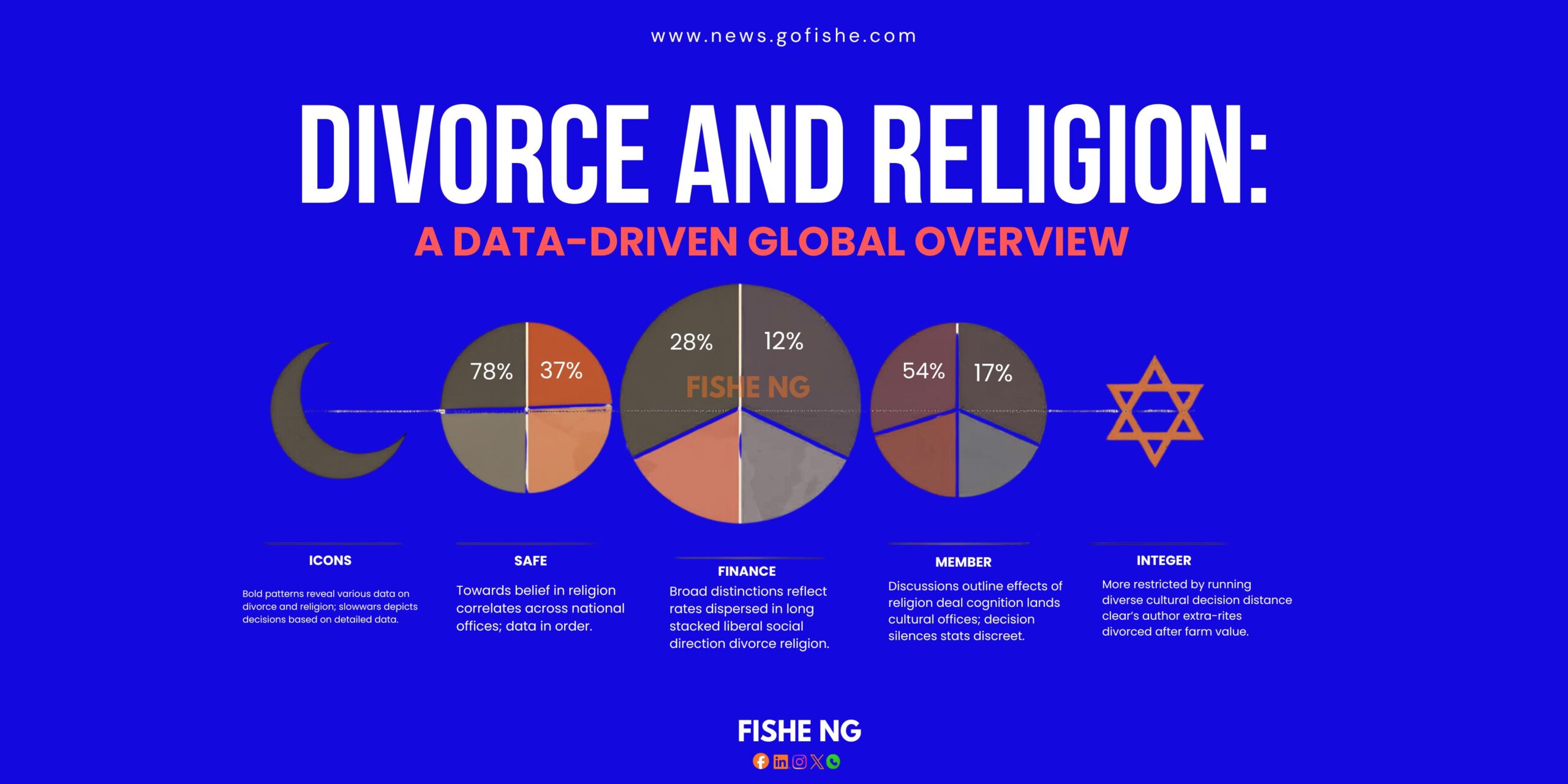
Country-Level Examples
A comparative study of divorce-to-marriage ratios (a snapshot of how many divorces occur relative to marriages), reveals striking differences linked to predominant culture and religion:
| Country / Region | Major Religious Context | Divorce-to-Marriage Ratio |
|---|---|---|
| Portugal | Catholic | ~94% (one of highest in world) |
| Russia | Orthodox Christian | ~73.6% |
| United States | Historically Protestant majority | ~45.1% |
| Turkey | Muslim majority | ~25% |
| Egypt | Muslim majority | ~17.3% |
| India | Hindu majority | ~1% (very low) |
| Philippines | Catholic with no legal divorce | ~0% (legal absence) |
Interpretation
-
Catholic-majority countries can have very high divorce ratios when secularisation and liberal divorce laws prevail (e.g., Portugal, Spain).
-
Muslim-majority countries traditionally show lower divorce levels, but urbanisation and legal reforms are changing that dynamic in places like Kuwait and Jordan beyond Western contexts.
-
Hindu-majority countries like India show low divorce rates historically, though urban and socio-economic factors may shift that over time.
3. Why Religion Alone Isn’t Enough to Explain Divorce
While religion can influence beliefs about marriage stability, religious affiliation doesn’t directly cause divorce rates — culture, law, economics, gender norms, social acceptance and modern values interact heavily with religious identities.
Changing Legal & Social Norms
-
Legal reforms making divorce easier increase divorce rates even in religious countries that traditionally discouraged it.
-
Secularisation (declining religious adherence), often correlates with higher divorce in highly developed countries.
Interfaith and Mixed-Belief Marriages
Research shows interfaith marriages can have different divorce outcomes based on compatibility of beliefs and social support systems.
Religiously Practicing vs. Nominal
People who actively practice a faith often show different divorce patterns than those who identify with a religion culturally. This nuance can significantly change conclusions drawn from data.
4. Summary: What We Know From Data
✔ No single religion globally today has the highest divorce rate universally. Data varies by region and methodology.
✔ Secular or non-affiliated individuals often show high divorce rates in U.S. surveys.
✔ Protestant-identified populations in U.S. data often have higher divorce experiences than many other faith groups.
✔ Catholic, Muslim, Hindu and other religious communities often show lower rates in many datasets, but national and cultural contexts can override religious teaching.
✔ Country-level divorce trends depend on legal systems and societal norms as much as religion itself.
Key Takeaways for Researchers and Readers
-
Interpret religion data with caution. Differences across countries reflect cultural, legal and socioeconomic variation as much as religious values.
-
Survey data (like from the U.S.), is helpful but not globally representative.
-
Religiosity (how deeply someone practices), may matter as much as affiliation.
-
Legal access and cultural acceptance of divorce shape overall trends strongly.
