

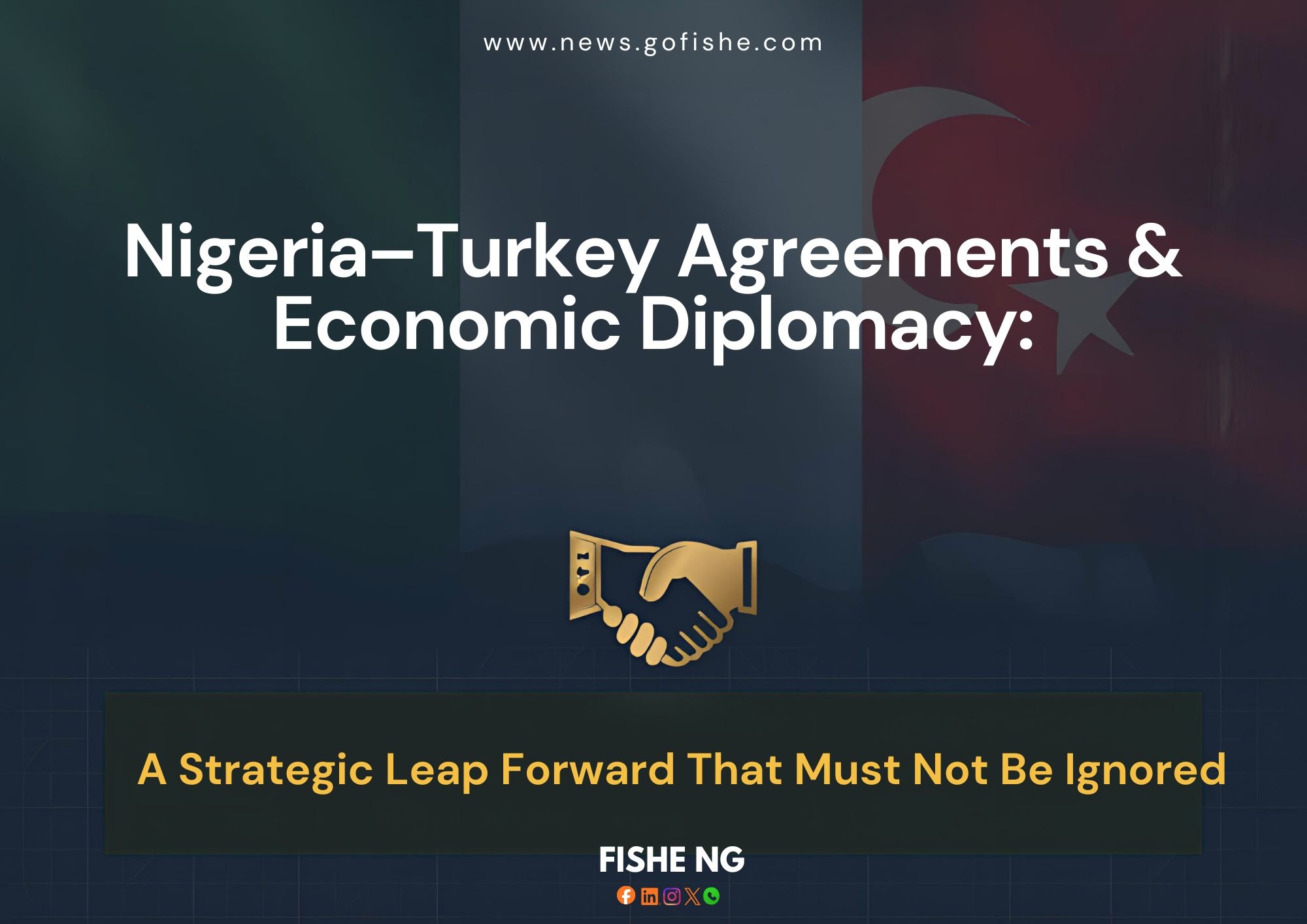
In a significant diplomatic engagement in Ankara, Türkiye, Nigerian President, Bola Ahmed Tinubu and Turkish President, Recep Tayyip Erdoğan concluded high-level talks that have set a bold new agenda for bilateral cooperation. The meetings — held on 27–28 January 2026 — produced multiple agreements across trade, defense, investment, and institutional collaboration, reflecting a deepened strategic partnership between two of the world’s regionally influential nations.
A Vision for Expanded Trade: $5 Billion Target
At the heart of the talks was an ambitious economic objective: boosting bilateral trade volume to $5 billion annually, a substantial increase from the current level of about $2 billion. Both presidents emphasized that Nigeria and Türkiye have identified concrete pathways to expand trade, remove structural barriers, and support private-sector engagement on both sides.
To help realise this target:
-
The two sides signed a joint declaration establishing a Joint Economic and Trade Committee (JETCO) — a permanent mechanism designed to harmonise trade policies, facilitate business engagement, and address regulatory bottlenecks.
-
A Memorandum of Understanding on Halal Quality Infrastructure was also inked, enabling easier certification and export of halal products — particularly important given the large Muslim populations in both countries.

Turkish officials point to the immense untapped potential in energy, manufacturing, and services sectors, while Nigerian counterparts are keen to attract Turkish investment to support industrialisation, energy development, and technology transfer.
Nine Agreements Across Strategic Sectors
The Ankara meetings culminated in the signing of nine legal instruments — including memoranda of understanding (MoUs) and cooperation protocols — that cut across a broad policy spectrum:
-
Diaspora Policy Cooperation — Strengthening ties with respective diasporas for cultural and economic exchanges.
-
Media and Communications — Collaborative projects in media, broadcasting, and information sharing.
-
Higher Education & Academic Exchange — Facilitating student and academic cooperation between universities.
-
Halal Accreditation — Supporting standardized halal production and trade.
-
Military & Defence Cooperation — A protocol to enhance training, joint exercises, and strategic coordination.
-
Diplomatic Training & Capacity Building — For foreign service and institutional development.
-
Social and Women’s Affairs Collaboration — Focused on gender, social policy, and community development.
-
Joint Economic and Trade Committee Establishment — Institutional framework for trade policy and investment.
-
Other sectoral MoUs on trade facilitation, technical cooperation, and educational programs.
These agreements collectively mark one of the most comprehensive partnership frameworks between Nigeria and Türkiye in decades.
Defense and Security: Shared Priorities
Security cooperation was a core pillar of the talks. Both nations agreed to deepen military and defense ties, focusing on shared challenges such as terrorism and regional instability.
Since prior engagement, Turkey has supplied Nigeria with military equipment — including drones and six ATAK T129 attack helicopters — and expanded training for Nigerian forces. The new defense cooperation framework signed in Ankara aims to institutionalise joint training, intelligence sharing, and tactical collaboration, reinforcing Nigeria’s capacity to tackle insurgency in the Sahel and beyond.
President Tinubu underscored the role of security as a prerequisite for sustainable economic growth, noting that Turkey’s expertise in counter-terrorism strategy would be a valuable complement to Nigeria’s ongoing efforts.
Economic Diplomacy and Investment Flows
Beyond bilateral trade figures, the Nigeria–Turkey engagement embodies broader economic diplomacy ambitions:
-
Nigerian officials highlighted the importance of investment flows, noting that the JETCO and related initiatives will facilitate significant Turkish investments in key sectors, including energy, infrastructure, and manufacturing.
-
More than 50 Turkish companies already operate in Nigeria, collectively representing investments worth hundreds of millions of dollars across construction, energy, textiles, and industrial sectors.
-
Turkish contractors have also been involved in projects valued at nearly $3 billion, underscoring Ankara’s deep commercial footprint in Africa’s largest economy.
For Nigeria, these partnerships support President Tinubu’s broader economic reforms aimed at job creation, diversification of the economy, and increased foreign direct investment.
Broader Diplomatic and Global Context
The Nigeria–Turkey rapprochement should also be seen in the context of Türkiye’s expanding diplomatic footprint in Africa, where Ankara has pursued deeper trade, security, and cultural ties across multiple nations. The Nigeria engagement represents one of the most significant bilateral efforts, given Nigeria’s demographic weight and regional leadership.
For Nigeria, strengthening ties with Türkiye aligns with its strategic goal of diversifying international partnerships, reducing dependency on traditional Western partners, and amplifying its role in global diplomacy.
In sum, the Ankara talks between Presidents Tinubu and Erdoğan signal a substantive upgrade of Nigeria–Turkey relations — anchored in economic ambition, security collaboration, and institutionalised cooperation mechanisms — with the bilateral $5 billion trade goal serving as both a symbol and a driver of deeper strategic engagement.
Nigeria–Türkiye Agreements Overshadowed At Home As Public Focus Shifts To Presidential Slip
Nigeria’s renewed economic and strategic engagement with Türkiye took a decisive step forward in Ankara last week, as President Bola Ahmed Tinubu and Turkish President Recep Tayyip Erdoğan concluded talks aimed at expanding bilateral trade to $5 billion.
Yet, despite the scale and potential significance of the agreements signed, much of the domestic conversation in Nigeria has been dominated not by diplomacy or economics, but by a verbal slip made by President Tinubu during a public appearance—an episode that quickly went viral and eclipsed discussion of what may be one of Nigeria’s most consequential bilateral engagements in recent years.
A Major Deal, Largely Ignored
In Ankara, Nigeria and Türkiye signed nine agreements and memoranda of understanding spanning trade, defence, education, media, diaspora engagement, and social policy.
The agreements also reinforced defence and security cooperation, building on Nigeria’s prior acquisition of Turkish military hardware and expanding collaboration in training, capacity building, and counter-terrorism—areas critical to Nigeria’s internal security challenges.
For economic planners, the Ankara talks signalled a deliberate push by Nigeria to diversify partnerships, court non-traditional investors, and leverage Türkiye’s growing footprint in Africa to support industrialisation, infrastructure development, and job creation.
However, these outcomes struggled to gain traction in Nigeria’s public space.
The Viral Moment That Shifted Attention
Instead, online platforms and talk shows were flooded with clips dissecting a perceived misstatement by the president. Memes, parody videos, and partisan commentary followed swiftly, turning the moment into a dominant political talking point.
While criticism and scrutiny of leaders are a feature of democratic discourse, analysts argue that the imbalance in attention reflects a deeper challenge in Nigeria’s political culture—where optics often outweigh substance, and policy outcomes struggle to compete with viral moments.
“The Ankara agreements should have triggered serious debate about trade strategy, defence partnerships, and investment flows,” said one Lagos-based political economist. “Instead, we’re debating semantics.”
What the Agreements Mean for Nigeria
The irony, observers note, is that the deals signed in Ankara align closely with issues Nigerians routinely demand action on:
-
Jobs and investment, through expanded Turkish manufacturing and construction projects
-
Security, via structured defence cooperation with a NATO-member country
-
Trade diversification, reducing over-reliance on traditional partners
More than 50 Turkish companies already operate in Nigeria, with projects valued at several billion dollars. The new framework seeks to scale this presence while giving Nigerian businesses better access to Turkish markets.
Yet these implications received limited mainstream attention compared to the president’s slip, raising questions about how foreign policy achievements are communicated—and consumed—at home.
A Communication Gap
Some critics argue that the government bears part of the blame. The absence of clear, simplified messaging around the Ankara outcomes created a vacuum quickly filled by sensational narratives.
Others counter that the reaction reflects growing public scepticism, with Nigerians demanding tangible results rather than diplomatic promises. In that context, viral moments resonate more easily than long-term economic projections for a people who wants Rome built overnight.
Between Optics and Outcomes
The Ankara visit underscores a recurring tension in Nigerian politics: the gap between policy substance and public perception. While President Tinubu keeps positioning Nigeria more assertively in global economic diplomacy, domestic discourse often remains trapped in short-term spectacle.
Whether the Nigeria–Türkiye agreements will translate into measurable gains—new investments, increased trade, or improved security—remains to be seen. But analysts warn that ignoring such developments altogether risks reducing foreign policy to background noise, noticed only when something goes wrong.
As Nigeria seeks new partners and pathways for growth, the challenge may be less about signing deals abroad—and more about ensuring that, at home, the significance of those deals is neither lost nor drowned out by the next viral clip.
