

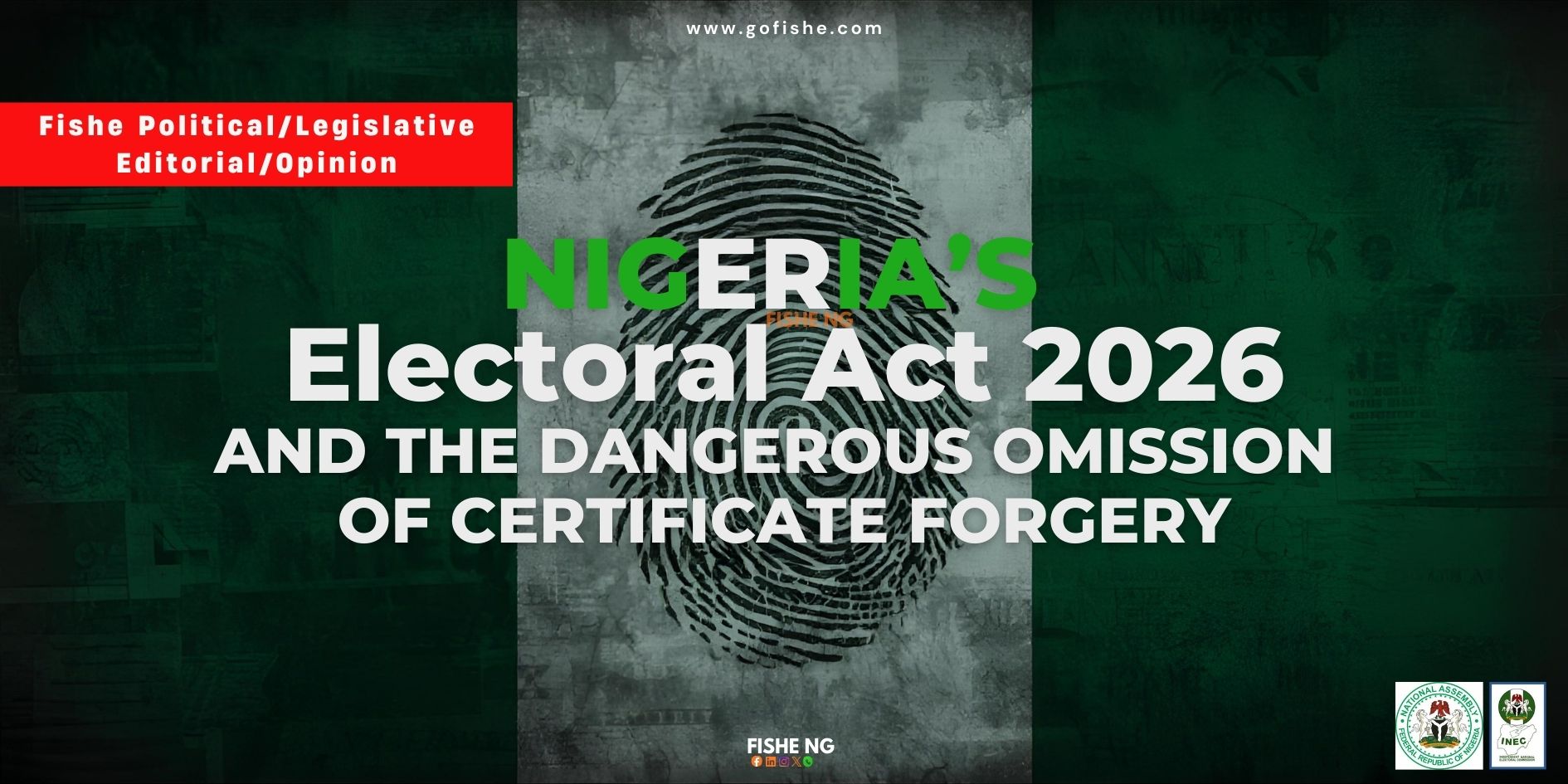
Nigeria’s democracy has been jolted by a controversial change in the Electoral Act 2026: the removal of certificate forgery as a ground for filing election petitions. Section 138 of the Act now restricts challenges to elections to only two grounds—either that the election was invalid due to corrupt practices or non-compliance with the law, or that the winner was not duly elected by a majority of lawful votes.
Acts that merely contradict INEC instructions, but do not violate the Act itself, also no longer qualify for contestation. Section 138(3) even imposes steep fines: at least ₦5 million on counsel and ₦10 million on petitioners who challenge elections outside these grounds. Section 139 further shields elections from invalidation if tribunals determine that procedural lapses did not materially affect outcomes.
The net effect? Allegations of forged certificates, which historically formed a cornerstone of electoral accountability, can no longer serve as a basis for post-election challenges.
Legal Experts Sound the Alarm
According to my update refreshed via BusinessDay, Senior Advocate of Nigeria, Jibrin Okutepa, has described the move as a “brazen attempt to redefine a society’s moral code by a morally compromised political class.”

He warned that removing certificate forgery as a ground for petitions could shield unqualified candidates from scrutiny, thereby weakening both legal and moral standards in governance.
“Hitherto, presentation of forged certificates had always been a ground for election petitions. But the new Electoral Act 2026 has removed that ground,” Okutepa noted. He further questioned whether the National Assembly overstepped its authority, given that qualifications for public office are constitutionally defined and cannot be overridden by ordinary legislation.
Political Stakeholders Decry a Retrogressive Step
Political voices across the spectrum have joined the chorus of criticism. Aminu Yakudima described the change as a serious setback for Nigeria’s democratic and institutional growth. He warned that it undermines the role of education and merit in leadership, sending a dangerous signal to young Nigerians who invest in formal education and aspire to public service.
Similarly, former chairman of the Inter-Party Advisory Council (IPAC), Peter Ameh, condemned the amendment as an “unfortunate legislative overreach” that appears to favour individual political interests while weakening democratic accountability.
“In every professional field, people are required to present certificates and evidence of competence before being entrusted with responsibility. Yet we are lowering the bar for those who want to govern millions,” he argued.
High Stakes: Penalties Could Chill Legitimate Petitions
Beyond removing certificate forgery, the Act now imposes significant fines on petitioners and lawyers who challenge elections outside the prescribed grounds. Critics argue that these penalties may deter legitimate legal scrutiny, further narrowing the avenues for holding unqualified candidates accountable.
Constitution vs. Electoral Act: Where Does Authority Lie?
Not all voices see this as catastrophic. Political scientist, Bernard Mikko, notes that the Nigerian Constitution already governs candidate qualifications, including disqualification for presenting forged certificates.
In his view, removing the provision from the Electoral Act does not override constitutional safeguards, meaning disputes over qualifications remain theoretically addressable.
Still, the practical impact may shift responsibility from tribunals to political parties and voters. According to Chief Press Secretary and Media Adviser to the INEC Chairman, Adedayo Oketola, allegations of certificate forgery will now fall under pre-election matters.
Political parties are expected to screen aspirants rigorously, while voters must exercise greater vigilance in scrutinising candidates’ backgrounds. History, however, shows that party gatekeeping is often inconsistent, leaving the electorate to carry the burden.
Democracy at Risk: Integrity Matters
Democracy is about more than elections; it is about ensuring those in power are qualified, competent, and credible. Weakening the ability to challenge candidates with forged credentials risks eroding public trust, undermining institutional integrity, and lowering standards of governance.
Electoral reforms should strengthen accountability, not create loopholes. By removing certificate forgery as a ground for petitions, the law sends a troubling signal that integrity and education matter less than political convenience.
Conclusion: Time to Reconsider
The National Assembly must revisit this provision. Nigeria cannot afford ambiguity in defining who is fit to govern. Upholding standards for public office is not optional—it is central to a functioning democracy. Electoral laws should reinforce merit, transparency, and accountability, not dilute them.
Until this gap is addressed, Nigeria risks sending a dangerous message: that the bar for leadership can be lowered, while the cost of challenging questionable candidates is made prohibitively high. That is a message democracy cannot afford to deliver.
