


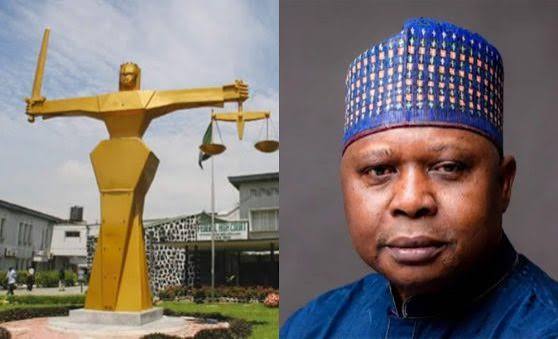
A High Court of the Federal Capital Territory (FCT), Abuja, on Thursday issued a bench warrant for the arrest of Kabiru Tanimu Turaki, a factional National Chairman of the Peoples Democratic Party (PDP), over his failure to appear in court for arraignment in an ongoing criminal case instituted by the police.
The trial judge, U.P. Kekemeke, ruled that Turaki had no valid justification for his absence and must be compelled to appear before the court.
Background of the Case
Turaki, a Senior Advocate of Nigeria (SAN), and former Minister of Special Duties and Inter-Governmental Affairs under Goodluck Jonathan, is being prosecuted by the Inspector-General of Police.
The charge against him stems from allegations that he provided false information to the police in a petition dated October 2022.

- The case involves a one-count criminal charge
- It is brought under relevant provisions of Nigeria’s Penal Code Law
- Proceedings are taking place at the FCT High Court in Abuja
Proceedings Leading to the Arrest Order
The matter initially came up for arraignment on January 28, but proceedings could not continue due to Turaki’s absence, despite an earlier court order mandating his appearance.
At the resumed hearing:
- The prosecution informed the court that the defendant had been duly served with the charge and hearing notice
- It subsequently applied for a bench warrant, citing his failure to honour the court summons
Justice Kekemeke agreed with the prosecution, noting that:
- The defendant was aware of the case
- No satisfactory explanation was provided for his absence
Defence Argument and Court Ruling
Counsel to Turaki argued that his absence was due to a petition submitted to the Chief Judge of the FCT High Court, requesting that the case be reassigned to another judge on grounds of lack of confidence in the court.
The defence also indicated that legal steps had been taken to challenge the validity of the charge.
However, the court rejected these arguments. In his ruling, Justice Kekemeke held that:
- Filing a petition against a judge does not automatically halt criminal proceedings
- Only a directive from the Chief Judge can justify such a delay
- A defendant must appear in court before raising preliminary objections
Issuance of Bench Warrant
Following the ruling:
- The court granted the prosecution’s application
- A bench warrant was issued for Turaki’s arrest
- Law enforcement agencies were directed to arrest and produce him before the court for arraignment
The judge emphasized that court processes must be respected and that non-appearance without lawful excuse cannot be tolerated.
Adjournment and Next Steps
After issuing the warrant:
- The matter was adjourned for further proceedings
- Authorities are expected to execute the arrest order and ensure Turaki’s presence in court at the next hearing
Legal and Political Implications
The development underscores key legal principles:
- Accountability before the law: Public office or political standing does not exempt individuals from criminal prosecution
- Judicial authority: Courts retain the power to compel attendance and prevent delays in justice delivery
- Procedural discipline: Defendants must submit to arraignment before raising objections
Politically, the case comes amid internal divisions within the PDP, and the situation may further influence factional dynamics within the party.
Political Context
The case comes at a time of internal divisions within the PDP, where factional leadership disputes have persisted. As a prominent political figure, Turaki’s legal challenges could:
- Affect ongoing alignments within the party
- Influence perceptions of leadership credibility
- Add another layer of tension to intra-party dynamics
Conclusion
The FCT High Court’s decision to order the arrest of Kabiru Turaki highlights the judiciary’s firm stance on enforcing compliance with court procedures. By issuing a bench warrant, the court reaffirmed that legal processes must be respected, and attempts to delay proceedings through absence or procedural challenges will not be entertained without proper authorisation.
As the case progresses, attention will remain on the execution of the arrest order and its broader legal and political ramifications.
