


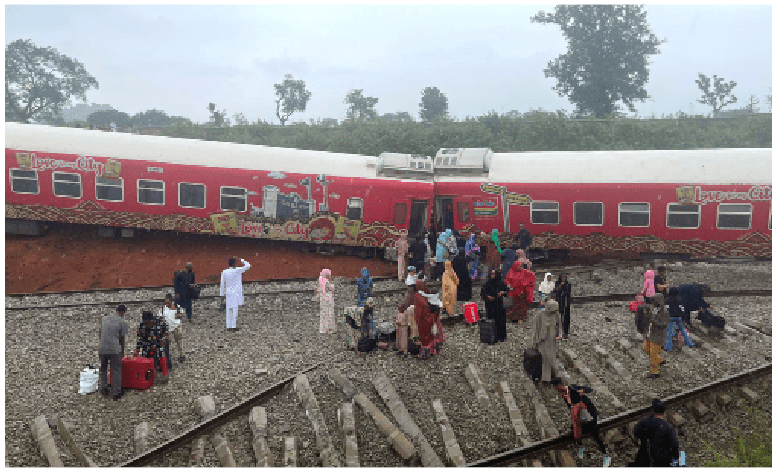
On Monday, March 16, 2026, a passenger train on the busy Abuja–Kaduna rail corridorexperienced a frightening technical malfunction near Asham, leaving several travellers injured and hundreds stranded. Reports confirmed that at least 22 passengers sustained injuries and were promptly transported to nearby medical facilities for treatment.
Rail services on the corridor were temporarily suspended as authorities worked to restore normal operations.
The Nigerian Railway Corporation (NRC), later confirmed that the incident was linked to a coupling problem involving a backup locomotive attached to the train, clarifying that it was not a head-on collision but rather the rear locomotive striking the power car and last passenger coach. Preliminary investigations are ongoing.
Passengers’ Harrowing Experiences
Passengers recounted moments of chaos, panic, and fear as the train suddenly jolted.


Mr. Ibrahim Musa, aboard the affected train, described the impact as abrupt and bewildering:
“We felt a heavy jolt from the rear, and people started screaming. It was confusing because many of us initially thought it was a collision with another train.”
He urged the NRC to prioritise routine technical inspections, particularly for locomotive couplings, noting that careful checks could prevent such incidents.
Mrs. Grace Daniel highlighted the panic in the rear coach, where most injuries occurred:
“Some passengers fell on each other during the impact. It was scary, especially for children and elderly people on board.”
Daniel also appealed for better communication and safety briefings:
“We need to be informed about safety procedures. It will help people stay calm if anything goes wrong.”
Passengers described hearing loud bangs and experiencing violent jolts, with many scrambling to secure themselves. The suddenness of the incident left commuters shocked and frightened, reinforcing calls for more robust preventive measures.
Emergency Response
-
Injured passengers were swiftly attended to by medical teams and transported to hospitals.
-
NRC and local authorities coordinated rescue operations to account for all passengers and ensure safety on the affected line.
-
The corporation assured the public that steps are being taken to strengthen safety measures, including staff training, operational reviews, and reinforced technical inspections.
Technical Explanation
An NRC official in Kaduna, speaking on condition of anonymity, explained that the incident arose from a technical issue during the attachment of a backup engine. While the train was not in a collision scenario, the impact of the rear locomotive against the power car and the last passenger coach caused the sudden jolt and subsequent injuries.
Investigators are now examining the exact cause of the coupling fault and assessing preventive protocols to avoid future occurrences.
Public Reaction and Safety Concerns
Though the incident was technical rather than malicious, it underscores broader safety and operational concerns along the Abuja–Kaduna corridor. Passengers expressed anxiety about mechanical failures, the adequacy of emergency preparedness, and the need for timely safety briefings.
Historically, this corridor has experienced both security and operational challenges. The March 2022 Abuja–Kaduna train attack — a violent bandit attack involving abductions and fatalities — remains a stark reminder of vulnerabilities in the rail system. While the 2026 incident was non-violent, public sentiment reflects ongoing concerns about passenger safety and system reliability.
Current Status
-
NRC and NSIB have begun formal investigations into the incident.
-
Injured passengers continue to receive medical care.
-
Operational updates and safety reviews are expected to be released as the probe progresses.
Moving Forward
The NRC has pledged to:
-
Review and reinforce operational procedures
-
Ensure regular technical inspections, especially of locomotive couplings
-
Enhance communication protocols and emergency preparedness for passengers
Passengers and observers alike hope that these measures, alongside ongoing investigations, will prevent future technical mishaps and restore confidence in Nigeria’s busiest rail corridor, and across all rain operations in Nigeria.