

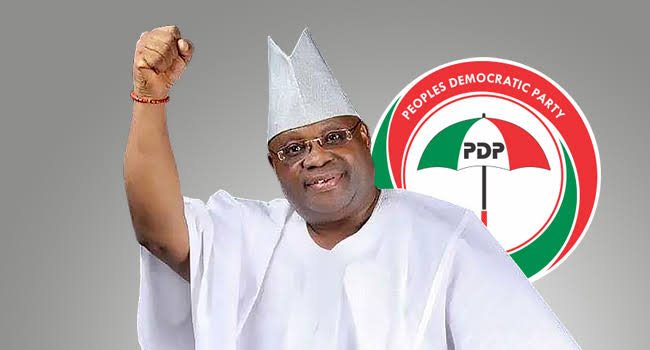
In the early hours of December 2, 2025, Ademola Adeleke — Governor of Osun State — announced his resignation from Peoples Democratic Party (PDP), citing a deepening leadership crisis at the national level of the party.
The decision reverberates across Nigeria’s political landscape, further underscoring the turbulence within PDP ahead of the 2026 governorship election cycle in Osun State.
The Decision: What Happened
-
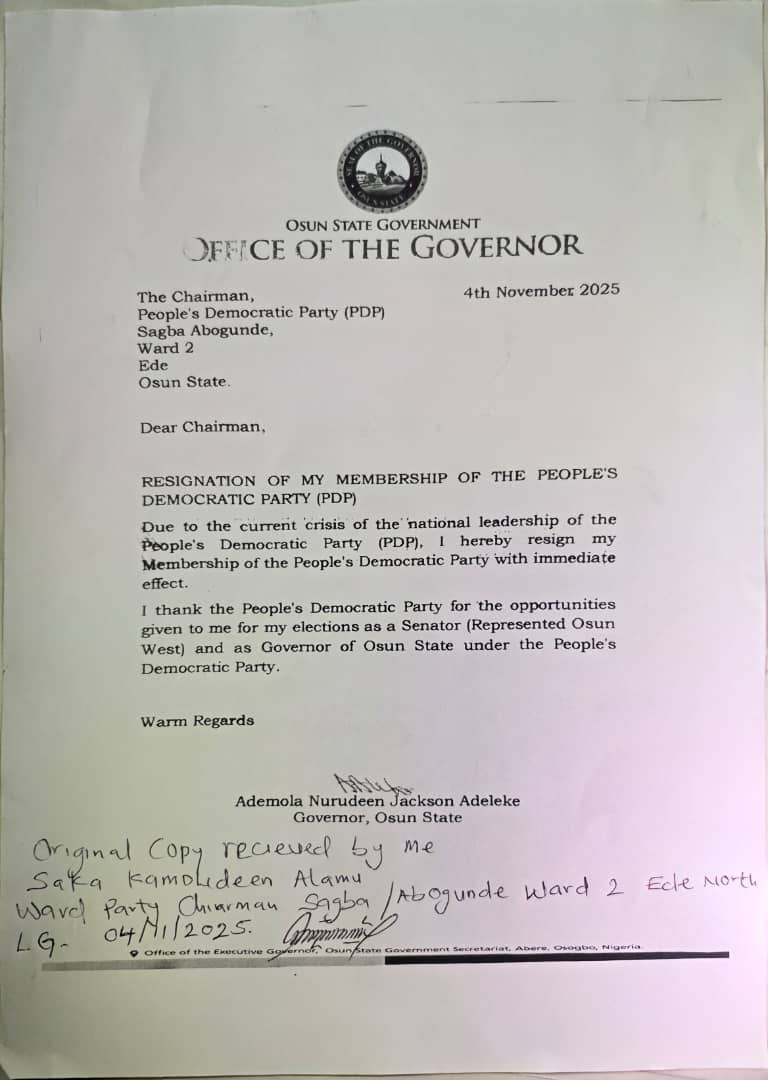
In a letter dated November 4, 2025, addressed to the chairman of PDP Ward 2 in Ede North LGA, Osun, Adeleke officially tendered his resignation.
-
His spokesperson confirmed the move on Monday night. The letter cited “the current crisis within the national leadership of PDP” as the cause for his departure.

-
The resignation was formally communicated as effective with immediate effect.
-
So far, Adeleke has not publicly disclosed which party (if any), he intends to join.
Why — The Crisis Inside PDP
The resignation didn’t come out of the blue. The internal turmoil within PDP had escalated to the point where even essential party functions, such as holding primaries, were disrupted.
-
The party’s national leadership has been embroiled in a protracted power struggle, with suspensions and counter-suspensions of key officers — creating uncertainty around the organizational capacity of the party.
-
As a direct consequence, the state chapter in Osun was forced to cancel the 2026 governorship primary which had been scheduled for December 2, 2025.
-
The instability meant that even though Governor Adeleke had complied with all the formal requirements — purchasing and submitting nomination forms, being screened and cleared — there was no clear pathway to a valid nomination.
-
In that environment of uncertainty, Adeleke saw little reason to remain in a party unable to guarantee a stable platform for contesting future elections.
As described by PDP’s Osun chairman, the cascading effect of suspended national officers disrupted the statutory ward and local government congresses (due in late November), which are necessary to elect delegates for primaries.
Implications — What This Means Politically
-
For Osun’s 2026 Election: With Adeleke out of PDP, the governorship race in Osun gains a new dimension. Residents may see a reconfiguration of alliances if he contests under a different party — or possibly runs as an independent, depending on Nigeria’s electoral laws and his next move.
-
Signal to Other Disgruntled Governors/Politicians: Adeleke isn’t alone — other governors (from Delta, Akwa Ibom, Enugu among others), have recently left PDP amid internal crises. His exit could trigger a further exodus, especially from members unhappy with the party’s direction.
-
PDP’s Credibility and Cohesion at Stake: The departure of a sitting governor over “leadership crisis” hurts PDP’s image as a stable opposition force. If unresolved, the crisis threatens to weaken PDP’s influence in states where it once held sway.
-
Opening for Other Parties: This creates a window for rival parties (or even new political alliances), to attract high-profile politicians — potentially reshaping political alignments ahead of 2027 general elections.
What’s Next — Speculations and Scenarios
-
At this point, it’s unclear which platform Adeleke may choose for the 2026 election. He may join another party — rumors swirl that he attempted to join All Progressives Congress (APC), but reportedly faced resistance from the party’s local Osun branch.
-
For PDP: The party leadership will need to move fast to repair internal fractures — especially ahead of upcoming primaries in other states. Without urgent resolution, more defections or withdrawals are possible.
-
For voters and political watchers: The coming weeks are likely to be politically volatile — as actors reposition themselves and new alliances are formed, particularly in states like Osun where elections are imminent.
Conclusion
Governor Adeleke’s resignation from PDP is both a symptom and a symbol: a symptom of the deep structural and leadership issues facing the party, and a symbol of how internal discord can shake even senior party members out of their longstanding affiliations. With Nigeria’s 2026 elections approaching, this move underscores how fragile party loyalty has become when institutional stability is compromised.
The remaking of political alignments is underway — and the decisions in the next few days and weeks will likely shape not only Osun’s future, but potentially influence the broader trajectory of party politics in Nigeria.
