


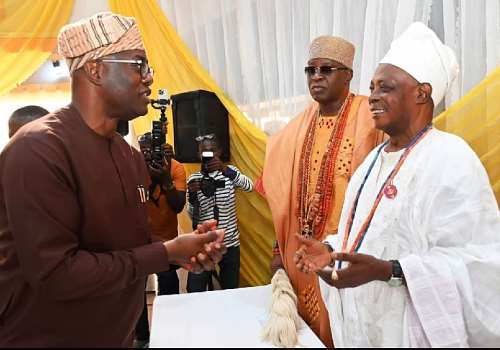
In a major development for traditional governance in Oyo State, the Olubadan of Ibadanland, Oba Rashidi Adewolu Ladoja (Arusa I), has been inaugurated as the inaugural chairman of the newly reconstituted Oyo State Council of Obas and Chiefs — a position that comes after years of inactivity and legislative amendment.
The ceremony took place on Thursday at the House of Chiefs Hall, State Secretariat, Ibadan.
Notably, the Alaafin of Oyo, Oba Abimbola Akeem Owoade I, one of the most senior traditional rulers in the state, was conspicuously absent from the event, drawing attention from observers and stakeholders alike.
Revival of a Dormant Institution
The inauguration marks the formal revival of the Oyo State Council of Obas and Chiefs, a statutory body that had been largely inactive for more than a decade — with its last significant activity traced back to around 2011.


The revival follows the passage of the Oyo State Council of Obas and Chiefs (Further Amendments) Bill, 2025, by the Oyo State House of Assembly, and its subsequent signing into law by Governor Seyi Makinde. The law was crafted to strengthen the traditional institution, provide clearer leadership structure, and enhance collaboration between the state government and paramount rulers.
New Rotational Leadership Arrangement
Under the amended law, the chairmanship of the Council of Obas and Chiefs will rotate every two years among three leading monarchs of Oyo State:
-
The Alaafin of Oyo
-
The Olubadan of Ibadanland
-
The Soun of Ogbomosoland
The rotational system is intended to promote unity and inclusivity among the key traditional institutions within the state, avoiding long-standing disputes over permanent leadership roles.
Governor Makinde, while inaugurating the council, emphasized that the rotational plan — which places the Olubadan first — was discussed with all three monarchs. According to the governor, the rotation ensures that no single traditional ruler dominates or monopolises leadership of the council.
Olubadan Takes the Helm
Oba Rashidi Adewolu Ladoja — a former governor of Oyo State who was installed as the 44th Olubadan of Ibadanland in September 2025 — was declared chairman of the Council for an initial two-year tenure. His role will include steering meetings of the council, coordinating deliberations on traditional matters and serving as a key liaison between royal institutions and the state government.
In his remarks at the event, Oba Ladoja underscored that the inauguration signaled not the end of a process, but the beginning of purposeful work for peace, development, and harmony across the domains of traditional rulers.
Alaafin’s Absence and Response
The absence of the Alaafin of Oyo, Oba Abimbola Akeem Owoade I, was a notable feature of the inauguration, sparking curiosity and commentary. Royal watchers had expected one of the most influential Yoruba monarchs to be present for such a historic event.
Subsequently, the Alaafin’s palace issued a statement distancing His Imperial Majesty from claims that he had agreed to the rotational arrangement with Governor Makinde. According to the palace, no meeting or endorsement took place with the governor or the other monarchs on the rotation before the inauguration.
The statement emphasized that the Alaafin was not consulted and did not approve the rotational leadership plan presented at the ceremony.
Significance for Oyo State’s Traditional Governance
The revival of the Statutory Council of Obas and Chiefs is widely seen as a major step toward strengthening the traditional institution in Oyo State, a pillar of social cohesion and cultural identity in the region. Over the years, the council had been dormant, leaving a gap in formal consultative engagement between the state government and traditional rulers.
The rotational leadership model also attempts to balance historic expectations — where the Alaafin traditionally held a position of enduring authority — with contemporary calls for inclusive leadership among the leading monarchs of the state’s major kingdoms.
Looking Ahead
As the new council takes shape under the leadership of the Olubadan, key issues likely to dominate the agenda include:
-
Strengthening peace and security across traditional domains
-
Enhancing cooperation with the state government
-
Restructuring and modernizing the council to meet current socio-political needs
Meanwhile, discussions about the role, influence, and prominence of traditional rulers — particularly in relation to rotational leadership — are expected to continue within palace circles and among the general public.