


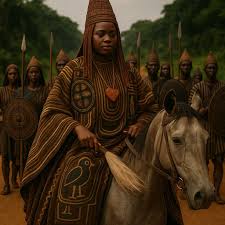
Alaafín Orompoto holds a singular place in West African history as the first and only female ruler of the Oyo Empire. Her story is one of courage, ingenuity, and defiance against deeply entrenched gender norms in 16th-century Yorubaland. Rising to power in 1554, Orompoto’s reign not only broke societal expectations but also reshaped the political and military landscape of Oyo, leaving a legacy that has endured in oral traditions and historical accounts.
Ascension to Power
Orompoto assumed the throne following the death of her brother, Alaafín Eguguojo, at a time when no male heir was available to rule. The Oyo Empire, one of the most powerful Yoruba states of the era, relied heavily on the acceptance of the Oyo Mesi, the council of kingmakers, to legitimise rulership.
To secure her position, Orompoto reportedly disguised herself as a man. Historical accounts suggest she went to extraordinary lengths, including performing a mastectomy and adopting male attire, to gain the political and cultural approval necessary to be recognised as Alaafín.
his bold maneuver highlights her determination and strategic acumen in navigating the patriarchal structures of her time.


Military Leadership and Innovations
Orompoto’s reign is distinguished by significant military reforms that expanded the power and prestige of the Oyo Empire. By 1557, she had undertaken measures to modernise and strengthen the army. One of her most notable initiatives was the importation of horses from Timbuktu, which facilitated the creation of a cavalry force exceeding 1,000 horsemen — a pioneering development in the region.
Her tactical ingenuity was also remarkable. During campaigns, Orompoto reportedly tied leaves to the tails of her horses, effectively masking their tracks and confounding enemy forces. Such strategies not only enhanced Oyo’s battlefield effectiveness but also reinforced her reputation as a formidable military commander.
Titles and Recognition
Orompoto was revered with titles that reflected her unique blend of spiritual authority, military skill, and political acumen, such as:
-
“The custodian of the vagina that kills evil plots”
-
“The king with the great gift”
-
“The king with the flabbergasting gift”
These honorifics underscore her exceptional status as both a ruler and a warrior, recognised for her wisdom, courage, and ability to transcend conventional gender roles.
Death and Legacy
Alaafín Orompoto’s reign ended in 1562 during the battle of Ilayi, where she died fighting on the frontlines rather than retreating. Her death in combat cemented her legacy as a warrior queen who embodied the ideals of courage, leadership, and unwavering commitment to her people.
Orompoto’s story has survived through centuries of oral history and has become a source of inspiration, symbolising the potential for women to hold positions of power and influence even within patriarchal societies.
Her life continues to challenge historical narratives, highlighting the capacity for innovation, strategy, and resilience in female leadership.
Timeline of Alaafín Orompoto
1554 – Ascension to the Throne
-
Following the death of her brother, Alaafín Eguguojo, Orompoto becomes the first and only female Alaafín of the Oyo Empire.
-
Disguises herself as a man, reportedly performing a mastectomy and adopting male attire, to gain recognition from the Oyo Mesi (council of kingmakers).
1555–1556 – Consolidation of Power
-
Secures her position and authority in a male-dominated political system.
-
Initiates military reforms to strengthen Oyo’s army and expand its influence.
1557 – Military Innovations
-
Imports horses from Timbuktu, Mali, establishing a cavalry force of over 1,000 horsemen, unprecedented in the region.
-
Implements strategic battlefield tactics, including tying leaves to horses’ tails to conceal their tracks from enemies.
1557–1562 – Reign and Recognition
-
Gains titles and honorifics reflecting her spiritual authority, intelligence, and military skill:
-
“The custodian of the vagina that kills evil plots”
-
“The king with the great gift”
-
“The king with the flabbergasting gift”
-
-
Restores Oyo’s military dominance and influence across southern Niger regions.
1562 – Death in Battle
-
Dies fighting on the frontlines at the battle of Ilayi, embodying the warrior spirit that defined her reign.
Legacy (Posthumous)
-
Celebrated in oral traditions as a symbol of courage, strategic brilliance, and female leadership.
-
Inspires future generations as a testament to the power of women to lead and innovate in even the most patriarchal societies.
Conclusion
Alaafín Orompoto’s tenure as ruler of the Oyo Empire stands as a testament to her indomitable spirit and extraordinary leadership. Her military reforms, innovative tactics, and political shrewdness not only strengthened the empire but also left an enduring mark on West African history.
Orompoto’s story reminds us that leadership and valour are not bound by gender, and her legacy continues to inspire generations across the region and beyond.