


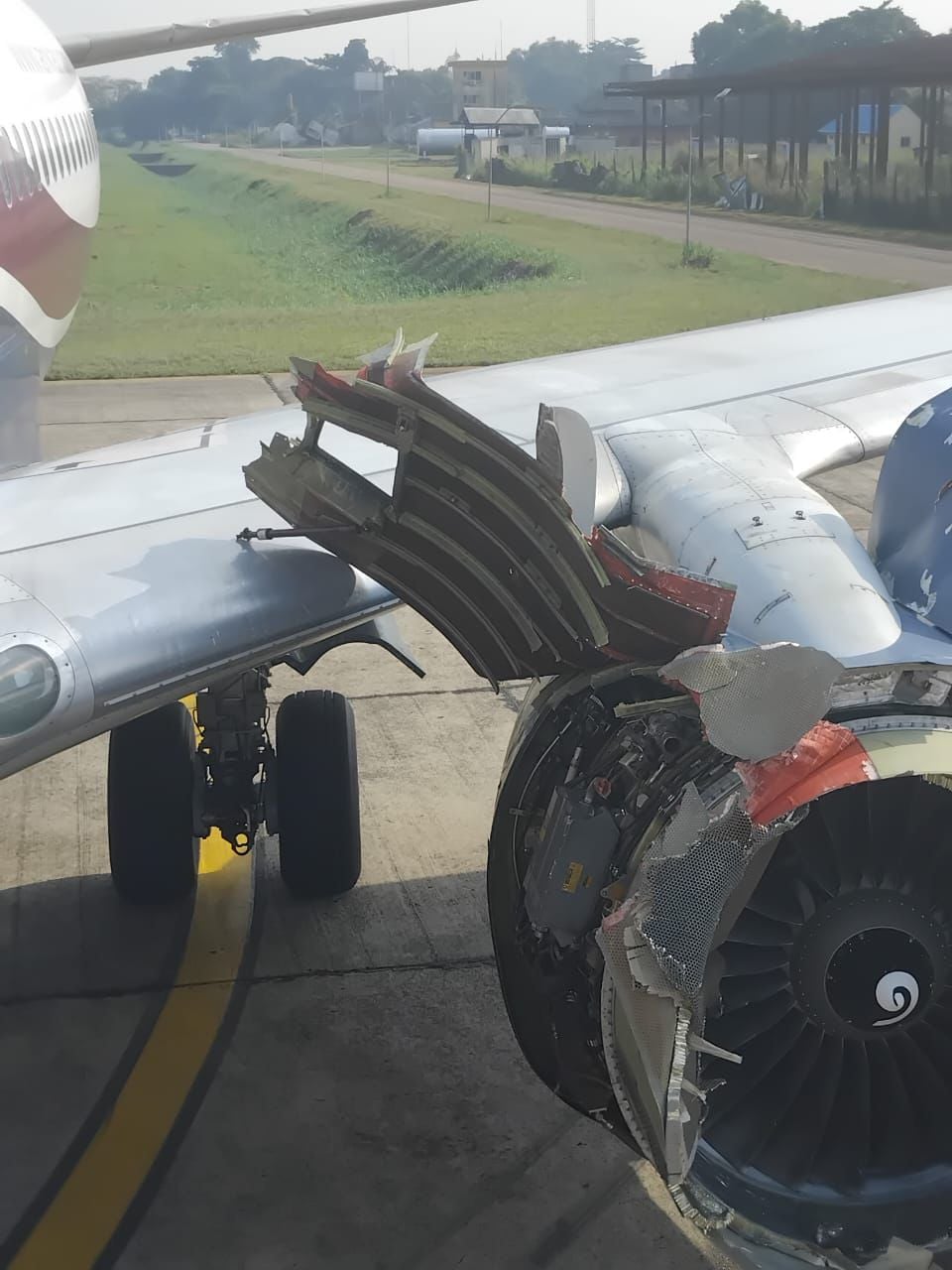
Passengers on an Arik Air flight from Lagos to Port Harcourt faced an unexpected detour on Wednesday when a loud bang from the Boeing 737-700’s left engine prompted the crew to divert the aircraft to Benin Airport. All 80 passengers and crew disembarked safely, and authorities, including the Nigerian Safety Investigation Bureau, have launched an inquiry into the engine anomaly.
The aircraft, registered 5N-MJF, had departed Murtala Muhammed International Airport, Lagos, and was on approach to Port Harcourt International Airport, Omagwa when the sound was detected.
Arik Air in a statement described the incident as a precautionary safety concern, prompting the diversion to the nearest suitable airport — Benin Airport — where the aircraft landed safely without incident.
Passenger Safety and Airline Response
Arik Air confirmed that all 80 passengers and crew on board were safely disembarked after the unscheduled landing in Benin, with no injuries reported.


In its official statement, the airline said:
“There were no injuries to passengers and crew as all 80 passengers on board were safely disembarked. Arrangements have been made to transport the affected passengers to their final destination.”
Arik Air also apologised to passengers whose journeys were disrupted, emphasising that:
“The safety and wellbeing of passengers is always our priority at Arik Air.”
This response underscores the airline’s commitment to safety and passenger care even when flights are interrupted due to unexpected technical concerns.
What Happened — In-Flight Engine Anomaly
Confirming the incident, the Nigerian Safety Investigation Bureau (NSIB), described the event as an in-flight engine anomaly.

According to the bureau’s Director of Public Affairs and Family Assistance, Bimbo Oladeji, the flight crew:
-
Detected abnormal engine indications during flight.
-
Conducted a precautionary engine shutdown of the affected unit.
-
Diverted the aircraft to Benin Airport in line with established safety procedures.
“The aircraft landed without incident, and all passengers and crew disembarked normally,” Oladeji confirmed, adding that no injuries were reported.
Preliminary Findings at Benin Airport
Initial observations at Benin Airport indicate significant damage to the affected left engine, based on a visual assessment conducted after the aircraft landed.

Investigation teams are already mobilised to:
-
Secure the aircraft and preserve the scene.
-
Document physical evidence from the aircraft and airport.
-
Interview crew members, passengers, and ground personnel.
-
Recover critical data from the flight data recorder and cockpit voice recorder.
These activities are crucial for understanding exactly what occurred and how the engine anomaly developed.
NSIB’s Formal Investigation and International Standards
The NSIB has launched a formal investigation in accordance with its statutory mandate and global aviation standards — specifically ICAO Annex 13 — as well as applicable Nigerian civil aviation regulations.
In line with these protocols:

-
A Preliminary Report is expected to be issued within 30 days.
-
A Final Report will be published after detailed analysis is completed.
The bureau is working closely with the Nigerian Civil Aviation Authority (NCAA), Arik Air, and other relevant stakeholders to determine the sequence of events and contributing factors.
NSIB has also urged the public to share any relevant information that may assist the investigation through official channels, stressing that further updates will be provided as more details emerge.
Safety Protocols in Action
Aviation safety experts say that mid-flight diversions following unusual engine sounds or indications — even when there is no immediate danger — are part of robust safety procedures designed to protect lives.
In this case, the flight crew’s prompt situational assessment and decision to divert reflect standard operating practices that prioritise risk mitigation over schedule adherence.

Such actions are grounded in comprehensive training and rigorous safety standards, ensuring that even in the face of unexpected mechanical issues, passengers and crew are kept out of harm’s way.
Conclusion
The Arik Air Lagos–Port Harcourt flight diversion to Benin Airport on February 11, 2026, underscores both the challenges inherent in commercial aviation and the effectiveness of safety systems designed to manage them. While the exact cause of the engine anomaly is still under investigation, the successful diversion and injury-free outcomehighlight the professionalism and safety-focused decision-making of the flight crew and aviation authorities.

As the NSIB’s investigation continues, more detailed information about the technical underpinnings of the incident is expected to be released in forthcoming reports.
