


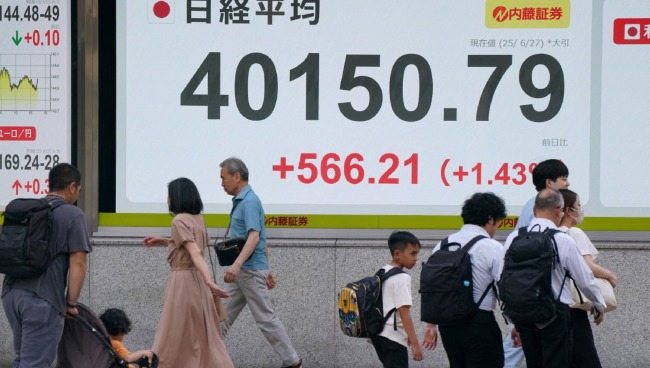
Asian markets struggled on Tuesday, failing to match the record highs seen on Wall Street, as traders turned their attention to upcoming US inflation data that could influence Federal Reserve policy in the weeks ahead.
The cautious mood came after a period of optimism driven by recent developments in US monetary policy, including last week’s interest rate cut and forecasts from the Fed for two more reductions by the end of the year to support a slowing labor market despite persistent inflation. Analysts are now closely watching Friday’s report on personal consumption expenditures, the Fed’s preferred measure of inflation, for further guidance on the path of monetary policy.
Market activity in the region was subdued, partly due to a public holiday in Japan and an approaching storm in Hong Kong, contributing to uneven performance across key Asian indices. Hong Kong’s Hang Seng fell 0.7 percent to 26,155.08, while Shanghai’s Composite dropped 0.8 percent to 3,797.10. Taipei surged over one percent, boosted by semiconductor giant TSMC, which rose nearly three percent following US tech counterpart Nvidia’s announcement of a $100 billion investment in OpenAI for next-generation artificial intelligence projects. Other markets showed mixed results, with Manila and Wellington retreating, while Sydney, Seoul, Singapore, and Jakarta posted modest gains.
Despite these gains, concerns are growing that recent rallies may have been overextended, and investors are wary of potential shocks, including a US government shutdown. Last week, the Republican-controlled House of Representatives narrowly passed a stopgap funding bill that was subsequently rejected by Democrats in the Senate. With both chambers scheduled for recess next week, the window to prevent a shutdown ahead of the September 30 fiscal year-end is rapidly closing.


A government shutdown would halt non-essential operations and leave hundreds of thousands of civil servants temporarily without pay, adding uncertainty to global markets already sensitive to US fiscal policy. Stephen Innes of SPI Asset Management described the situation as “rickety bridges ahead,” warning that the unresolved shutdown drama could trigger volatility. He noted that while markets rarely collapse on the first sign of trouble, complacency could quickly turn into chaos as investors face unpredictable developments in Washington.
Currency and commodity markets reflected the cautious sentiment, with the euro rising slightly to $1.1805 from $1.1799, the pound falling to $1.3510 from $1.3515, and the dollar edging down against the yen to 147.79 from 147.87. Oil prices eased, with West Texas Intermediate dropping 0.4 percent to $62.03 per barrel and Brent North Sea crude down 0.4 percent to $66.28 per barrel, indicating a modest pullback amid the mixed trading environment.
Meanwhile, US and European markets showed resilience, with the Dow closing up 0.1 percent at 46,381.54 and London’s FTSE 100 also rising 0.1 percent to 9,226.68. The contrasting dynamics between robust equity performance in the West and cautious trading in Asia highlight the delicate balance investors face, as the combination of inflation data, potential policy shifts, and political developments in Washington could shape market direction in the coming days.