

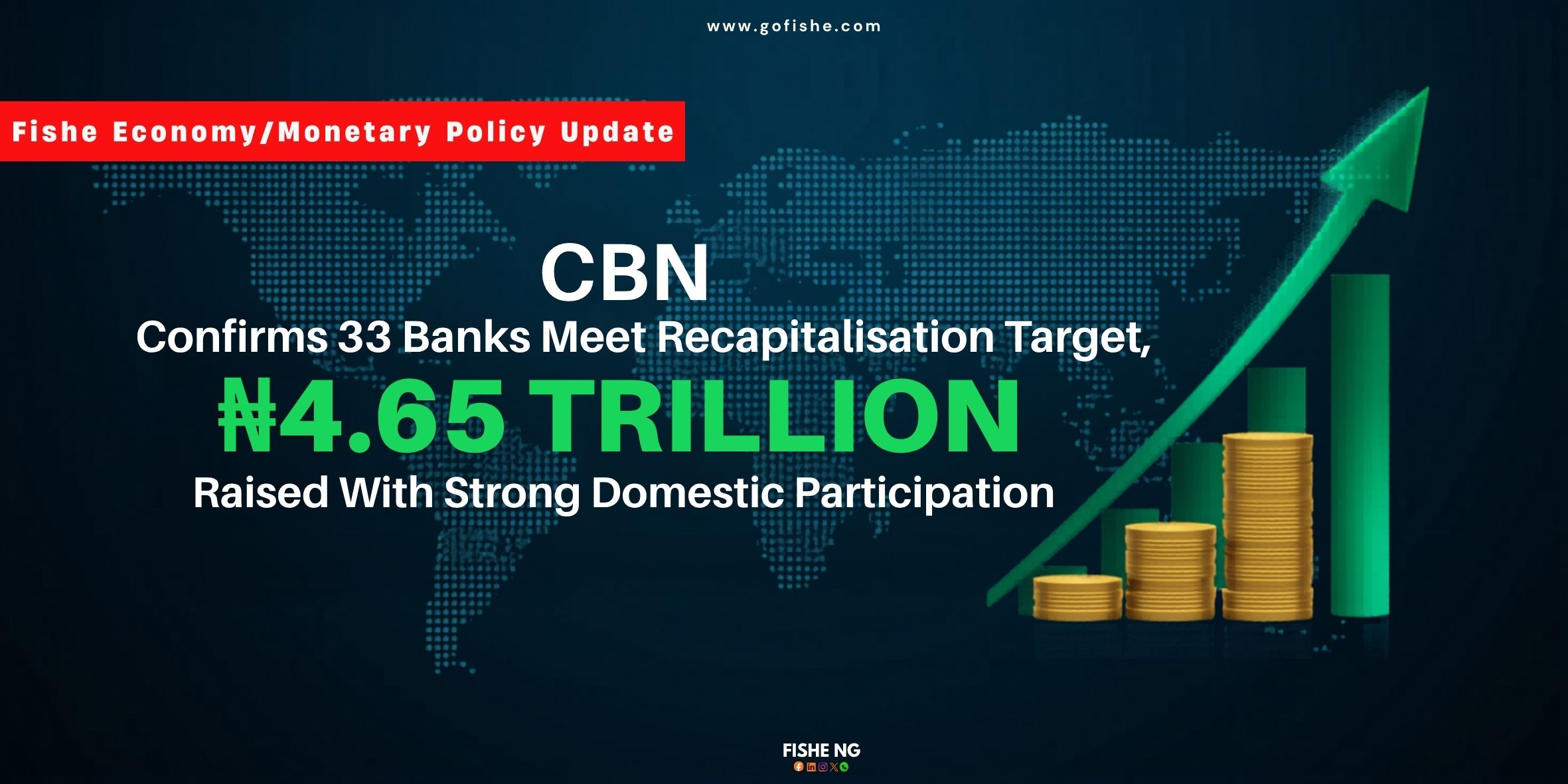
The Central Bank of Nigeria (CBN), has announced that 33 banks have met the updated minimum capital requirements under its recently completed recapitalisation initiative, marking a key step toward bolstering the stability of the banking sector. According to the apex bank, the programme mobilised a total of ₦4.65 trillion over a two-year period from April 2024 to March 2026.
This programme, first announced in November 2023 following the appointment of Yemi Cardoso as CBN Governor, and formalised in March 2024, was designed to enhance banks’ capacity to support economic growth, absorb shocks, and improve capital adequacy ratios, now above Basel benchmarks.
Scope and Targets
Approximately 37 banks were affected, with 33 meeting the recapitalisation requirements, including all listed banks.
The minimum capital requirements under the programme were categorised based on licensing:
| License Type | Minimum Capital Requirement |
|---|---|
| International | ₦500 billion |
| National | ₦200 billion |
| Regional | ₦50 billion |
| Non-Interest (National) | ₦20 billion |
| Non-Interest (Regional) | ₦10 billion |
The CBN described these targets as ambitious but necessary to strengthen financial stability and investor confidence.


Capital Raised and Investor Participation
The recapitalisation programme saw strong participation from both domestic and international investors:
- Domestic (Nigerians): 72.55%
- International: 27.45%
This highlights robust confidence among Nigerian investors, including high-net-worth individuals and retail shareholders. Analysis of listed banks’ shareholder distribution indicates that majority shareholders (over 5% stake), largely maintained their positions post-recapitalisation.
The methods used to raise capital included:
- Rights issues
- Public offers
- Private placements
- Strategic mergers and acquisitions
Banks Meeting the Targets and Ongoing Processes
The 33 compliant banks successfully raised the required capital, reinforcing resilience and lending capacity.
For banks that did not meet the targets, the CBN confirmed ongoing regulatory and judicial processes:

- Some banks are under review, with potential outcomes including mergers, acquisitions, or judicial intervention.
- Unity Bank is undergoing a merger with Providus Bank, a compliant institution.
- Union Bank’s acquisition by Titan Trust Bank is currently under judicial review.
- At least one bank has been downgraded to a lower tier due to non-compliance.
Despite these measures, the CBN emphasized that all banks remain operational, ensuring continued access to banking services.
Implications for the Banking Sector
a. Financial Stability
- Capital adequacy ratios across the sector are now above Basel benchmarks, improving resilience against economic shocks.
- Banks now have stronger balance sheets, enabling more sustainable growth and lending.
b. Lending and Economic Support
- The recapitalisation enhances banks’ ability to finance large-scale projects and support critical sectors like infrastructure, ICT, and energy.
- Strengthened banks contribute to a more competitive financial landscape, driving efficiency and innovation.
c. Domestic Investor Confidence
- With over 72% of funds raised locally, the programme reflects growing trust in Nigerian banks.
- Retail participation and engagement from high-net-worth investors suggest long-term investor commitment.
Challenges and Risks Ahead
While the recapitalisation is a success, several challenges remain:
- Efficient Deployment of Funds: Banks must allocate ₦4.65 trillion productively to generate returns.
- Profitability Pressure: Large capital raises may temporarily dilute returns on equity (ROE), until lending activities mature.
- Macroeconomic Risks: Inflation, currency volatility, and credit risks could impact performance.
- Ongoing Judicial Processes: Some acquisitions and mergers are pending regulatory or court approvals, adding uncertainty for affected banks.
Conclusion
The CBN’s recapitalisation programme represents a significant reform in the banking sector, marking one of the most ambitious capital-raising exercises since the 2004 consolidation era.
- 33 banks raised ₦4.65 trillion, with strong local participation.
- Capital adequacy ratios now surpass global standards, strengthening the sector’s ability to absorb shocks and support the economy.
- Banks that did not meet the target are under regulatory or judicial review, while mergers and acquisitions continue to reshape the sector.
This milestone demonstrates renewed confidence in the Nigerian banking system, stronger financial resilience, and a foundation for sustainable economic growth.