

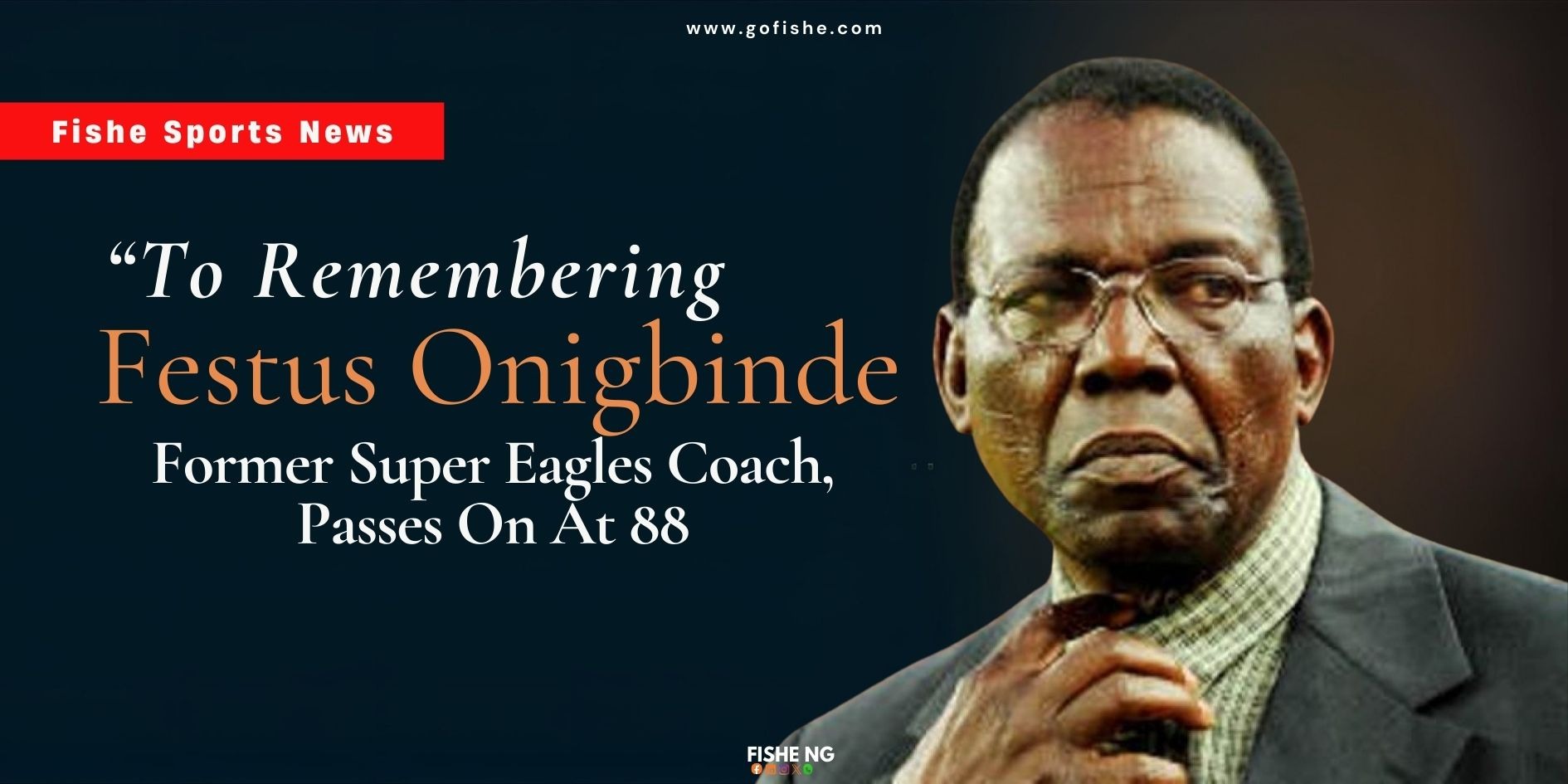
Nigeria’s football community is mourning the passing of one of its most respected tacticians, Chief Festus Adegboye Onigbinde, who died at the age of 88. The revered coach, widely known as “The Teacher,” passed away on March 9, 2026, after a brief illness, according to a statement released by his family.
Onigbinde’s death marks the end of a remarkable era in Nigerian football. For decades, he was celebrated as a pioneer of indigenous coaching and a key figure in the development of the national team.
Early Life and Background
Festus Adegboye Onigbinde was born on March 5, 1938, in Modakeke, Osun State, southwestern Nigeria.
He grew up during a period when football was rapidly gaining popularity across Nigeria. From an early stage, Onigbinde developed a passion for the game, eventually moving into coaching and football administration. His deep understanding of tactics and discipline would later earn him the nickname “The Teacher.”


Beyond football, he was also a high chief in Modakeke, a role that reflected his strong ties to community leadership and cultural heritage.
A Pioneer of Indigenous Coaching
Onigbinde holds a special place in Nigeria’s football history as one of the earliest indigenous coaches to lead the national team. At a time when foreign coaches dominated African football, he became a powerful advocate for local coaching expertise.
His first stint with the Nigerian national team—then known as the Green Eagles—came between 1983 and 1984. During that period, he achieved one of the Nigeria’s most memorable football milestones.

1984 Africa Cup of Nations Success
Under his leadership, Nigeria reached the final of the 1984 Africa Cup of Nations (AFCON). Although the team eventually lost 3–1 to Cameroon, the achievement cemented Onigbinde’s reputation as one of our finest tacticians.
The tournament marked a significant moment for Nigerian football, proving that local coaches could compete at the highest level.
World Cup Leadership in 2002
Nearly two decades after his first tenure, Onigbinde returned to manage Nigeria at the 2002 FIFA World Cup in Japan and South Korea.
The team faced a difficult challenge in what many described as the “group of death,” alongside Argentina, England, and Sweden. Despite Nigeria’s early exit from the tournament, his appointment again highlighted our nation’s faith in indigenous coaching talent.
Club Football Achievements
Beyond his contributions to the national team, Onigbinde also enjoyed a successful club coaching career.
One of his most notable achievements was guiding Shooting Stars Sports Club of Ibadan to the final of the Africa Club Champions Cup in the mid-1980s.
His work with club football further strengthened his reputation as a tactician capable of building competitive teams.
Advocate for Football Development
Throughout his career, Onigbinde remained deeply involved in football development.
He served as a technical instructor for FIFA and the Confederation of African Football (CAF), helping to mentor young coaches and promote professional coaching standards across Africa.
He also consistently championed the importance of grassroots football development and local coaching education, arguing that Nigeria’s football future depended on empowering homegrown talent.
Tributes from the Football Community
Following news of his passing, tributes poured in from across Nigeria and the wider football community.
Many described him as a visionary coach, mentor, and father figure in Nigerian football. His influence stretched beyond trophies and tournaments, shaping generations of players, coaches, and administrators.
In a statement, his family described him as:
“A father, husband, grandfather, great-grandfather, brother and friend… a great man who lived a fulfilled life.”
A Lasting Legacy
Chief Festus Onigbinde leaves behind a legacy defined by discipline, integrity, and dedication to Nigerian football.
From leading Nigeria to the 1984 AFCON final to guiding the national team at the 2002 FIFA World Cup, his contributions helped shape the country’s football identity.
More importantly, he paved the way for future generations of indigenous Nigerian coaches, proving that local expertise could thrive on the global stage.
As tributes continue to pour in, one truth remains clear: Festus Onigbinde was more than a coach—he was a teacher, a pioneer, and a builder of Nigerian football’s foundations.