

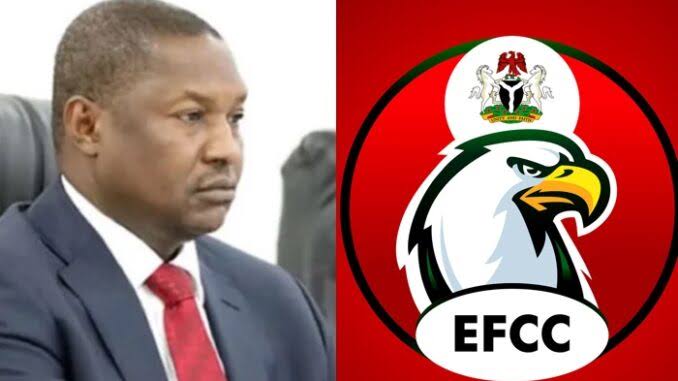
“The Economic and Financial Crimes Commission (EFCC), has conducted coordinated raids on the offices and private homes of former Attorney-General of the Federation and Minister of Justice, Abubakar Malami (SAN), in Abuja and Kebbi State.”
The operations, confirmed by Malami’s media aide Mohammed Doka, have sparked fresh controversy over the conduct and legality of the anti-graft agency’s actions.
Raid Linked to Salami Report Chapter 9
According to Doka, the raids came shortly after Malami’s office publicly referenced Chapter 9 of the Justice Ayo Salami Judicial Commission of Inquiry Report. The EFCC reportedly sought to seize documents relating to that chapter.
Malami’s team claims the chapter contains sensitive findings and recommendations about the roles of senior government officials, including Malami, during his tenure as supervising minister of the EFCC. It has become the centerpiece of a broader dispute over the impartiality of the current EFCC leadership.

Allegations of Bias and Intimidation
Doka accused EFCC Chairman Ola Olukoyede of bias and demanded his recusal from any proceedings involving Malami. The statement described the timing and scale of the raids as troubling, questioning the motive, legality, and intent behind the operations.
Malami’s camp described the raids as intimidation and retaliation for his recent calls for transparency regarding the Salami report. The statement also warned that the safety of Malami and his staff could be at risk, placing Nigerians and the international community on alert.
Background: The Salami Commission
The Justice Ayo Salami Judicial Commission was established in 2021 to probe allegations of corruption, abuse of office, and mismanagement of recovered assets within the EFCC, particularly during the tenure of former EFCC Chairman Ibrahim Magu.
Although the panel submitted its report to the Presidency in November 2021, much of it remains unpublished. Chapter 9, however, has attracted attention for its revelations concerning senior government officials, making it the focal point of Malami’s recent challenges to EFCC leadership.
Calls for Transparency and Due Process
Malami reiterated his willingness to submit to a neutral and lawful process before a competent court, emphasizing that raids and media trials cannot replace due process or the rule of law.
He also urged civil society organisations, professional bodies, and human rights groups to pressure the government to release the full Salami Commission report, particularly Chapter 9, arguing that public access would promote transparency, accountability, and public confidence in anti-corruption efforts.
EFCC Yet to Respond
As of filing, the EFCC has not issued an official response to the allegations or clarified the legal basis for the searches. Analysts note that the development marks another high-profile chapter in ongoing anti-corruption investigations in Nigeria, raising questions about the independence and neutrality of key institutions.
