

On Tuesday, February 24, 2026, President Bola Ahmed Tinubu, GCFR, formally accepted the resignation of Kayode Egbetokun as the Inspector-General of Police (IGP), and appointed Assistant Inspector-General of Police, Tunji Disu as the Acting Inspector-General of Police with immediate effect.
What the Presidency Announced
In a statement released by Bayo Onanuga, Special Adviser to the President on Information and Strategy, the presidency confirmed that Egbetokun submitted his letter of resignation to President Tinubu, citing “pressing family considerations” as the reason for his decision to step down.
President Tinubu acknowledged Egbetokun’s decades of distinguished service to the Nigeria Police Force and to the nation, expressing appreciation for his dedication, professionalism, and commitment to strengthening Nigeria’s internal security architecture during his tenure.
Egbetokun had been appointed IGP in June 2023 and was serving a term that was legally scheduled to conclude in June 2027, under the amended provisions of the Police Act 2020 that extended the tenure of an IGP to a four-year term irrespective of mandatory retirement age.


Appointment of Acting Inspector-General: Tunji Disu
Acting on current national security concerns and legal guidance, President Tinubu approved the immediate appointment of Assistant Inspector-General of Police, Tunji Disu, to serve in the capacity of Acting Inspector-General of Police.
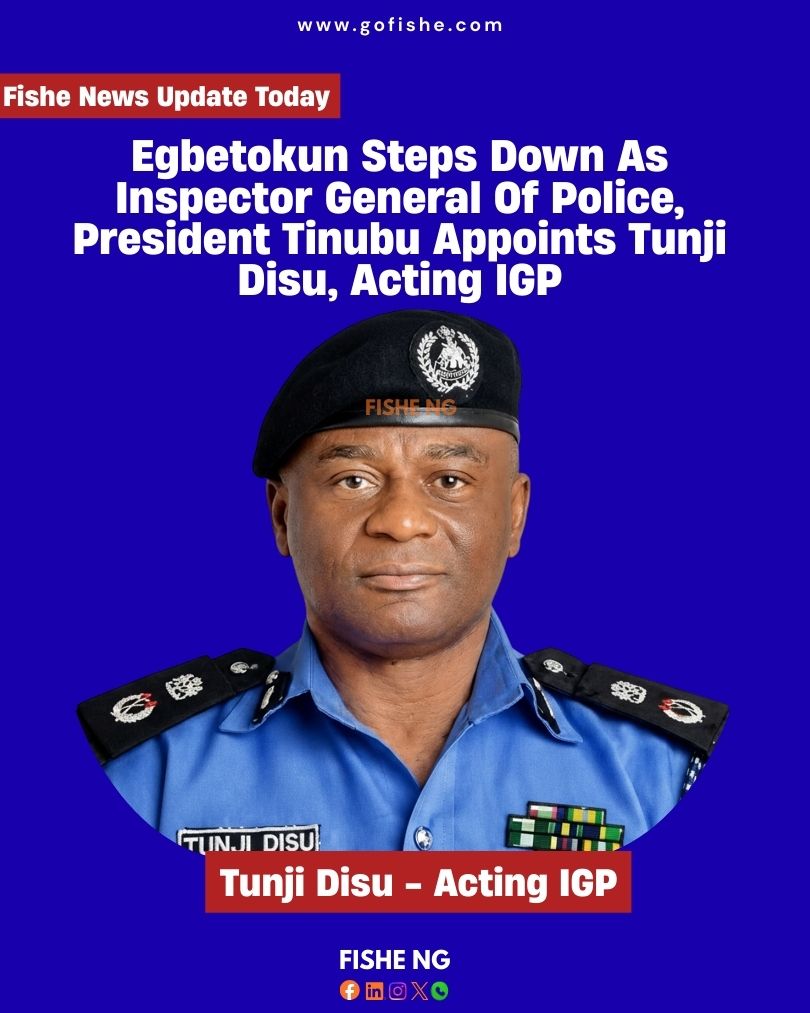

The presidency expressed confidence in Disu, noting his operational experience, leadership qualities, and depth of knowledge in policing as key assets that will provide steady and focused direction for the Nigeria Police Force during this transitionary period.
In accordance with the Police Act provisions, President Tinubu is expected to convene a meeting of the Nigeria Police Council to formally consider Disu’s appointment as the substantive IGP after which his name will be forwarded to the Senate for confirmation.
Who Is Tunji Disu?
Tunji Disu is a senior police officer with decades of service in various operational and leadership positions. According to his biography, Disu was born on April 13, 1966, and has served in key roles such as Commissioner of Police in both the Federal Capital Territory (FCT), Abuja, and in Rivers State.
He is also noted for his leadership of high-profile units within the force, including the Intelligence Response Team (IRT)—a role previously held by Abba Kyari—and has been involved in intelligence and tactical operations across Nigeria.
Disu holds academic qualifications in English Education and advanced degrees in Administration and Criminology, Security and Legal Psychology, equipping him with a blend of scholarly and operational expertise.
Background to the Transition
Egbetokun’s appointment in 2023 was initially welcomed as a fresh leadership direction for the Nigeria Police Force. However, his extended stay beyond the traditional retirement age after the amendment of the Police Act became a matter of contentious debate among legal experts, civil society, and public commentators, some of whom questioned provisions of tenure and institutional governance.
The amendment to the Police Act in 2024 allowed an IGP to serve a single four-year term regardless of age or prior years of service, which meant that Egbetokun, who had reached the mandatory retirement age of 60 in September 2024, could legitimately remain in office until 2027.
Nonetheless, Egbetokun’s resignation ends what has been a high-profile and sometimes controversial chapter in the leadership of the Nigeria Police Force.
What This Means for National Security
The appointment of Disu comes at a time of significant security challenges across Nigeria, including issues related to insurgency, banditry, kidnap for ransom, and communal conflicts. The government’s choice of Disu indicates a preference for continuity of experienced leadership, even as it prepares for formal confirmation processes through the Police Council and Senate.
President Tinubu reiterated his administration’s commitment to enhancing national security, strengthening institutional capacities, and ensuring that the Nigeria Police Force remains professional, accountable, and capable of fulfilling its constitutional mandate.
All You Need To Know About Tunji Disu – The Officer Taking The Helm Of Police Force
With his recent appointment as Acting Inspector-General of Police by President Bola Ahmed Tinubu, Assistant Inspector-General of Police Tunji Disu has stepped into one of the most demanding security roles in Nigeria. Known within policing circles for his operational toughness, administrative discipline, and strategic intelligence background, Disu’s elevation signals continuity combined with reform-minded leadership at a critical time for our security architecture.
Early Life and Education
Born on April 13, 1966, Tunji Disu hails from Lagos State, Nigeria. He earned a degree in English Education from Lagos State University before advancing his academic pursuits in Public Administration and later in Criminology, Security and Legal Psychology.
His academic grounding in both humanities and security studies has often been cited by colleagues as shaping his communication skills and analytical approach to crime management. Unlike purely operational officers, Disu blends field experience with policy awareness—an increasingly important combination in modern policing.
Career Trajectory in the Nigeria Police Force
Disu enlisted in the Nigeria Police Force (NPF), in 1992 as a Cadet Assistant Superintendent of Police. Over the years, he rose steadily through the ranks, holding several key operational and command positions across Nigeria.
Key Positions Held:
-
Commissioner of Police, Rivers State
-
Commissioner of Police, Federal Capital Territory (FCT), Abuja
-
Head of the Intelligence Response Team (IRT)
-
Various command and strategic postings in Lagos and other states
His time in Rivers State, a region often challenged by militancy, oil-related crimes, and organised criminal networks, was particularly defining. Under his leadership, police operations reportedly intensified against cultism, kidnapping syndicates, and armed robbery gangs.
As head of the Intelligence Response Team (IRT), Disu handled high-profile investigations and coordinated tactical operations nationwide. The role demanded discretion, rapid intelligence gathering, and decisive operational execution—qualities that have come to define his professional persona.
Leadership Style: Firm, Tactical, and Results-Driven
Observers describe Disu’s leadership style as:
1. Operationally Hands-On
He is known to engage directly with field commanders and tactical teams rather than relying solely on administrative briefings. This hands-on approach has earned him respect among rank-and-file officers.
2. Intelligence-Centered Policing
With experience leading the IRT, Disu emphasizes intelligence gathering and data-driven decision-making rather than reactive policing. His approach aligns with global best practices that prioritise prevention over response.
3. Structured Discipline
Colleagues often highlight his insistence on procedural compliance and accountability within commands he supervises. He reportedly maintains strict internal standards while encouraging professionalism among subordinates.
4. Strategic Communication
Unlike some officers who avoid public engagement, Disu has demonstrated the ability to communicate clearly during security briefings—an essential trait for rebuilding public trust in the police.
Challenges Ahead as Acting Inspector-General
As Acting IGP, Disu inherits a police force grappling with:
-
Banditry and rural insecurity
-
Urban crime and kidnapping
-
Terrorism threats in certain regions
-
Public trust deficits
-
Welfare and morale concerns within the force
His appointment follows the resignation of his predecessor amid broader conversations about institutional reforms within the police hierarchy. Now, expectations are high that Disu will stabilise leadership while advancing modernisation and accountability reforms.
What His Appointment Signals
President Tinubu’s decision to appoint Disu suggests a preference for:
-
Continuity with operational experience
-
Internal promotion over external political appointment
-
A strong intelligence background in leadership
Security analysts believe his experience in both metropolitan policing (Abuja, Lagos), and high-risk states (Rivers), positions him to balance national security coordination with grassroots law enforcement realities.
The Road Ahead
Should he be confirmed as substantive Inspector-General by the Nigeria Police Council and the Senate, Tunji Disu will have the opportunity to shape the Nigeria Police Force’s direction over the coming years.
Key reform areas likely to define his tenure include:
-
Police modernisation and digitisation
-
Community policing expansion
-
Officer welfare reforms
-
Tactical restructuring against emerging security threats
Whether his tenure becomes transformational will depend not only on his leadership but also on political support, funding, and institutional cooperation across Nigeria’s broader security framework.
Tunji Disu now stands at the center of Nigeria’s internal security leadership. His track record suggests discipline and operational depth; the coming months will reveal whether those strengths translate into lasting national impact.
May Tunji Disu Succeed, May Nigeria Succeed.