


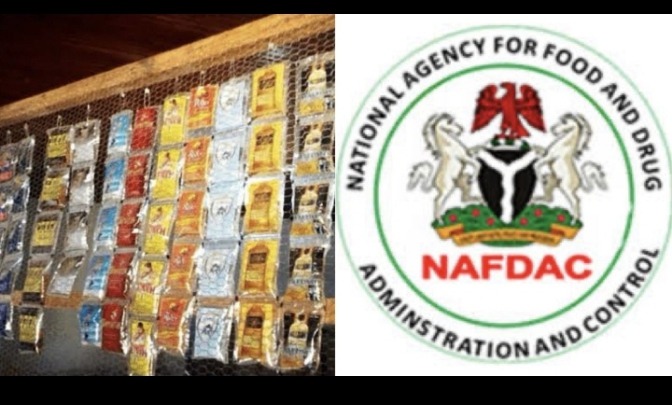
Amid mounting controversy, the Federal Government has ordered NAFDAC to halt enforcement of the proposed ban on sachet alcohol and 200ml PET bottle products, a decision that has intensified nationwide debate over health policy and economic consequences.
The directive, which includes an immediate halt to the sealing of factories and warehouses, was contained in a statement issued on Wednesday in Abuja by the Special Adviser on Public Affairs to the Secretary to the Government of the Federation (SGF), Terrence Kuanum.
Government’s Directive
According to Kuanum, the order followed a joint intervention by the Office of the Secretary to the Government of the Federation (OSGF), and the Office of the National Security Adviser (ONSA), which raised concerns about the security implications of continued enforcement in the absence of a fully implemented National Alcohol Policy.
“Accordingly, all actions, decisions, or enforcement measures relating to the ongoing ban on sachet alcohol are to be suspended pending the final consultations and implementation of the National Alcohol Policy and the issuance of a final directive,” the statement read.
Although the National Alcohol Policy has reportedly been signed by the Federal Ministry of Health in line with the directive of President Bola Tinubu, the SGF’s office and the NSA insisted that NAFDAC must refrain from enforcement measures until the policy is fully operational and further directives are issued.


The government specifically warned the agency to stop:
-
Factory shutdowns
-
Warehouse sealing
-
Public emphasis suggesting a total ban is already in effect
It described the continued sealing of warehouses and what it termed a “de facto ban” as actions taken without a harmonised policy framework, warning that such steps were already causing economic disruptions and posing security risks.
Security and Economic Concerns
According to the statement, enforcement actions were affecting jobs, supply chains and informal distribution networks nationwide. The government warned that premature enforcement without coordinated policy implementation could destabilise communities, worsen unemployment and trigger broader security challenges.
Kuanum noted that the involvement of the National Security Adviser indicates that the issue has gone beyond regulatory concerns and now touches on national stability.
He further revealed that this position reinforces an earlier directive issued by the SGF’s office in December 2025, which suspended actions relating to the proposed ban pending consultations and a final decision.
The SGF’s office had also received a letter dated November 13, 2025, from the House of Representatives Committee on Food and Drugs Administration and Control. The letter, referenced NASS/10/HR/CT.53/77 and signed by the Deputy Chairman, Hon. Uchenna Okonkwo, raised concerns over NAFDAC’s proposed enforcement actions and cited existing National Assembly resolutions on the matter.
The Federal Government stated that it is currently reviewing legislative resolutions, public health considerations, economic implications and broader national interest factors before reaching a final decision.
It assured Nigerians and industry stakeholders that a definitive directive would be communicated after consultations and inter-agency coordination.
Background: The Sachet Alcohol Controversy
The ban on sachet alcohol and 200ml PET bottle products has been one of the most contentious regulatory issues in recent years.
NAFDAC had moved toward enforcement after years of debate, arguing that small, inexpensive alcohol sachets are:
-
Easily accessible to youths and vulnerable populations
-
Linked to harmful drinking patterns
-
Associated with increased social problems such as road accidents, domestic violence and school dropouts
The products are widely consumed due to their affordability and portability, particularly within low-income and informal communities.
Public health advocates have supported restrictions, arguing that tighter controls are necessary to curb alcohol abuse and protect young Nigerians.
However, manufacturers, distributors and labour groups have warned that an outright ban could:
-
Lead to massive job losses
-
Disrupt manufacturing and retail chains
-
Reduce government revenue from excise duties
-
Expand illicit alcohol markets
The current directive appears to reflect the government’s attempt to balance these competing interests.
Conflicting Signals and Regulatory Tension
While the Federal Government’s statement clearly calls for suspension of enforcement actions, previous reports indicated that NAFDAC maintained it had not received formal communication halting the ban and remained committed to operating within its statutory mandate.
The situation highlights ongoing tension between regulatory enforcement and executive coordination, as well as the broader challenge of implementing nationwide health policies in a way that aligns with economic and security realities.
At the centre of the dispute is the National Alcohol Policy — reportedly signed but not fully implemented — which is intended to provide a comprehensive framework governing production, marketing, distribution and consumption of alcohol in Nigeria.
Government officials argue that enforcement without full policy harmonisation risks confusion, economic shock and instability.
What Happens Next?
For now, NAFDAC has been directed to suspend enforcement actions pending:
-
Final consultations
-
Full implementation of the National Alcohol Policy
-
Issuance of a definitive government directive
The Federal Government maintains that its ultimate goal is to act in the interest of public health, economic stability and national security.
As consultations continue, stakeholders — including health advocates, industry operators, lawmakers and security agencies — will be watching closely for clarity on whether the sachet alcohol ban will eventually proceed, be modified, or be permanently shelved.
The unfolding developments underscore the complex interplay between health regulation, economic realities and governance in Nigeria’s policy environment.