


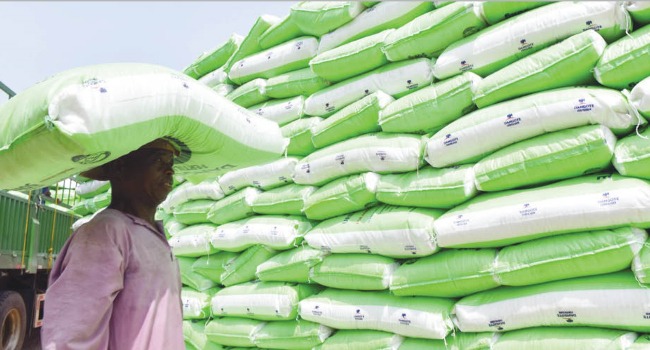
The Presidential Fertilizer Initiative (PFI), has announced enhanced efforts to secure a stable and uninterrupted fertilizer supply for Nigerian farmers, aligning with President Bola Tinubu’s vision for food sovereignty.
According to Tajudeen Ahmed, Executive Director, Portfolio, the initiative has launched a new phase, PFI 3.0, aimed at ensuring a steady supply of raw materials to blending plants and ultimately making Nigeria self-sufficient in crop production for both food and industrial purposes.
“As of September 2025, more raw materials have been supplied or ordered than the total supplied in 2024. Additional arrangements with fertilizer raw material manufacturers have been concluded to stock warehouses nationwide. Blenders will have access to as much material as their production capacity allows,” the statement read.
Data from the Ministry of Finance Incorporated (MOFI) shows that from 2022 to 2025, 48 vessels have delivered critical raw materials for fertilizer blending under the PFI. In 2025 alone, 10 vessels have already discharged cargoes, totaling over 560,000 metric tonnes of inputs at Nigerian ports, supporting robust production and continuity in Nigeria’s fertilizer supply chain.

Dr. Armstrong Takang, Managing Director and CEO of MOFI, highlighted that the PFI focuses not just on volume but also on building a system to shield farmers from global market fluctuations and promote long-term agricultural planning. He described the initiative as a model of public–private collaboration capable of addressing complex national challenges.
The PFI has enabled consistent local production, with over 4.5 million metric tonnes of finished fertilizer produced between 2021 and 2024. Since its inception, the program has facilitated the distribution of more than 128 million bags of fertilizer directly to farmers nationwide.
Alhaji Sadiq Kassim, President of the Fertilizer Producers and Suppliers Association of Nigeria (FEPSAN), noted that an expanding network of blending plants has strengthened output. “The number of operational blending plants has increased to over 90, providing a total blending capacity of up to 13 million metric tonnes. This ensures fertilizer is more accessible to farmers and helps reduce transportation costs,” he said.
While supply remains strong, industry leaders acknowledge farmers’ concerns over rising prices in recent seasons, attributing them to foreign exchange fluctuations and global raw material costs rather than local shortages.
