


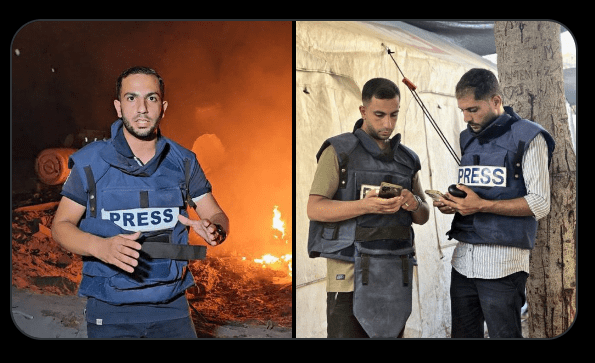
Gaza Mourns As Israeli Strike Claims Lives Of Six Journalists Near Al-Shifa Hospital.
Gaza City is reeling from a devastating Israeli airstrike that killed six journalists near Al-Shifa Hospital on Sunday, 10 August 2025. The attack, which targeted a media tent clearly marked with a “Press” sign, has sparked widespread grief and condemnation, with many describing it as a deliberate assault on press freedom. The journalists, who were among the few remaining voices reporting from within Gaza, were killed while sheltering outside the hospital complex, a location many assumed would be safe from attack.
The victims have been identified as Al Jazeera correspondents Anas al-Sharif and Mohammed Qreiqeh, camera operators Ibrahim Zaher and Moamen Aliwa, assistant Mohammed Noufal, and freelance journalist Mohammad al-Khalidi. Anas al-Sharif, aged 28, was a prominent figure, often referred to as “the voice of Gaza” for his unflinching coverage of the war’s toll on the region. His reports, broadcast to millions, highlighted the starvation and destruction gripping northern Gaza. Mohammed Qreiqeh, 33, a Gaza City native, leaves behind two young children. The strike also claimed the life of al-Sharif’s 19-year-old nephew, Mosaab al-Sharif, and damaged the hospital’s emergency department entrance.


The Israeli military swiftly claimed responsibility, alleging that al-Sharif was the leader of a Hamas cell involved in rocket attacks, a claim both he and Al Jazeera had repeatedly denied as baseless. The Committee to Protect Journalists (CPJ) had warned weeks earlier that al-Sharif was at risk, accusing Israel of orchestrating a smear campaign to justify targeting him. The CPJ condemned the strike, stating, “Israel’s pattern of labelling journalists as militants without providing credible evidence raises serious questions about its intent and respect for press freedom.” The United Nations also denounced the killings as a “grave breach of international humanitarian law,” with UN human rights chief Volker Türk calling for an independent investigation.
Al Jazeera described the attack as a “targeted assassination” and a “premeditated attack on press freedom.” The network noted that the journalists were among the last providing unfiltered accounts of Gaza’s humanitarian crisis, as Israel has barred international media from entering the territory throughout the conflict. Since the war began on 7 October 2023, following a Hamas-led attack that killed 1,200 people and took 251 hostages, Gaza’s health ministry reports over 61,000 Palestinian deaths and the displacement of 90% of its 2.2 million residents. The CPJ estimates that at least 186 journalists, mostly Palestinians, have been killed, making this the deadliest conflict for reporters in modern history.
Social media platforms have been flooded with tributes to the fallen journalists, with users praising their courage and mourning the loss of vital voices. One post read, “Anas al-Sharif bled for two years watching his people being genocided.” British MP Jeremy Corbyn called the killings “sickening beyond words,” accusing Israel of attempting to “silence the truth.” Palestinian journalist Maha Hussaini suggested the strike coincided with Israel’s plans to occupy Gaza City, stating, “By erasing their voices, Israel is trying to rewrite reality.”
Hours before the strike, Israeli Prime Minister Benjamin Netanyahu announced that foreign journalists would be allowed into Gaza with military approval, a move critics argue is an attempt to control the narrative. Hamas claimed the killings were intended to pave the way for a major offensive in Gaza City by silencing witnesses. The strike has intensified calls for international action, with the Palestinian Journalists Syndicate urging global intervention to protect reporters.
Hundreds gathered at Gaza City’s Sheikh Radwan cemetery on Monday to mourn the journalists, their bodies wrapped in white sheets. In a posthumous message shared by Al Jazeera, al-Sharif wrote, “I never hesitated to convey the truth as it is, without distortion or falsification. Do not forget Gaza.” His words have become a rallying cry for those demanding justice and an end to the targeting of journalists in the region.
The international community faces mounting pressure to address the escalating violence and ensure accountability. As Gaza mourns, the loss of these journalists underscores the perilous conditions faced by those documenting the war, leaving the world with fewer eyes on the ground to bear witness to the unfolding tragedy.