


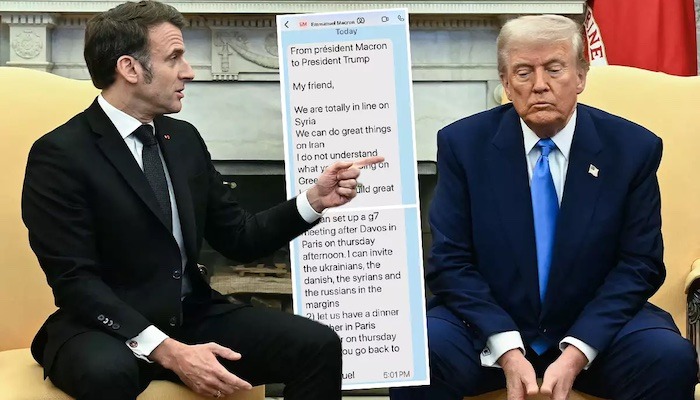
What began as a geopolitical curiosity has rapidly escalated into a major international dispute involving the United States, European powers, NATO allies and even Russia. The flashpoint is Greenland, the vast Arctic island that is an autonomous territory of the Kingdom of Denmark and holds substantial strategic, economic and military value due to its location in the Arctic Circle.
U.S. President, Donald Trump, has reignited and intensified controversy by publicly pursuing U.S. acquisition—or in some arguments, control—of Greenland, citing its strategic importance for U.S. and global security.
This initiative, framed by Trump as a measure against perceived Russian and Chinese geopolitical ambitions in the Arctic, has drawn sharp criticism and resistance from European allies, particularly Denmark and France.
Macron’s Proposal: Multilateral Diplomacy Over Confrontation
In this charged atmosphere, French President, Emmanuel Macron, made a striking diplomatic overture aimed at de-escalation and broader international dialogue.


According to private messages exchanged with President Trump—later shared by Trump on social media—Macron proposed that France host a meeting in Paris involving:
-
The Group of Seven industrial nations (G7)
-
Denmark (as Greenland’s sovereign state)
-
Russia (excluded from the G7 since 2014, but included in Macron’s outreach)
-
Ukraine and Syria (as stakeholders in broader geopolitical discussions)
The proposed meeting was to take place after the World Economic Forum in Davos, reflecting Macron’s intention to widen the diplomatic discussion beyond bilateral U.S.–Europe tensions and include key global players.
Macron’s message reportedly stressed cooperation with the U.S. on other issues such as Syria and Iran, while openly questioning the logic behind Trump’s Greenland push. In his words, “I do not understand what you are doing on Greenland,” indicating both confusion and concern among European allies.
He also extended a personal dinner invitation to Trump in Paris on the sidelines of the meeting, underscoring a preference for diplomacy and dialogue over confrontation.
Why Russia’s Inclusion Matters
Inviting Russia into talks originally conceived among Western leaders is a politically sensitive and symbolically charged move. Russia was expelled from what was once the G8 following its 2014 annexation of Crimea and remains a strategic adversary to many Western states, particularly on issues like Ukraine.
Including Moscow—even on the fringes of this diplomatic meeting—signals Macron’s belief in reintegrative dialogue when global crises escalate.
This contrasts sharply with the growing polarisation surrounding the Greenland question, which has included:
-
Public tariff threats from Washington against European allies who oppose U.S. pressure on Greenland.
-
Strong pushback from European leaders, framing U.S. policy as unacceptable coercion.
-
Russian commentary portraying the dispute as exposing a deep NATO crisis, with Moscow asserting it has no territorial designs on Greenland.
Denmark’s Position: Sovereignty at Stake
Denmark, as Greenland’s constitutional sovereign, has been a central actor in the dispute. Copenhagen and Nuuk (the capital of Greenland), have both emphasised that Greenland should remain part of the Kingdom of Denmark, with full respect for its autonomous status and the will of its people.
Denmark has also made clear—publicly and privately—that any attempt to transfer sovereignty or impose external decisions would be unacceptable without proper legal and democratic processes.
The Danish government has also steered allied responses, calling for collective action from NATO and the EU and reinforcing the argument that Greenland’s defense needs do not require U.S. control.
The Broader Strategic Stakes
Greenland’s importance stems from several factors:
-
Arctic strategic value: Its geographic position controls access to Arctic sea routes and proximity to North American and European theaters.
-
Defense infrastructure: Long-standing U.S. military presence (e.g., Thule Air Base), underscores its role in early-warning and missile defense systems.
-
Natural resources: Greenland holds potential reserves of critical minerals and hydrocarbons as climate change opens new access in the Arctic.
-
Global power competition: The Arctic has become a stage for U.S., Russian and Chinese influence competition.
What Comes Next
As the proposed Paris meeting looms, several key questions remain:
-
Will Trump accept Macron’s offer, and will the meeting dilute or intensify tensions?
-
How will NATO allies balance solidarity with the U.S. against defense of Greenland’s status?
-
What role might Russia play in any broad diplomatic forum, especially given the war in Ukraine?
The outcome of these diplomatic efforts could influence not only the future of Greenland but also broader alliances and the framework for Arctic security cooperation in a rapidly changing world.