


Overview
The 2026 edition of the Hotel Chain Development Pipelines in Africa report by W Hospitality Group reveals a record-breaking growth in the continent’s hotel development sector. Key highlights include:
-
Total pipeline: 123,846 rooms across 675 hotels and resorts.
-
Year-on-year growth: 18.6% overall; 12.2% on a same-store basis.
-
Development concentration: While Africa sees continental growth, activity is increasingly concentrated in a small number of dominant markets.

The top 10 countries account for 79% of total pipeline rooms and over 75% of new signings.
Top Performing Markets
North Africa Leads Overall Volume
-
Egypt dominates the African hotel development landscape, with:
-
45,984 rooms across 185 properties, representing over one-third of the entire African pipeline.
-
39 new deals signed last year.
-
33 openings anticipated in 2026, signaling strong ongoing momentum.
-
-
Morocco ranks second with:
-
10,606 rooms across 75 hotels.
-
Along with Egypt, these two countries account for over 45% of the total pipeline.
-
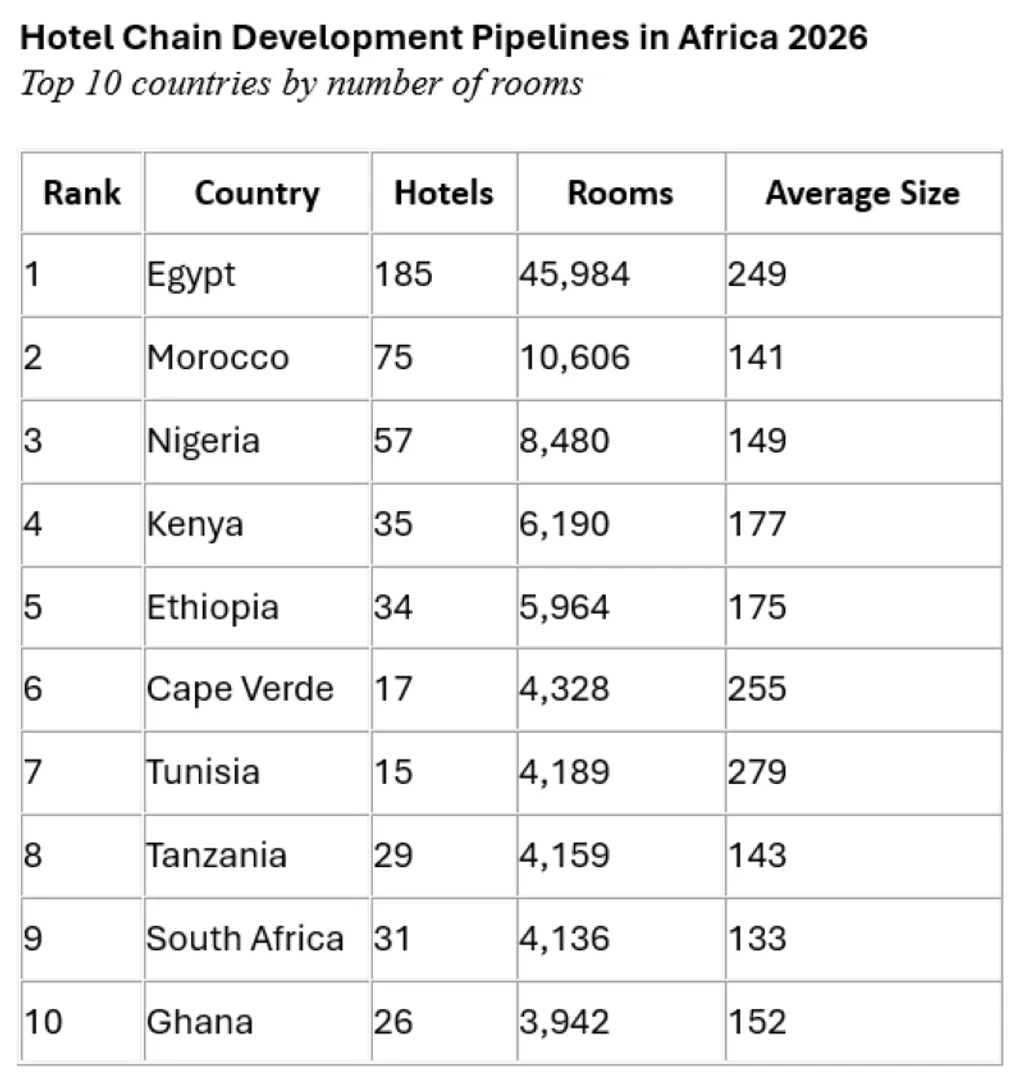
Other notable markets in terms of room numbers include Nigeria (8,480), Kenya (6,190), Ethiopia (5,964), and Cape Verde (4,328).
Top 10 Countries by Rooms
| Rank | Country | Hotels | Rooms | Average Size |
|---|---|---|---|---|
| 1 | Egypt | 185 | 45,984 | 249 |
| 2 | Morocco | 75 | 10,606 | 141 |
| 3 | Nigeria | 57 | 8,480 | 149 |
| 4 | Kenya | 35 | 6,190 | 177 |
| 5 | Ethiopia | 34 | 5,964 | 175 |
| 6 | Cape Verde | 17 | 4,328 | 255 |
| 7 | Tunisia | 15 | 4,189 | 279 |
| 8 | Tanzania | 29 | 4,159 | 143 |
| 9 | South Africa | 31 | 4,136 | 133 |
| 10 | Ghana | 26 | 3,942 | 152 |
Pipeline Status and Execution Momentum
While North Africa dominates in overall volume, East Africa leads in active development:
-
Kenya: 79.5% of rooms under construction.
-
Ethiopia: 79.9% under construction.
-
Tanzania: 77.5% under construction.
In contrast, Nigeria and Cape Verde have significantly lower percentages of projects under construction, indicating that while they contribute sizable pipelines, execution is slower.
| Rank | Country | Hotels | Total Rooms | Rooms Under Construction | % Under Construction |
|---|---|---|---|---|---|
| 1 | Egypt | 185 | 45,984 | 23,622 | 51.4% |
| 2 | Morocco | 75 | 10,606 | 6,859 | 64.7% |
| 3 | Nigeria | 57 | 8,480 | 3,328 | 39.2% |
| 4 | Kenya | 35 | 6,190 | 4,922 | 79.5% |
| 5 | Ethiopia | 34 | 5,964 | 4,768 | 79.9% |
| 6 | Cape Verde | 17 | 4,328 | 374 | 8.6% |
| 7 | Tunisia | 15 | 4,189 | 2,673 | 63.8% |
| 8 | Tanzania | 29 | 4,159 | 3,222 | 77.5% |
| 9 | South Africa | 31 | 4,136 | 2,778 | 67.2% |
| 10 | Ghana | 26 | 3,942 | 2,196 | 55.7% |
As noted by Trevor Ward, Managing Director of W Hospitality Group, the high construction ratios in East Africa suggest that short- to medium-term supply increases are likely to come from Kenya, Ethiopia, and Tanzania.
Operator-Level Concentration
Development activity is highly concentrated among major global hotel chains:
-
Marriott International leads with 31,782 rooms.
-
Followed by Hilton and Accor.
-
The Big Five global chains (Marriott, Hilton, Accor, IHG, Radisson) account for roughly 80% of all pipeline hotels and rooms across Africa.
This concentration highlights both the reliance on established operators and the limited participation of smaller chains in large-scale development projects.
Anticipated Openings
Despite a robust pipeline, historical actualization rates indicate that projected openings may not fully materialise, showing a gap between ambition and execution.
| Anticipated Opening Year | Hotels | Rooms | Cumulative New Rooms |
|---|---|---|---|
| 2026 | 183 | 31,768 | 31,768 |
| 2027 | 177 | 33,381 | 65,149 |
| 2028 | 131 | 25,065 | 90,214 |
| 2029 | 60 | 11,001 | 101,215 |
| To Be Confirmed | 124 | 22,631 | 123,846 |
Observation: More than 65,000 rooms are forecasted to open in 2026 and 2027, but delivery may fall short, emphasizing the need for careful monitoring of project execution.
Key Insights
-
Concentration of growth: A handful of markets – especially Egypt, Morocco, Kenya, and Ethiopia – are driving the bulk of Africa’s hotel development.
-
North vs. East Africa: North Africa leads in overall pipeline volume, while East Africa shows stronger execution momentum.
-
Operator dominance: The African pipeline remains dominated by a few global hotel brands, with smaller operators playing a minor role.
-
Delivery uncertainty: While projected openings are high, historical trends suggest that not all planned developments will come online on schedule.
Conclusion:
Africa’s hotel development landscape in 2026 is marked by record-scale growth, regional concentration, and strong pipeline momentum in East Africa, positioning the continent for continued expansion in the coming years. However, the gap between ambition and execution remains a key consideration for investors and operators alike.
