


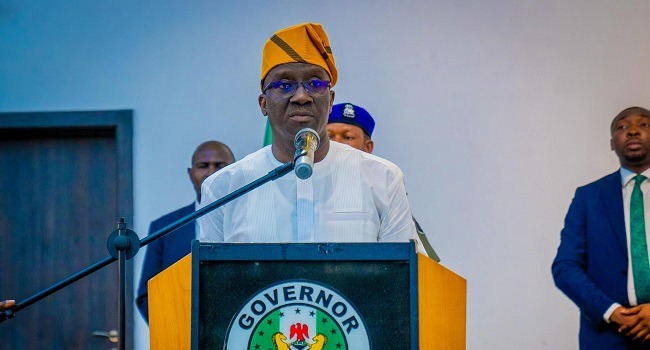
On 28 November 2025, Monday Okpebholo, Edo State governor, made a bold declaration: he is so confident that President Bola Tinubu will win Edo in the 2027 presidential election, that if the president fails to carry the state — Okpebholo says he will resign as governor.
Below I give an overview of the declaration, drawing from other reliable sources; its political context, and possible implications for Edo’s political landscape.
What Governor Okpebholo Said
-
Okpebholo described Tinubu as “even more popular than me here now,” arguing that Edo people appreciate what his administration has done — and they know it’s because of Tinubu’s influence.
-
He insisted that there is “no real opposition” in Edo ahead of 2027.

-
He projected that Edo citizens would overwhelmingly vote for Tinubu — and vowed to personally resign if that forecast did not materialise.
According to Okpebholo, the growing support is rooted in what he calls a “grassroots,” people-first approach to governance — a style he described as inspired by his political mentor.
The Political Context: Why This Declaration Matters
• Consolidation of Power in Edo
-
Since being sworn in as governor in November 2024 (after winning a contested election), Okpebholo’s victory was upheld through multiple court judgments, including by the Supreme Court of Nigeria.
-
Under his watch, a number of local government‑area chairmen recently defected to the ruling All Progressives Congress (APC), a move Okpebholo pointed to as proof of APC’s growing dominance in Edo.
• Framing 2027 As a Referendum on APC’s Governance
By tying his own political fate to Tinubu’s success, Okpebholo is essentially framing the 2027 vote in Edo not just as a presidential election, but as a verdict on his administration (and by extension — APC’s governance). That raises the stakes considerably.
• Challenging the Opposition: Public Confidence Claim
Okpebholo went further by publicly disparaging the relevance of the opposition — including former governor Godwin Obaseki and the main opposition party, Peoples Democratic Party (PDP). He insisted that the former governor’s record is unpopular and that the opposition cannot “come back” to Edo.
What It Means: Risks, Realities, and Reactions
For Okpebholo & APC:
-
This statement could galvanise and mobilise the ruling party’s base — giving a rallying cry for party members to work hard toward delivering on the promised outcome.
-
It signals confidence and control: by openly staking his governorship on Tinubu’s success, Okpebholo is trying to project dominance and overconfidence — possibly to demoralise opposition parties and supporters.
Potential Risks:
-
If the 2027 election in Edo does not go as predicted, Okpebholo’s threat to resign could backfire — possibly weakening APC’s hold, creating internal turmoil, or emboldening opposition.
-
The declaration may deepen political polarisation in Edo: critics may view it as hubris and overreach, or as putting undue pressure on voters.
What Opposition Parties Might Do:
-
Opposition parties could seize this as an opportunity: with such a public vow, they might intensify campaigning in Edo — positioning themselves as defenders of democratic contest.
-
They could also amplify criticisms of APC governance, past or present, to challenge the notion that the state is under “no opposition.”
What to Watch Out For Going Forward
-
Local Government Dynamics: Whether defections continue or whether local opposition structures re-emerge in Edo ahead of 2027.
-
Public Sentiment: Whether citizens’ lived realities — jobs, security, infrastructure, social services — align with the “people-first” narrative Okpebholo is advancing.
-
Opposition Strategy: Whether the opposition — PDP or others — rebuilds, forms coalitions, or introduces fresh candidates to challenge APC’s dominance.
-
2027 Campaign Election Environment: Whether the election will be genuinely competitive, and whether the playing field will remain open and fair.
Conclusion
Governor Monday Okpebholo’s declaration — that he will resign if President Tinubu doesn’t win Edo in 2027 — is as much a political gambit as it is a statement of confidence. On one hand, it demonstrates boldness and an attempt to rally support; on the other, it raises the stakes high — tying personal political fate to electoral success in a state whose mood and dynamics may shift.
Whether this will motivate supporters or energise the opposition remains to be seen. But one thing is clear: with that statement, Okpebholo has turned 2027 into more than just another election — he’s turned it into a referendum on himself, on APC governance, and on Edo’s political direction.
