


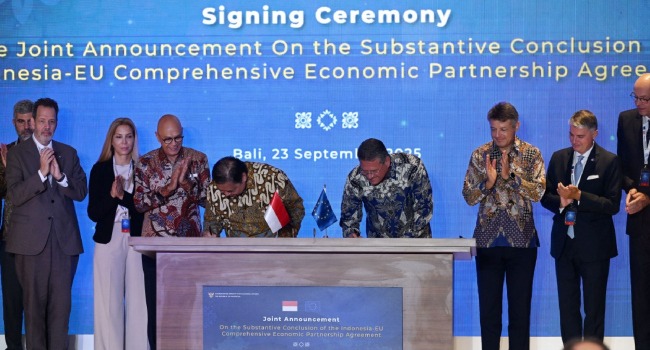
Indonesia and the European Union have finalized the long-awaited Comprehensive Economic Partnership Agreement (CEPA), marking a major step in trade relations between the Southeast Asian nation and the bloc.
Signed in Bali by EU Trade Commissioner Maros Sefcovic and Indonesian Minister of Economic Affairs Airlangga Hartarto, the deal will open investment opportunities in key sectors including electric vehicles, electronics, and pharmaceuticals.
EU officials highlighted the economic benefits of the agreement. Sefcovic said the pact demonstrates a shared commitment to open, rules-based, and mutually beneficial trade, while EU President Ursula von der Leyen noted that EU exporters will save around 600 million euros ($708 million) annually in duties on goods entering Indonesia, making European products more accessible to Indonesian consumers.
Negotiations, which began in 2016, faced delays over contentious issues such as palm oil and deforestation. Analysts say the urgency to conclude the deal accelerated after US President Donald Trump’s broad tariff measures created a need for alternative trade markets. The agreement also includes a protocol on palm oil, though specific details have not been disclosed.

President Prabowo Subianto and Ursula von der Leyen reached a “political agreement” in Brussels this July after 19 rounds of negotiations. Airlangga Hartarto noted that uncertainties from global tariff disputes prompted both sides to pursue a stable bilateral deal. He described the decade-long negotiation process as a milestone reflecting the commitment of stakeholders to fair, open, and sustainable economic collaboration.
Under the CEPA, about 80 percent of Indonesian exports to the EU will become tariff-free once the deal comes into force, benefiting major exports such as palm oil, footwear, textiles, and fisheries. The agreement also strengthens EU access to Indonesia’s domestic market of roughly 280 million people, while mitigating risks from global trade tensions.
Environmental concerns remain, with activists warning that rising demand for Indonesian palm oil under the trade deal could accelerate deforestation. Greenpeace Indonesia’s Syahrul Fitra cautioned that remaining natural forests within palm oil concessions could be cleared for plantations. The deal now moves to legal checks, document translation, and ratification by EU member states, the European Parliament, and Indonesia, with full implementation expected by 2027.
