

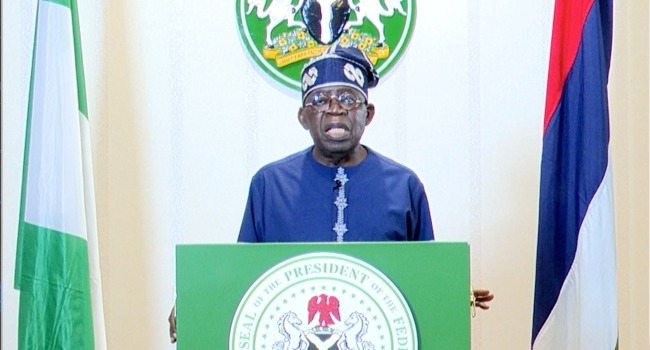
The Indigenous People of Biafra (IPOB) has rejected President Bola Tinubu’s Independence Day speech, describing it as divisive and hate filled.
IPOB accused Tinubu of recklessly and falsely linking the group with Boko Haram while exonerating ISWAP, Al Qaeda in the Maghreb, and Lakaruwa. According to IPOB’s Media and Publicity Secretary, Emma Powerful, Tinubu’s speech was a deliberate attempt to misrepresent the group’s activities and criminalize the Igbo nation.
“We state categorically that IPOB is not Boko Haram, not ISWAP, not Al Qaeda. We are a people struggling for our survival in the face of state sponsored genocide,” IPOB said. The group emphasized that it is a peaceful movement pursuing self determination through nonviolent means, citing a 2017 Federal High Court ruling that declared IPOB is not a terrorist organization.
IPOB’s leader, Mazi Nnamdi Kanu, has been detained despite multiple court orders for his release. “If Tinubu truly believes in justice, let him obey the courts instead of propagating lies,” IPOB added. The group condemned Tinubu’s hypocrisy, saying he downplays atrocities committed by armed herdsmen while demonizing unarmed Igbo youths.

Tinubu’s speech has been criticized for its double standard, with IPOB pointing out that when entire communities are wiped out, his government calls it “farmer herder clashes,” but when unarmed Igbo youths protest peacefully, they are branded terrorists. “This double standard exposes Tinubu’s deep seated prejudice against the Igbo race,” IPOB alleged.
The group has called on all Nigerians to focus on unity, dialogue, and adherence to the rule of law as the nation celebrates its 65th Independence anniversary. IPOB reiterated its commitment to peaceful advocacy and self determination, urging the government to respect legal processes concerning Kanu’s detention.
“The struggle for Biafra’s liberation is a just cause rooted in truth, justice, and international law. No amount of blackmail will erase that,” IPOB maintained. The group’s rejection of Tinubu’s speech highlights the ongoing tensions between IPOB and the Nigerian government.
