


The stage is officially set for the biggest FIFA World Cup in history. The full group-stage draw for the 2026 tournament has been confirmed, unveiling all 12 groups that will shape the opening chapter of this expanded 48-team competition. Hosted across the United States, Canada, and Mexico, the upcoming World Cup promises unprecedented drama, fresh rivalries, and new opportunities for emerging football nations.
With the groups now finalised and the path to the knockout rounds taking shape, fans around the world can finally begin charting their teams’ journeys toward global glory.
Draw Day: What Happened
-
The group-stage draw for the 2026 FIFA World Cup took place on 5 December, 2025 at the Kennedy Center in Washington, D.C.
-
The tournament will feature 48 teams, divided into 12 groups (Groups A through L), of four teams each.

-
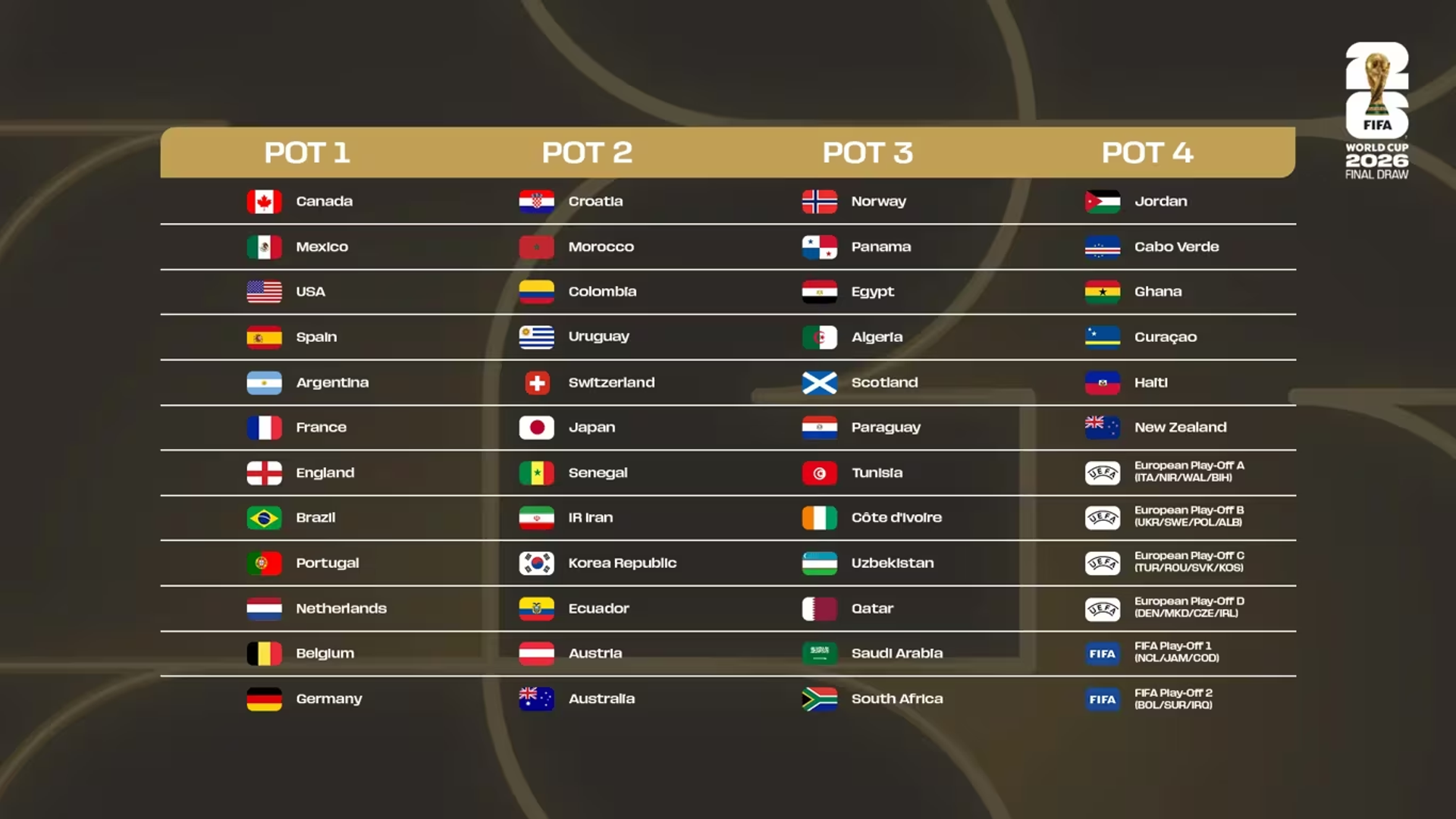
The 48 teams are drawn from four “pots” — one team from each pot lands in every group.
How the Draw Worked: Pots, Seeds, and Rules
-
Pot Allocation: The three co-hosts — United States national football team (USA), Canada national football team, and Mexico national football team — were automatically placed in Pot 1 alongside the nine highest-ranked qualified teams (according to the November 2025 FIFA rankings).
-
Confederation Constraints: Teams from the same continental confederation generally cannot be drawn into the same group — except for Europe (UEFA), where a group may contain up to two European teams.
-
Hosts’ Positions Fixed: To facilitate scheduling and logistics, the three host nations received fixed group-positions: Mexico → Group A, Canada → Group B, USA → Group D.
-
Play-off Placeholders Included: Since six qualifying berths (four from European play-offs and two inter-confederation slots), were still undecided at draw time, play-off winners were allocated as placeholders — all placed in Pot 4.
The Groups: Teams and Some Key Matchups
With the draw completed, here’s how the 12 groups look. Some highlights:
| Group | Teams |
|---|---|
| A | Mexico (host) – South Africa, South Korea, European Play-off D team |
| B | Canada (host) – Qatar, Switzerland, European Play-off A team |
| C | Brazil, Morocco, Haiti, Scotland |
| D | USA (host) – Paraguay, Australia, European Play-off C team |
| E | Germany, Curaçao, Ivory Coast, Ecuador |
| F | Netherlands, Japan, Tunisia, European Play-off B team |
| G | Belgium, Egypt, Iran, New Zealand |
| H | Spain, Cape Verde, Saudi Arabia, Uruguay |
| I | France (holders) – Senegal, Norway, FIFA Play-off 2 team |
| J | Argentina, Algeria, Austria, Jordan |
| K | Portugal, Colombia, Uzbekistan, FIFA Play-off 1 team |
| L | England, Croatia, Ghana, Panama |
Some Takeaways:
-
Tough Groups: Group C — with Brazil, Morocco and Scotland — stands out as one of the trickiest draws.
-
Hosts’ Advantage: Mexico, Canada, and USA each get to play at home during the group stage, which could shape their early matches.
-
Second Seeds + Underdogs Mix: Groups like E (Germany with Curaçao and Ivory Coast), or L (England with Ghana and Panama), combine top-tier teams with relatively less experienced sides — offering potential for surprises.

What It Means: Format, Stakes, and Expectations
-
This edition is the first 48-team World Cup, expanding beyond the traditional 32.
-
Because of that expansion:
-
The tournament will feature 12 groups of four.
-
32 teams will progress to the knockout rounds: the top two from each group (24 teams), plus the eight best third-placed teams across all groups.
-
-
For many teams — especially from outside traditional powerhouses — this format increases their chances of progress, making the group stage more competitive and unpredictable.
What’s Next Before Kick-off
-
The final match schedule — including stadiums and kickoff times — will be published shortly (likely within a day of the draw).
-
Meanwhile, the final six spots (play-off winners), will be filled after March 2026, which may slightly change the composition of a few groups (Pot 4 placeholders).
-
Teams, players, and fans now begin preparations: coaches may start planning group-stage strategies, while fans begin speculating on matchups, venues, and tickets.
The full draw confirms what many had anticipated: the 2026 World Cup will be bigger, more global, and more unpredictable.
The expansion to 48 teams and 12 groups opens up opportunities for emerging football nations — while traditional giants still aim for glory. With groups finalised, the road to the summer of 2026 begins in earnest.
