

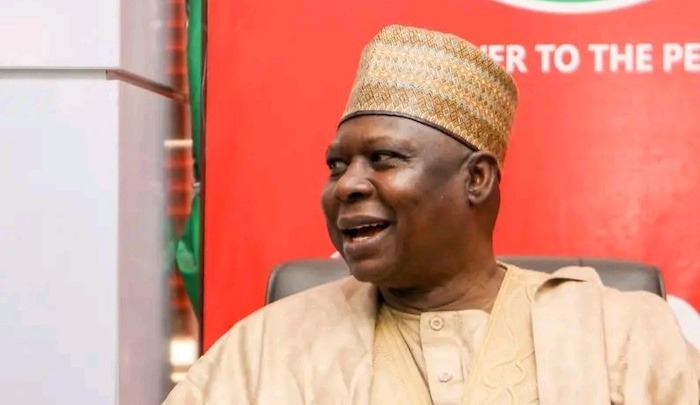
The Peoples Democratic Party (PDP), has entered a new phase of leadership following the election of Kabiru Tanimu Turaki, former Minister of Special Duties and Intergovernmental Affairs, as its new National Chairman. The election—held on Saturday during the party’s national convention in Ibadan, the Oyo State capital—capped weeks of strategic consultations, zoning decisions, and internal alignment within the opposition party.
Turaki, who emerged as the sole contender for the party’s top administrative seat, received an overwhelming 1,516 votes, securing a sweeping mandate from party delegates across the country. His emergence followed the withdrawal of Lado Danmarke, the PDP’s 2023 governorship candidate in Katsina State, who nonetheless polled 275 votes—a reflection of delegates who had already cast their ballots or chose to express preference symbolically.
A Convention Marked by Consensus and Continuity
The Ibadan convention showcased an atmosphere of controlled coordination and party-wide agreement. While some positions witnessed active contests—such as the deputy national organising secretary won by Solarin Sunday Adekunle, who garnered 633 votes—many others were returned unopposed. Seventeen national offices fell into this category, underscoring a deliberate effort by party leaders to avoid divisiveness.
Two key positions—Youth Leader and Deputy National Legal Adviser—were stepped down entirely, reportedly to allow further consultations and avoid hasty decisions that could disrupt party unity.

Zoning Decisions That Shaped the Outcome
Turaki’s ascension did not occur in a vacuum. In August, the PDP’s National Executive Committee (NEC), reaffirmed the party’s long-standing zoning policy by assigning the 2027 presidential ticket to the South. In accordance with this tradition, the National Chairmanship—a role typically balancing the origin of the presidential candidate—was zoned to the North.
This set the stage for a series of influential meetings held in October, during which stakeholders from the North-West rallied behind Turaki as their consensus candidate. These gatherings were attended by some of the party’s most prominent voices, including:
-
Bala Mohammed, Governor of Bauchi
-
Caleb Mutfwang, Governor of Plateau
-
Ahmadu Fintiri, Governor of Adamawa
-
Dauda Lawal, Governor of Zamfara
-
Umar Damagum, PDP Acting National Chairman
-
Bukola Saraki, Former Senate President
-
Jerry Gana, Former Minister of Information
-
Abba Moro, Senate Minority Leader
-
Ibrahim Shekarau, Former Minister of Education
Their endorsement signaled a broad coalition of northern leaders determined to present a unified front—a move that significantly strengthened Turaki’s candidacy and paved the way for his uncontested path at the national convention.
Turaki’s Mandate: Unity, Reform, and Electoral Revival
Turaki’s election comes at a critical moment for the PDP, which has spent the last several years navigating internal divisions and recalibrating its strategies following the 2023 general elections. As National Chairman, Turaki steps into a role that carries immense responsibility: restoring cohesion, rekindling grassroots support, and positioning the party as a credible alternative ahead of the 2027 elections.
His campaign emphasized:
1. Rebuilding Internal Democracy
Turaki has consistently argued that the PDP must reinforce transparent processes and eschew the culture of impunity that has weakened its internal structures.
2. Strengthening Grassroots Engagement
He has pledged to reconnect the party to its base across wards and constituencies—areas once regarded as the engine of PDP’s dominance.
3. Driving Strategic Electoral Reforms
With the presidential ticket already zoned to the South, Turaki will be instrumental in fostering synergy between northern and southern blocs, a crucial factor for electoral success.
4. Fostering Reconciliation
Perhaps his most immediate challenge will be unifying returning, aggrieved, and competing factions within the party—many of whom have lingering grievances.
A New Beginning for the Main Opposition Party
Kabiru Turaki’s election as National Chairman is more than a ceremonial transition—it is widely seen as a recalibration of the PDP’s leadership ethos. By emerging as both a consensus candidate and the overwhelming choice of convention delegates, Turaki enters office with a rare blend of political backing and organizational goodwill.
Whether he can harness this momentum to restore the PDP’s competitive edge on the national stage remains to be seen. But for now, the party’s rank-and-file appear united behind his leadership, hopeful that this new era will bring renewed purpose, stronger cohesion, and a more formidable opposition ahead of future elections.
