


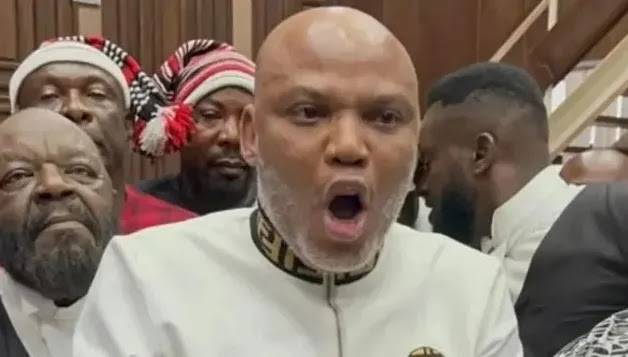
In recent weeks Kanu and his defence team have mounted a number of legal challenges to the continuation of his trial:
-
He filed a preliminary objection arguing that the statute under which he is being prosecuted, (the Terrorism (Prevention) (Amendment) Act 2013) was repealed by the later Terrorism (Prevention and Prohibition) Act 2022, and therefore cannot validly support his prosecution.
-
He argues that the proscription of IPOB was carried out by an ex parte order obtained without prior hearing, and that his rendition from Kenya lacking formal extradition procedure invalidates jurisdiction.
-
He has asked the court to arrest judgment (i.e., to halt the delivery of judgment) pending the hearing and determination of those jurisdictional/constitutional challenges.

-
His position is that proceeding to judgment without first resolving these foundational issues would violate his constitutionally-guaranteed right to a fair hearing under Section 36 of the Nigerian Constitution.
The Court’s Position
On the other side, the Abuja Federal High Court (Justice James Omotosho presiding) has fixed 20 November 2025 as the date for judgment.
The Court also held that because Kanu was granted six days to open his defence and declined to call witnesses (or open his defence), he cannot later claim he was denied fair hearing.
Moreover, the Court has refused to entertain certain motions at this stage, regarding them as either dilatory or raising issues that must be settled but not before judgment.
Key Legal Issues at Stake
The clash raises several fundamental legal questions:
-
Statutory Basis of Prosecution: Can a prosecution proceed under a statute that has been repealed, especially when the defendant argues that the later statute abolished the earlier offence? Kanu’s team says no; they point to Section 98(3) of the 2022 Act and Section 122(2)(a) of the Evidence Act.
-
Proscription and Jurisdiction: If IPOB’s proscription order was obtained without a hearing or while an earlier order was in force declaring IPOB was not unlawful, then the foundation for criminalising its leader may be constitutionally defected.
-
Right to Fair Hearing: Section 36 of the Constitution guarantees the right to be heard before any tribunal or court decision affecting one’s rights or obligations. Kanu argues that the court moving ahead without hearing his jurisdictional motion breaches that right.
-
Extradition/Rendition Issues: The manner of his extradition from Kenya (allegedly without formal procedure) is argued to have stripped the Nigerian court of proper jurisdiction or at least vitiated the fairness of the process.
Political and Business Implications
This is not just a technical legal battle. The outcome resonates politically and socially. For Southeastern Nigeria, Kanu’s case is seen by many as emblematic of perceived marginalisation, and his movement (IPOB) remains a potent symbol of Igbo self-determination.
On the government side, there is a strong interest in maintaining the integrity of the criminal justice process and asserting the state’s ability to prosecute alleged insurgency/terrorism.
Observers are also watching whether the judiciary will uphold the rule of law in a highly charged case, balancing state security and individual rights.
What Happens Next
-
The court is set to deliver its judgment on 20 November 2025 unless delayed further.
-
If the court ignores or declines to resolve the pending jurisdictional challenges before judgment, Kanu’s defence may argue that any judgment is a nullity from inception (void ab initio).
-
Regardless of the immediate result, the case may be appealed up to the Supreme Court of Nigeria, and could have far-reaching precedents for how terrorism prosecutions must align with statute repeal, fair hearing guarantees, and jurisdictional legitimacy.
Conclusion
In sum, Nnamdi Kanu’s current legal strategy is not merely a delaying tactic: it raises fundamental questions about the legitimacy of the charges, the validity of the statute under which he is being tried, and whether his trial process has complied with constitutional guarantees of fair hearing and jurisdiction.
The court’s willingness to deal with these questions — and to what extent, will likely determine not just his fate, but an important precedent for Nigerian criminal jurisprudence in terrorism and national-security cases.
