


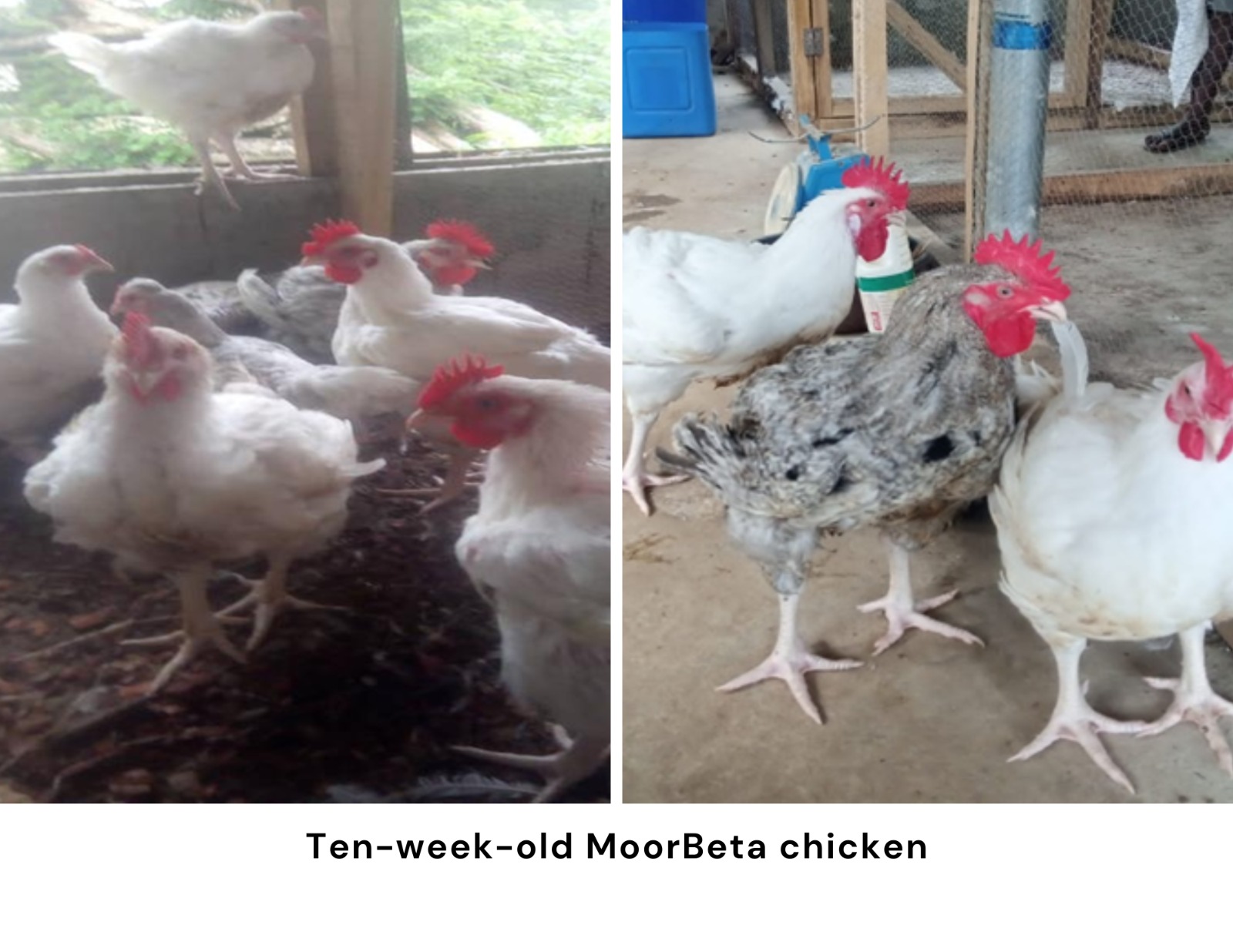
The Federal government has taken a significant step toward strengthening its poultry sector with the approval of a new indigenous meat-type chicken breed known as MoorBeta. This development reflects ongoing efforts to enhance food security, promote local livestock production, and improve the livelihoods of farmers across the country.
Background and Approval
MoorBeta was officially approved for release and registration on March 26, 2026, by the National Crop Varieties and Livestock Breeds Registration and Release Committee (NVRC). The approval meeting took place at the National Centre for Genetic Resources and Biotechnology (NACGRAB), located in Ibadan, Oyo State.
The release was welcomed by the Federal Ministry of Livestock Development Nigeria, which has played a collaborative role in the breed’s development and is also represented within the NVRC.


Research and Development
The MoorBeta chicken was developed by the Poultry Research Team at the Institute of Agricultural Research and Training (IAR&T), which operates under Obafemi Awolowo University in Moor Plantation, Ibadan.
The breeding program spanned over a decade and involved careful crossbreeding of indigenous and exotic meat-type chickens. The objective was to create a breed that combines the resilience of local birds with the productivity traits of improved commercial varieties.
Key Characteristics of MoorBeta
Growth Performance
- Achieves an average live weight of approximately 2.8 kg at 10 weeks
- Demonstrates efficient feed conversion, reducing production costs
- Maintains a high survival rate exceeding 95%
Physical and Meat Quality Traits
- Predominantly white plumage with brown, black, or red speckles
- Features a large single comb
- Possesses a well-developed body structure, supporting higher meat yield
- Produces meat that is tender, juicy, and retains quality with minimal cooking loss
Environmental Adaptability

- Highly tolerant to heat stress, making it suitable for Nigeria’s tropical climate
- Performs well under diverse environmental and management conditions
- Particularly suited for smallholder and backyard farming systems
Economic Viability
A cost-benefit analysis conducted in 2025 highlights the strong financial potential of MoorBeta production:
- Raising 100 birds can yield a net profit exceeding ₦278,000
- Production cycle lasts approximately 10 weeks
- Offers a high return on investment (ROI), for both small-scale and commercial poultry farmers
This economic advantage positions MoorBeta as an attractive option for farmers seeking to increase profitability while managing costs.
Implications for Food Security and Agriculture
The introduction of MoorBeta aligns with national agricultural priorities in several ways:
- Enhanced Food Security: Increased poultry meat production helps meet growing protein demand
- Support for Local Breeds: Strengthens the development and adoption of indigenous livestock
- Income Generation: Provides farmers with a profitable and sustainable production option
- Reduced Import Dependence: Encourages local production over reliance on imported poultry products
Government and Institutional Support
The Federal Ministry of Livestock Development has reaffirmed its commitment to:
- Partnering with research institutions
- Supporting dissemination and adoption of improved breeds
- Enhing productivity across the livestock sector
- Promoting food and nutrition security nationwide

Conclusion
The approval and release of MoorBeta represent a major milestone in Nigeria’s poultry industry. By combining adaptability, high productivity, and strong economic returns, the breed offers a practical solution to many of the challenges faced by poultry farmers.
With continued government support and widespread adoption, MoorBeta has the potential to significantly boost local poultry production, improve farmer incomes, and contribute meaningfully to national food security.
