


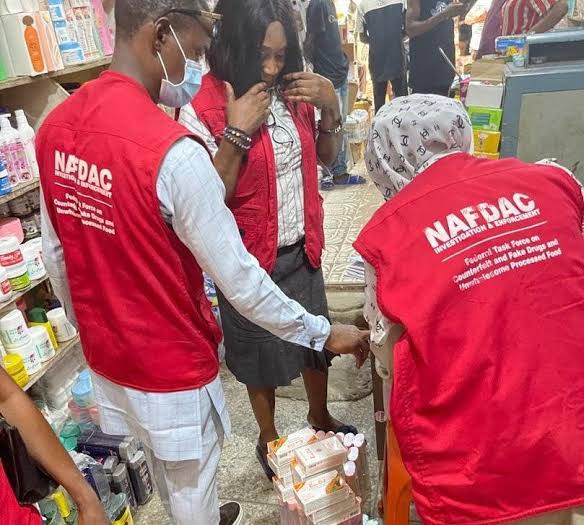
The National Agency for Food and Drug Administration and Control (NAFDAC) has intercepted counterfeit malaria drugs valued at over N1.2 billion in Lagos, intensifying its campaign against substandard and fake medicines nationwide.
The agency seized 277 cartons of unregistered and counterfeit Malamal Forte malaria drugs stored in a warehouse located in the Ilasa-Oshodi area of Lagos State. These fake drugs were concealed in cartons labeled as Diclofenac Potassium 50mg, illegally imported from Shanxi Tianyuan Pharmaceuticals Group in China, and falsely declared as spare parts to evade detection.
In a statement posted on its official X handle on Friday, NAFDAC reaffirmed its commitment to eliminating fake drugs that threaten public health. The agency’s Director-General, Prof. Mojisola Adeyeye, stressed that with full backing from the Presidency and the Federal Ministry of Health, NAFDAC is resolute in protecting Nigerians from counterfeit medicines. She emphasized that this seizure forms part of an ongoing nationwide enforcement campaign aimed at ensuring that only safe and quality medicines circulate in the country.
Prof. Adeyeye further disclosed that recent coordinated raids on illicit drug markets in Lagos, Onitsha, and Aba have generated fines totaling about N2.5 billion from traders caught selling counterfeit or substandard medicines. According to the DG, NAFDAC has spent approximately N996 million on enforcement operations, borrowed N159 million from a donor grant, and allocated N1.18 billion toward regulatory expenses, leaving the agency with a balance of N207 million. These operations involved the deployment of over 1,300 security personnel and uncovered widespread violations, including expired drugs, unapproved medicines, and poor storage practices.


In a separate but related public health intervention, NAFDAC carried out a sensitization exercise in the Billiri Local Government Area of Gombe State on Friday, following reports of fruits being artificially ripened with calcium carbide—a chemical known to pose serious health risks. The state coordinator, James Agada, explained that artificially ripened fruits often appear yellow on the outside but remain unripe inside and may show powdery residues or peel off quickly. He warned that consumption of such fruits could lead to severe health problems such as cancer, heart, kidney, and liver failure, as well as permanent skin damage.
Agada emphasized that NAFDAC’s approach prioritizes education and awareness before enforcement action. He encouraged fruit sellers to adopt safer alternatives to calcium carbide and to always verify the authenticity of products using NAFDAC’s digital platforms, including the Green Book app, NAPAMS, and Scan2Verify. Responding to the campaign, the Chairman of the Fruit Sellers Association in Billiri, Alhaji Murtala Mohammed, praised NAFDAC’s enlightenment efforts and urged members to avoid calcium carbide. He recommended safer natural ripening agents like pear and garden egg extracts to protect consumer health.