


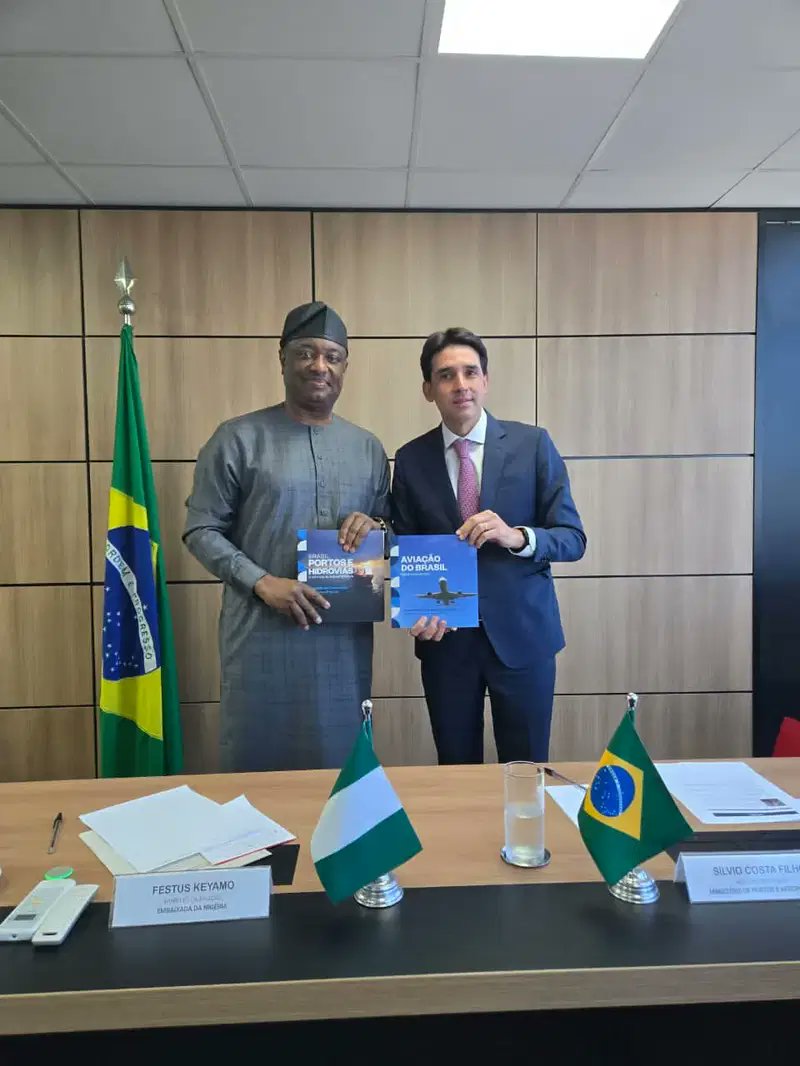
Nigeria And Brazil To Launch Direct Flights With Historic MoU Signing.
The Federal Republic of Nigeria is poised to sign a landmark Memorandum of Understanding (MoU) with Brazil to establish a Bilateral Air Service Agreement (BASA), paving the way for direct flights between the two nations. The announcement, confirmed by Mr Obafemi Bajomo, Special Adviser on Foreign Direct Investments to Nigeria’s Minister of Aviation and Aerospace Development, marks a significant step in strengthening economic and cultural ties between Africa’s largest economy and South America’s powerhouse.


The agreement, set to be formalised during President Bola Tinubu’s state visit to Brasilia on 24 August 2025, follows months of high-level discussions that began in May 2025. Nigeria’s Minister of Aviation and Aerospace Development, Festus Keyamo, and Brazil’s Minister of Ports and Airports, Silvio Costa Filho, have worked to finalise the BASA, overcoming bureaucratic hurdles to enable this long-awaited air link. The MoU is expected to facilitate four to five weekly direct flights, likely operated by Nigerian carriers such as Air Peace and Caverton, transforming connectivity across the South Atlantic.
This development promises to significantly reduce travel times and logistics costs, opening new avenues for trade in agricultural products, manufactured goods, and services. “For Nigerian exporters, Brazilian markets will become more accessible than ever before,” Mr Bajomo told the News Agency of Nigeria. The agreement also aims to boost tourism and cultural exchanges, leveraging the deep historical ties between the two nations, particularly the shared Yoruba heritage woven into Brazil’s cultural fabric.
Beyond air connectivity, both countries have outlined plans for technical cooperation, including pilot training and airport infrastructure upgrades. These initiatives are set to enhance Nigeria’s aviation sector and position it as a stronger player in global aviation. Keyamo, who will join President Tinubu for the signing, described the agreement as a bridge for commerce, tourism, and shared aspirations, noting that “Nigeria and Brazil are like twins separated at birth, now reunited.”
The BASA has undergone rigorous statutory processes, including legal clearance by Nigeria’s Federal Ministry of Justice and approval by the Federal Executive Council, ensuring a smooth path to implementation. Brazilian authorities have similarly prepared the necessary documentation, reflecting a shared commitment to expediting the agreement.
Public sentiment on social media platforms like X has been overwhelmingly positive, with Nigerians and Brazilians alike celebrating the prospect of stronger ties. The agreement is seen as a milestone in transcontinental partnership, promising to foster economic resilience and cultural understanding for generations to come. As the signing date approaches, anticipation builds for a new era of connectivity between Nigeria and Brazil.