


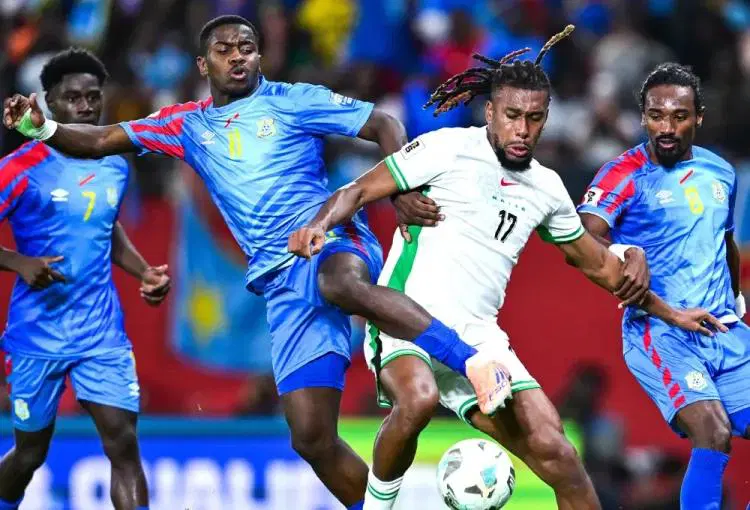
The world football governing body, FIFA, has imposed disciplinary sanctions on the football federations of Nigeria and the Democratic Republic of the Congo following infractions that occurred during their decisive 2026 World Cup qualifying play-off match. The sanctions relate to crowd misconduct and security breaches during the match held in November 2025.
The decision comes amid ongoing controversy surrounding the play-off result and a separate complaint lodged by Nigeria over alleged ineligible players fielded by DR Congo.
Background to the Match
The incident stems from the African play-off stage of the qualification process for the 2026 FIFA World Cup. Nigeria’s national team, the Super Eagles faced DR Congo in a decisive play-off match in November 2025.
The match ended dramatically, with DR Congo defeating Nigeria 4–3 in a penalty shoot-out after a tightly contested game. The victory secured DR Congo the African slot in the intercontinental play-offs, leaving Nigeria’s World Cup hopes uncertain.


The match generated controversy not only because of the result but also due to incidents involving spectators and supporters during the game.
FIFA Disciplinary Investigation
Following the match, FIFA’s Disciplinary Committee reviewed reports submitted by match officials and security authorities. The review found that both national federations were responsible for breaches of the FIFA Disciplinary Code relating to match security and fan behaviour.
These violations fell under Article 17 of the FIFA Disciplinary Code, which deals with order and security during matches.
Sanctions Against Nigeria
The Nigeria Football Federation was sanctioned after supporters were found guilty of throwing objects onto the pitch during the match. Such behaviour constitutes a violation of stadium security regulations and threatens the safety of players, officials, and spectators.
As a result:
-
FIFA ruled that Nigeria breached Article 17 and Article 17.2(b) of the Disciplinary Code.
-
The NFF was fined 1,000 Swiss francs.
Although the fine is relatively small, the sanction serves as a formal warning to ensure improved crowd control and match-day security in future competitions.
Sanctions Against DR Congo
The football federation of the Democratic Republic of the Congo received a heavier penalty after supporters were found to have used laser pointers or similar electronic devices during the match.
The use of such devices is prohibited because it can distract or temporarily blind players and referees. FIFA determined that the action violated Article 17.2(d) of the disciplinary code.
The punishment included:
-
A 5,000 Swiss franc fine imposed on the Congolese federation.
This penalty was significantly larger than Nigeria’s due to the seriousness of the offence.
Nigeria’s Protest Over Player Eligibility
Beyond the disciplinary sanctions, Nigeria also filed a formal complaint with FIFA challenging the eligibility of certain DR Congo players used during the qualifiers.
The petition, submitted by the Nigeria Football Federation in December 2025, alleged that the Congolese federation may have improperly processed nationality switches for some players who had previously represented other countries.
Nigeria requested FIFA to:
-
Investigate the players’ eligibility
-
Consider disqualifying DR Congo if violations were confirmed
-
Review the outcome of the play-off match
The ruling on this separate matter was still pending at the time the sanctions were announced.
Implications for Nigeria’s World Cup Hopes
The disciplinary sanctions themselves do not alter the match result or qualification standings. However, the outcome of Nigeria’s eligibility complaint could still have major implications for the country’s chances of qualifying for the World Cup.
If FIFA rules in Nigeria’s favour:
-
DR Congo could be disqualified from the qualification pathway.
-
Nigeria might regain a route to the intercontinental play-offs.
Until FIFA delivers its final decision on the eligibility case, Nigeria’s chances of reaching the 2026 World Cup remain uncertain.
Reactions and Controversy
The match and subsequent sanctions have sparked intense debate among fans and analysts across Africa. The controversial penalty shoot-out loss, combined with allegations of player eligibility violations, has kept the issue in the spotlight for months.
Football stakeholders have emphasized the importance of stricter enforcement of stadium security rules and transparent player registration processes to prevent similar disputes in future competitions.
Conclusion
FIFA’s decision to sanction Nigeria and DR Congo highlights the governing body’s commitment to maintaining discipline, security, and fair play in international football competitions. While the penalties imposed on both federations relate primarily to crowd misconduct, the broader controversy surrounding the match continues due to Nigeria’s protest over DR Congo’s player eligibility.
The final decision on that dispute could significantly influence the qualification landscape for the 2026 FIFA World Cup. Until then, the sanctions stand as a reminder of the strict regulatory framework governing international football matches.