


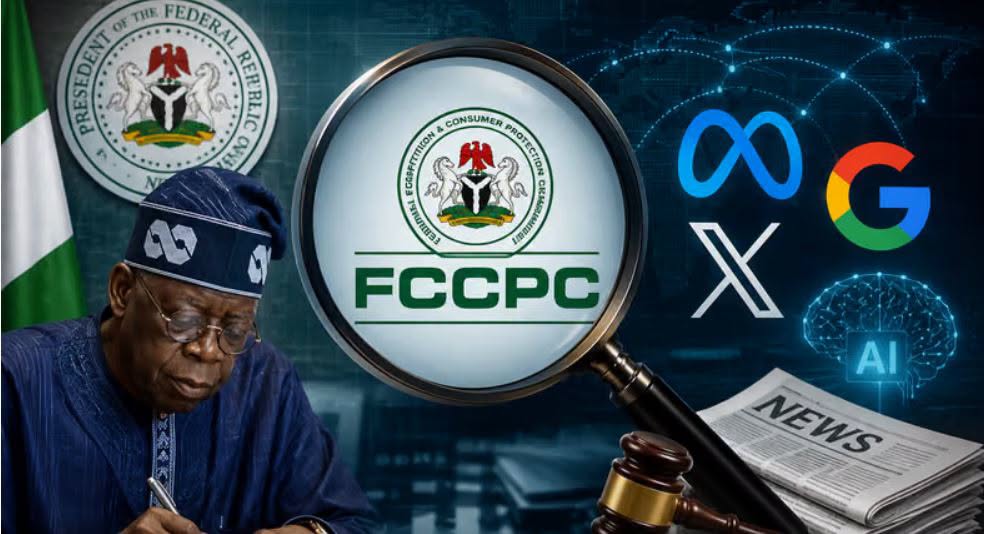
President Bola Ahmed Tinubu’s call for the Federal Competition and Consumer Protection Commission (FCCPC), to look into the actions of major tech companies and Generative Artificial Intelligence platforms is a pivotal moment in Nigeria’s digital landscape. While this move was sparked by a petition from the Nigerian Press Organisation (NPO), the implications reach far beyond just the interests of newspaper publishers and broadcasters.
This inquiry touches on crucial issues like Nigeria’s economic independence, the future of journalism, the oversight of artificial intelligence, and whether the laws of Nigeria will hold the same weight against the biggest tech giants in the world.
Thus, this investigation should be seen as a positive step—not as an accusation against any specific company, but as a rightful exercise of Nigeria’s authority to ensure that competition in its digital economy remains fair, transparent, and within the bounds of the law.
Every nation eventually faces a crucial decision: will its digital future be dictated by foreign corporations, or will it be shaped by rules crafted through democratic processes? Nigeria has now arrived at this pivotal moment.


For more than a decade, Big Tech companies have become essential gateways for Nigerians seeking information, connecting with others, promoting their businesses, and staying updated with the news. Their innovations have undeniably opened up new avenues for commerce, education, entertainment, and political engagement.
Countless Nigerian businesses rely on these platforms daily, and it’s hard to overlook the significant role they play in driving economic growth.
However, the immense power wielded by these companies also brings up some serious policy concerns.
Who truly benefits from Nigerian journalism? Who takes home the advertising dollars generated by Nigerian audiences?
Who decides which stories millions of Nigerians get to see—or miss out on entirely?
Who gains when artificial intelligence systems consume years of hard work from Nigerian journalists? These aren’t just hypothetical questions anymore.
They are crucial to the future of Nigeria’s information landscape.
Professional journalism comes with a hefty price tag. Investigative reporting demands a lot—time, travel, skilled editors, legal checks, and a solid investment from institutions.
Newspapers have bureaus spread out all over the country, while broadcasters send reporters into risky situations. Online publishers are grappling with rising operational costs, all while facing dwindling advertising revenue.
At the same time, global tech platforms are pulling in audiences like never before.
Nigerian media organisations are raising a red flag, pointing out that these platforms are raking in huge profits by distributing, indexing, and summarising journalistic content, yet the creators of that content often see little to no financial reward in return.
If this situation is confirmed, it wouldn’t just be a commercial issue; it would highlight a fundamental flaw that could threaten the very existence of independent journalism.
For a democracy to thrive, it needs journalism that can stand on its own two feet.
When newsrooms face a drop in revenue, the quality of investigative reporting takes a hit.
As investigative reporting dwindles, the level of accountability diminishes.
And when accountability falters, democracy pays the price. This is why the FCCPC investigation is so crucial and deserves our attention.
The situation becomes even more pressing in the era of Generative Artificial Intelligence.
AI models need vast amounts of text for their training. Across the globe, publishers are raising concerns about whether their copyrighted news articles have been scraped, used, or exploited without their consent or fair compensation.
If Nigerian journalistic content has been used to train commercially valuable AI systems without proper licensing, it raises significant legal and ethical issues.
Nigerian intellectual property holds value. The hard work of Nigerian journalists is valuable too.
The archives that Nigerian newspapers and broadcasters have painstakingly built over the years hold significant value.
We shouldn’t let the digital age overshadow these truths just because technology has outpaced our legal frameworks. This investigation offers Nigeria a chance to define how AI companies should interact with local content creators moving forward.
The goal shouldn’t be to isolate ourselves from technology or to resist innovation.
Instead, Nigeria should create clear guidelines that promote innovation while also honouring copyright, competition laws, and fair business practices. It’s worth noting that Nigeria isn’t stepping into uncharted waters.
Australia has already implemented laws that require negotiations between digital platforms and publishers. Canada has taken similar steps.
The European Union has bolstered the rights of publishers under copyright law. South Africa has also looked into the dynamics between digital platforms and news organisations, resulting in agreements aimed at supporting the local media landscape.
Nigeria should take a close look at these examples—not to copy them exactly, but to craft solutions that fit its unique market conditions.
Nigeria stands as the most populous country in Africa, boasting one of the continent’s largest digital economies and a rapidly growing tech sector. It should seize the opportunity to play an active role in shaping global digital governance.
This investigation also has wider implications for competition policy. Digital markets often display traits that traditional competition laws never anticipated.
Network effects make it increasingly tough to challenge dominant platforms. Having control over advertising infrastructure gives these platforms an extra edge in competition.
Algorithms play a crucial role in determining visibility, audience reach, and overall commercial success.
The accumulation of data only serves to strengthen the position of established players. Artificial intelligence takes these advantages to a whole new level.
Regulators around the globe are still trying to navigate these complex realities. Nigeria can’t afford to sit back and watch as the framework of the global digital economy develops around it.
At the same time, the FCCPC needs to carry out its investigation with the utmost fairness. It’s reassuring and crucial that the Commission makes it clear that no company is automatically considered guilty.
The credibility of regulations relies not on political speeches but on solid evidence. Every company facing an investigation deserves fair treatment.
Each allegation should be thoroughly examined. Every conclusion must be backed by clear, demonstrable facts. If violations are found, appropriate actions should be taken. Conversely, if allegations turn out to be baseless, that result should also be acknowledged.
This kind of institutional discipline actually boosts investor confidence instead of undermining it. Policymakers should also heed an important warning.
Nigeria must steer clear of creating a regulatory atmosphere that seems unfriendly to innovation or foreign investment.
Technology companies have made significant investments in digital infrastructure, entrepreneurship, digital skills, and economic growth throughout Africa.
Nigeria stands to gain significantly from these investments. The goal should be to find a balance—not to impose punishment.
A well-regulated digital economy is far more appealing than one filled with uncertainty. Businesses appreciate having clear and predictable rules.
Publishers seek fair compensation for their work. Consumers are on the lookout for innovation. Governments prioritise adherence to national laws. These goals can align when regulation is both transparent and proportionate.
In the end, this investigation goes beyond just newspapers, broadcasters, or artificial intelligence. It raises the question of whether Nigerian institutions have the confidence and capability to effectively regulate the key technologies that will shape the twenty-first century.
This raises some important questions about whether Nigerian creative and intellectual work will get the recognition it deserves in the global digital economy.
It also brings up the issue of whether local industries can thrive alongside the big multinational tech companies. And we need to consider if Nigeria will take charge of its digital future or just go along with decisions made by others.
President Tinubu’s directive has sparked a crucial national discussion. Now, the FCCPC has the responsibility to ensure that this conversation leads to clear outcomes instead of controversy, relies on solid evidence rather than mere speculation, and brings about reforms that safeguard both innovation and fairness.
Nigeria’s digital economy can only grow stronger if every player—whether local or global, traditional or tech-based—follows transparent rules that promote healthy competition, reward creativity, and uphold the law.
This isn’t about protectionism.
It’s about practicing responsible governance in our digital era.