


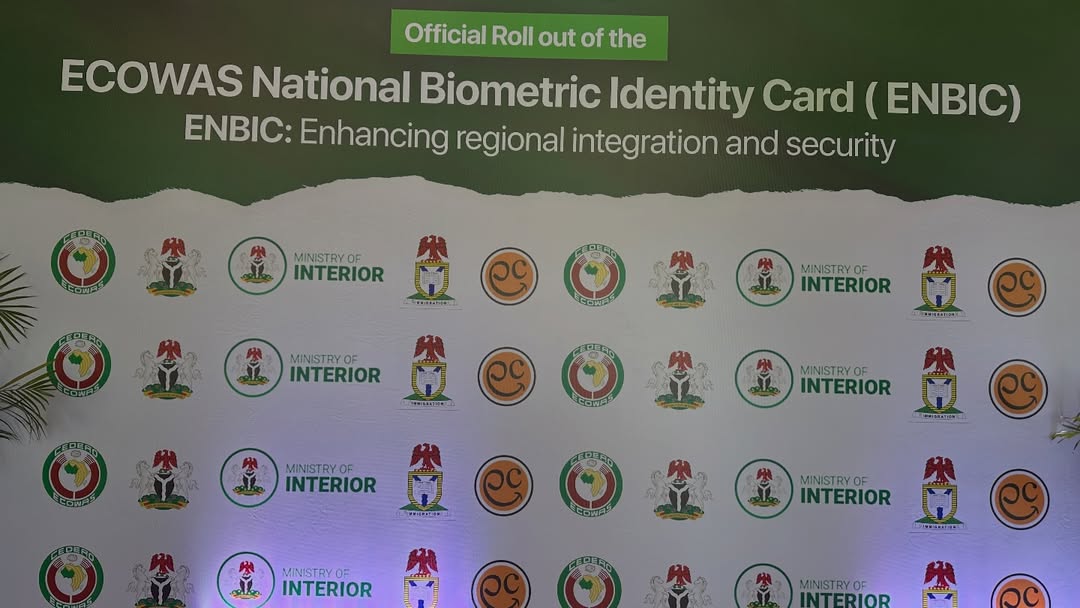
Nigeria has officially launched the Economic Community of West African States (ECOWAS), National Biometric Identity Card (ENBIC), a pivotal step aimed at strengthening regional integration, modernising identity management, and bolstering security across the sub-region.
The unveiling took place at the Transcorp Hilton Hotel in Abuja, where Minister of Interior, Olubunmi Tunji-Ojo led the ceremony before an audience of government officials, diplomats, and representatives from ECOWAS institutions.
A New Era of Identity Management
Describing the rollout as “a powerful new beginning,” Tunji-Ojo said the ENBIC signals Nigeria’s commitment to a harmonised, secure regional identity system aligned with global best practices.



The ENBIC, adopted by ECOWAS in 2014, replaces the bloc’s outdated handwritten travel certificate. The new card contains an embedded electronic chip storing biometric and biographical data, providing a robust, modern mechanism for identity verification and reducing vulnerability to document fraud.
Seven Countries and Counting
Senegal became the first state to issue the card in 2016. Since then, Guinea-Bissau, Ghana, Benin, The Gambia, and Sierra Leone have fully deployed it, making Nigeria the seventh country in the bloc to implement the system.
Tunji-Ojo acknowledged that Nigeria should ordinarily have been at the forefront of this initiative.
“It is unlike the Nigerian standard. That is very unusual,” he noted. “But the good news is that President Tinubu came in, insisted on delivery, and today the promise has become a reality. This is leadership in action—not about what we will do, but what we have done.”
Enhancing Security Through Reliable Identification
The minister emphasized that the ENBIC will form the bedrock of a modern security architecture—one capable of transforming intelligence gathering, border surveillance, and migration management.

“You cannot protect who you do not know. Identification is the bedrock of security,” he said, stressing that the biometric card will help curb irregular migration and strengthen Nigeria’s border integrity.
The system’s biometric features—supported by encrypted digital technology—will allow authorities to authenticate identities more efficiently and detect fraudulent activity with far greater precision.
Towards a Schengen-Style West African Security System
Tunji-Ojo also revealed that the Nigerian government is collaborating with ECOWAS to establish a regional migration database, similar to the Schengen Information System used across Europe.
Such a platform, he said, would revolutionize cross-border intelligence sharing, harmonize migration data across member states, and create a unified front against transnational threats.
A New Pathway for Regional Mobility
With the introduction of the ENBIC, Nigerians travelling within ECOWAS states will be able to move more freely, reducing administrative barriers and reinforcing the bloc’s free-movement protocol. For traders, students, tourists, and migrant workers, the card promises lower travel costs, reduced bureaucracy, and a smoother mobility experience.
Its launch represents not just a technological upgrade, but a reaffirmation of Nigeria’s leadership role in shaping a more integrated, secure, and cooperative West Africa.