

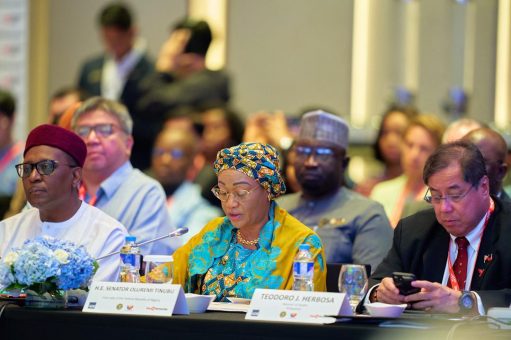
First Lady Senator Oluremi Tinubu has urged that Nigeria’s battle against tuberculosis (TB) should not be dependent on foreign assistance, highlighting the importance of building resilient local systems and capacity to eradicate the disease by 2030.
Speaking in Manila, Philippines, at the 39th Stop TB Partnership Board Meeting, where she was the special guest of honour, Tinubu stressed Nigeria’s unwavering commitment to the TB response despite fluctuations in donor support. Her Senior Special Assistant on Media, Busola Kukoyi, said the First Lady noted that “through steadfast leadership, community engagement, and strategic national coordination, we have ensured that the number of people diagnosed and treated for TB in 2025 did not decline.”
She described this achievement as evidence of “the power of country ownership and the unwavering commitment of Nigerians who continue to drive this response forward, even in the face of uncertainty.”
As both Global and National Stop TB Champion, Tinubu reiterated Nigeria’s determination to eliminate TB by 2030, aligning with President Bola Tinubu’s Renewed Hope Agenda. She emphasized the human cost of the disease, noting that “TB remains the biggest infectious killer disease, claiming close to 1.3 million lives each year. In Nigeria alone, about 479,000 people developed TB in 2023, and more than 150,000 lives were lost.”

The First Lady commended the Federal Ministry of Health and Social Welfare, the Stop TB Partnership, and other partners for their transparency and commitment to expanding access to testing, diagnosis, and treatment. Speaking at the meeting, the Chair of the Stop TB Partnership Board, Philippines Secretary of Health Teodoro Herbosa, highlighted that tuberculosis is “more than a health issue but a development challenge” that requires innovation, including artificial intelligence and digital tools for early detection and treatment.
Dr. Lucica Ditiu, Executive Director of the Stop TB Partnership, called for stronger political commitment, urging countries to develop sustainable systems, integrate TB services into primary healthcare, and empower communities and survivors. Nigeria’s Coordinating Minister of Health and Social Welfare, Prof. Muhammad Ali Pate, also attended the meeting.
