


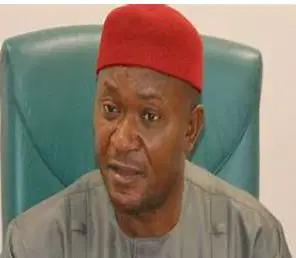
Nigeria’s unity and progress are being undermined by systemic exclusion and ethnic profiling, particularly against the Igbo people, according to Hon. Linus Okorie, a former member of the House of Representatives.
Okorie represented the Ohaozara/Onicha/Ivo Federal Constituency and spoke out on the issue in reaction to President Bola Tinubu’s Independence Day address. Okorie highlighted the disparity in infrastructure allocation, citing that the Southwest received ₦2.5 trillion for road construction compared to the Southeast’s ₦446 billion.
The Southeast was excluded from the national gas pipeline infrastructure, despite Imo State having the largest gas reserve in Nigeria. Okorie noted that the Southeast received only the constitutional minimum of five ministerial slots, with three being junior positions, while Ogun State alone had five full cabinet rank ministers. According to Okorie, this exclusion is evident in various aspects of national life.
The Lagos International Trade Fair demolitions were cited as an example of economic targeting, with predominantly Igbo business owners being displaced and suffering enormous financial losses. Okorie emphasized that the “Obidient” philosophy remains a flame of hope for a restructured, inclusive, and prosperous New Nigeria.

Okorie urged Igbos to take voter registration seriously, framing it as a collective redemptive duty to shape Nigeria’s future in 2027. He stressed the need for collective action to address the systemic exclusion faced by the Igbo people. Okorie’s comments have sparked a renewed conversation about the need for inclusivity and fairness in Nigeria’s development.
The issue of systemic exclusion has been a longstanding concern in Nigeria, with many calling for a more equitable distribution of resources and opportunities. Okorie’s statement is expected to add momentum to the ongoing debate about the need for restructuring and greater inclusivity in the country.
