


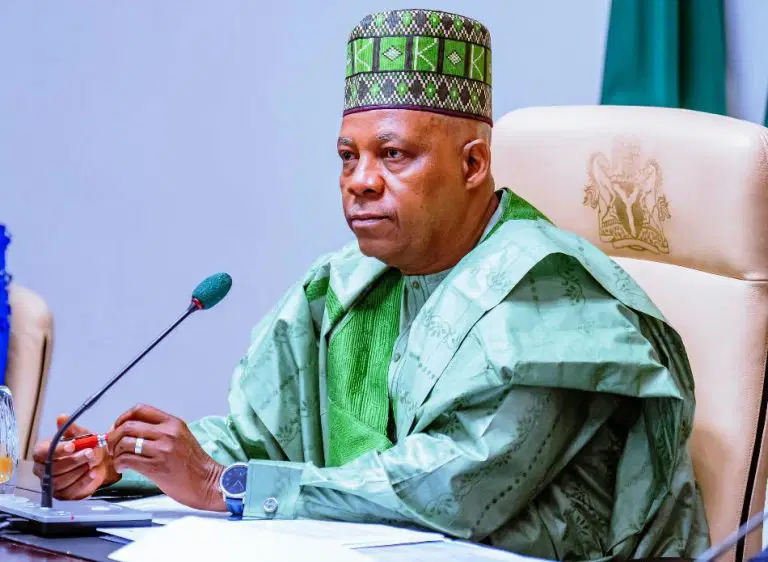
Vice President Kashim Shettima has emphasized that Nigeria’s true wealth lies in the creativity and enterprise of its people, rather than its oil or natural resources.
He made this statement at the Made in Naija Trade Exhibition, organised by the House Committee on Commerce, where he was represented by his Special Adviser on Special Duties, Dr. Aliyu Modibbo Umar.
Shettima stressed that Nigeria’s global identity would ultimately be shaped by what it creates and exports, saying, “There is nothing that advertises the pride of a nation as much as the craft and creativity of its people. Our future depends on the ingenuity of our citizens.” He described the exhibition as a statement of intent, signalling both government and private-sector readiness to elevate Nigerian-made products to global competitiveness.
The Vice President noted that Nigerians have already demonstrated excellence in various sectors, including agro-processing, architecture, textiles, technology, manufacturing, and the creative industry. However, he emphasized that production alone is not enough, urging Nigerians to patronise locally made products. “We must patronise what we produce. Each time we buy Nigerian, we invest in an entrepreneur, an artisan, a factory worker,” he said.

Shettima assured that the Tinubu administration is committed to building an innovation-driven economy, with ongoing reforms targeting infrastructure, access to finance, port efficiency, and certification systems aligned with global standards. “With the world’s highest quality, we want the answer to be Nigeria,” he said.
Speaker of the House of Representatives, Rt. Hon. Abbas Tajudeen, also reaffirmed the commitment of the National Assembly to policies that prioritise local production. He described the exhibition as timely and aligned with the country’s push for industrial growth, especially under the African Continental Free Trade Area (AfCFTA).
Chairman of the House Committee on Commerce, Hon. Ahmed Munir, said Nigeria is on the verge of an industrial rebirth driven by local manufacturing, innovation, and strong legislative backing. He estimated that substituting key imports with local alternatives could save the country up to $20 billion annually and potentially create over five million jobs by 2030.
