

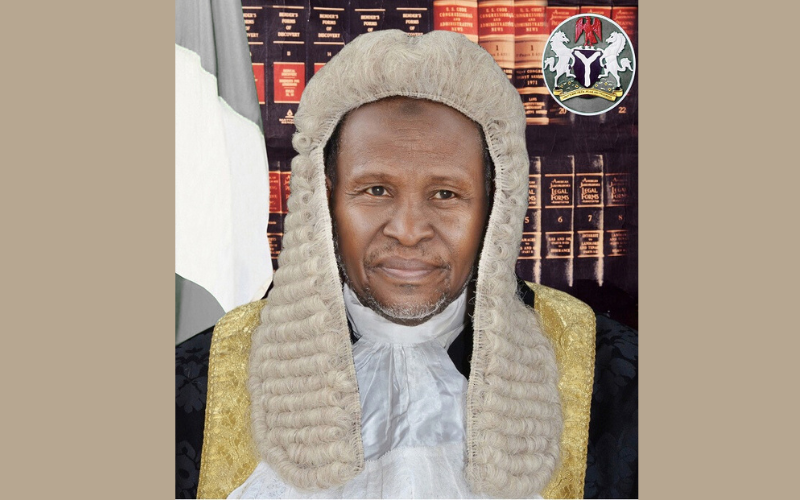
The unexpected passing of Justice Ibrahim Tanko Muhammad, former Chief Justice of Nigeria (CJN), marks a solemn moment in our nation’s history. At age 71, he died on December 16, 2025, in a hospital in Saudi Arabia after a brief illness, just weeks before he would have turned 72.
The news of his passing was formally confirmed on Tuesday in Abuja through a condolence statement issued by the Nigerian Association of Muslim Law Students (NAMLAS).
In a message titled “NAMLAS Condolence Message on the Passing of Hon. Justice Ibrahim Tanko Muhammad, GCON, Former Chief Justice of Nigeria,” the association described his death as a profound and irreplaceable loss—not only to the judiciary, but to the nation as a whole.
“Indeed, to Allah we belong, and to Him we shall return,” the statement began, echoing the solemnity with which the news has been received across legal and religious circles. NAMLAS noted that Justice Muhammad’s demise represents “a monumental loss to the Nigerian judiciary, the legal profession, the Muslim Ummah, and the nation at large.”
Justice Ibrahim Tanko Muhammad’s journey through Nigeria’s judicial system was one defined by perseverance and distinction. Rising through the ranks to become the 17th Chief Justice of Nigeria, he embodied the aspirations of many who believe in the rule of law as the bedrock of national stability. His years on the bench, particularly at the Supreme Court and later as CJN, placed him at the heart of some of Nigeria’s most consequential legal moments.

While his tenure was not without challenges and internal controversies—reflecting broader structural tensions within the judiciary—Justice Muhammad remained a central figure in the ongoing discourse about judicial independence, administrative reform, and ethical leadership. His career mirrored both the strengths and the unresolved complexities of Nigeria’s justice system.
One of the most significant and defining events of his tenure occurred in 2022, when Justice Muhammad resigned as Chief Justice following an unprecedented internal crisis within the Supreme Court. Several senior justices had formally raised concerns over administrative practices, welfare issues, and leadership style—an episode that brought rare public attention to internal governance challenges within Nigeria’s highest court.
His resignation, though controversial, marked a watershed moment in the judiciary’s history, exposing the urgent need for transparency, institutional cohesion, and reform at the highest levels of judicial administration.
That episode, while difficult, underscored the broader struggles of our justice system—balancing independence, accountability, and ethical leadership under intense national and political pressure. It also ignited a national conversation about judicial welfare, internal checks, and the preservation of the dignity of the courts.
Beyond the courtroom, his passing resonates deeply within the Muslim community and among young legal minds who saw in him a symbol of possibility and faith-driven service. That NAMLAS, an association of aspiring legal practitioners, was among the first to publicly mourn him underscores the influence he wielded beyond his judgments—an influence rooted in mentorship, identity, and representation.
As Nigeria mourns, this moment should transcend ritual condolences. It should prompt sober reflection on the state of the judiciary he once led and the urgent need to strengthen institutions entrusted with dispensing justice. The true honour to Justice Ibrahim Tanko Muhammad’s memory lies not only in words of praise, but in renewed commitment to the ideals of fairness, integrity, and unity within the legal system.
In death, as in life, Justice Ibrahim Tanko Muhammad remains a figure of national significance. May his soul find rest, and may his legacy inspire a judiciary worthy of the confidence of the people it serves.
