


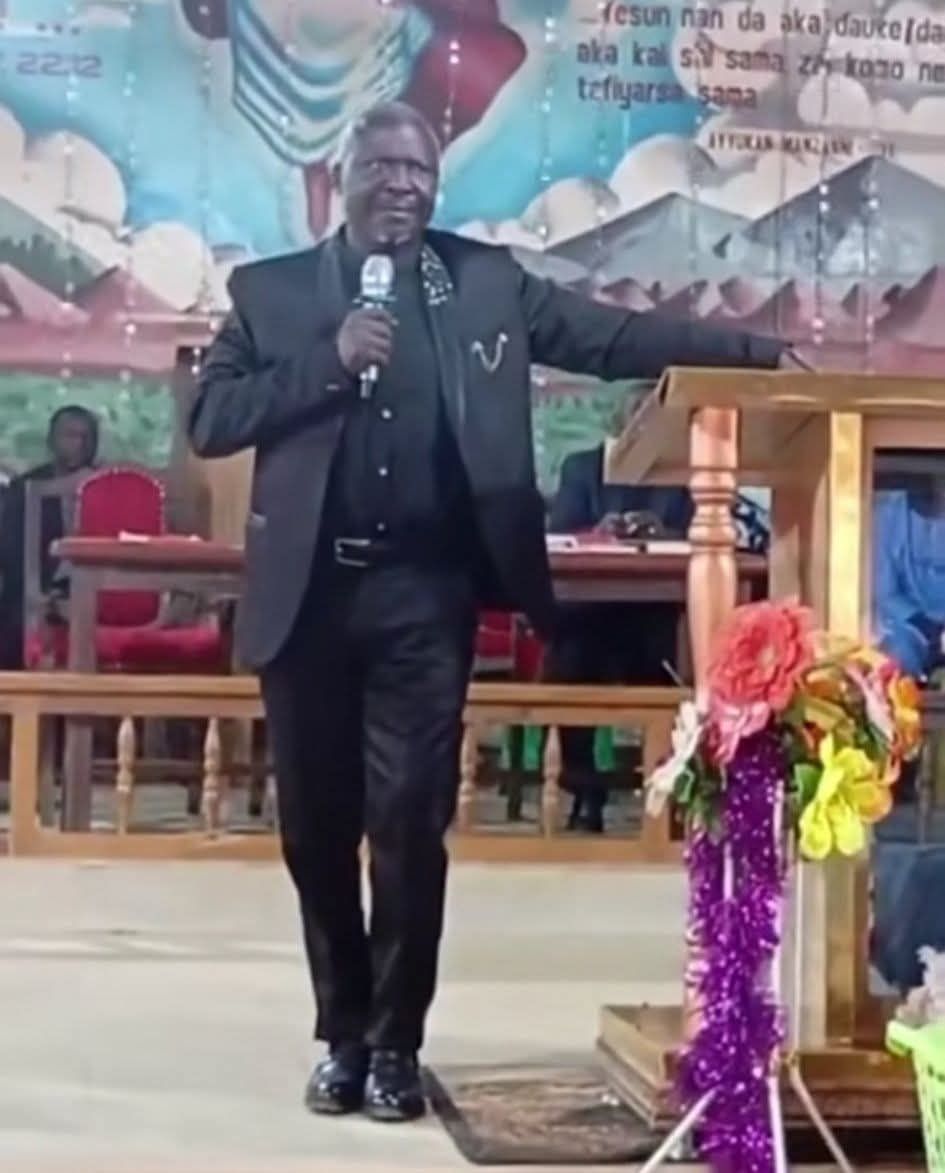
In a move that has sparked outrage among his supporters and renewed debates over religious persecution and freedom of speech, the Facebook account of popular Plateau State cleric, Reverend Ezekiel Dachomo, has been deleted.
Dachomo himself confirmed the development to multiple media outlets on Saturday when contacted for verification. When asked if his account had indeed been removed, he simply stated, “It’s true.”
Who Is Rev. Ezekiel Dachomo?
Reverend Ezekiel Bwede Dachomo is a prominent pastor with the Church of Christ in Nations (COCIN), and serves as a regional chairman in Barkin Ladi Local Government Area, Plateau State. Over the years, he has become one of Nigeria’s most vocal advocates for Christians, particularly in regions affected by violent attacks.
Dachomo has gained international attention for his outspoken commentary on what he describes as an ongoing Christian genocide in Nigeria. In a recent interview with British journalist, Piers Morgan, he claimed to have conducted over 70 mass burials, highlighting the scale of attacks on Christian communities.


Facebook Account Deletion Amid Advocacy
The deletion of Dachomo’s Facebook account comes amid his heightened activism. He has used the platform to document attacks, mobilise awareness, and share videos of affected communities. Supporters argue that removing his page amounts to silencing a critical voice at a time when visibility for these issues is vital.
In addition to his social media presence, Dachomo has taken his advocacy to international arenas. He recently testified before the United States Congress, providing testimony on the ongoing violence against Christians in Nigeria.
Political Context and Controversy
Dachomo’s activism intersects with sensitive political discussions. US President, Donald Trump, designated Nigeria as a ‘Country of Particular Concern’, a classification often reserved for nations exhibiting religious persecution. However, the Nigerian government, which recently sent officials to the United States, dismissed this designation, claiming that the president relied on “faulty statistics.”
This clash has intensified debates over both the severity of attacks on Christians and the Nigerian government’s handling of the crisis. Dachomo’s supporters argue that removing his Facebook account could further limit international attention to the matter.
Christian Genocide Claims
-
Mass Burials
Dachomo has repeatedly stated that he has overseen mass burials of Christian victims. His claim of over 70 mass burials underscores the scale of violence in Plateau State and surrounding regions. -
Threats and Security Concerns
The cleric has publicly shared that he faces threats to his life, citing ongoing intimidation and past attacks. Supporters say that these threats, coupled with the deletion of his social media presence, put him in an increasingly vulnerable position. -
International Advocacy
Beyond Nigeria, Dachomo’s testimony before the US Congress signals his intention to raise global awareness and pressure international bodies to recognise and address the alleged Christian killings.
Implications for Freedom of Speech and Religion
The removal of Rev. Dachomo’s Facebook page highlights several pressing issues:
-
Religious Freedom: If Dachomo’s claims are accurate, then silencing his voice could amount to suppressing a minority community’s witness to violence.
-
Censorship Concerns: Whether Facebook acted independently or under external pressure, the action has raised alarms about the potential for online platforms to silence controversial but critical voices.
-
International Spotlight: With Dachomo’s global outreach, including Congressional testimony, this move may ironically draw even more attention to the issues he raises.
Conclusion
Rev. Ezekiel Dachomo’s deleted Facebook account is more than a social media incident; it symbolizes the tension between advocacy, religious freedom, and censorship in Nigeria. As he continues to raise his voice on Christian persecution, the world will be watching to see how Nigerian authorities and international actors respond.
For Dachomo’s supporters, the account deletion is not the end of the conversation — it may be just the beginning of a broader push for accountability, recognition, and protection of vulnerable communities.