


President Bola Ahmed Tinubu has formally sworn in the newly appointed Chairman and 37 Commissioners of the Federal Character Commission (FCC), marking a significant step in revitalising one of Nigeria’s key constitutional bodies responsible for promoting fair representation in federal appointments and public sector opportunities.
Inauguration Ceremony at the Presidential Villa
The swearing-in ceremony took place on Thursday at the Council Chambers of the Presidential Villa in Abuja, where the President administered the oath of office to the new FCC leadership, including the Chairman, Hulayat AyoOmidiran, and commissioners representing the 36 states of the federation and the Federal Capital Territory (FCT).
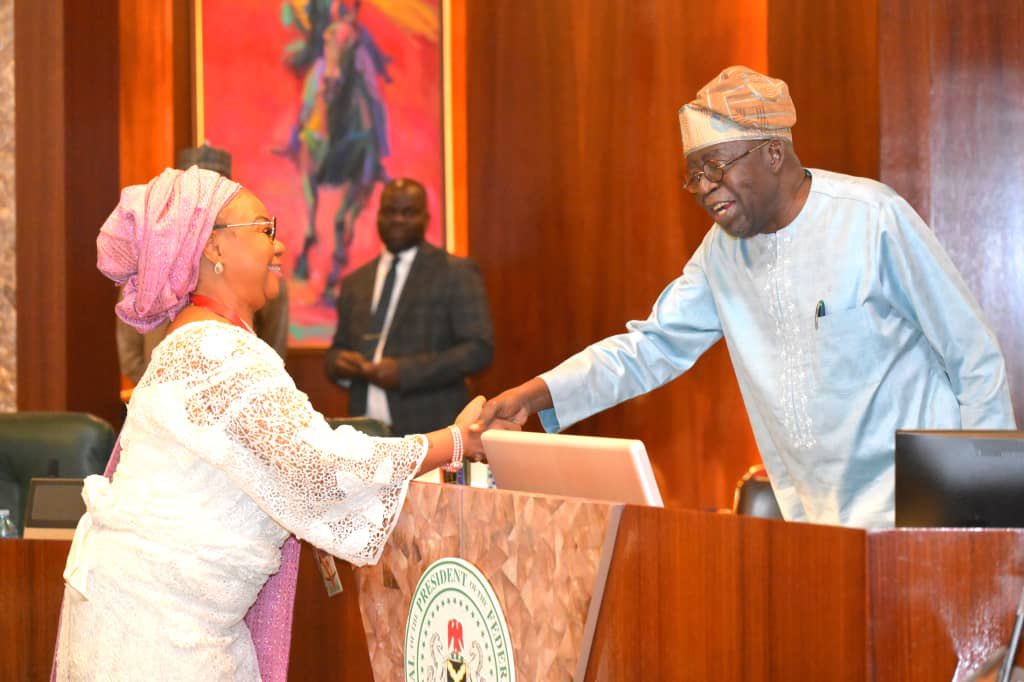
President Tinubu offered his congratulations and best wishes immediately after the inauguration — notably captured in photographs showing him warmly congratulating Chairman Omidiran in the Presidential Villa setting.
Who Is the New Chairman?
Hulayat Ayo Omidiran, aged 59 and an indigene of Ikire in Osun State, takes over leadership of the FCC from Dr. Muheeba Dankaka. Omidiran’s appointment reflects both her legislative and administrative experience:

-
She served two terms in the House of Representatives for the Ayedaade/Irewole/Isokan Federal Constituency between 2011 and 2019.
-
A graduate in Biochemistry from Ahmadu Bello University, Zaria.
-
Her career spans sports administration, including key roles with the Nigeria Football Federation (NFF), FIFA Women’s Football Committee, and the Nigeria Olympic Committee.
-
She is also the founder of Omidiran Babes Football Club, a women’s football team based in Osogbo.
Her appointment was confirmed by the Nigerian Senate on November 27, 2025, following statutory vetting, including security screening and a committee appearance.

Commissioners Representing States and the FCT
Alongside Omidiran, 37 commissioners were sworn in to represent the nation’s federating units, reflecting Nigeria’s diversity and commitment to equitable federal character implementation. Among these are:
-
Peter Eze (Enugu)
-
AbdulWasiu Bawalla (Lagos)
-
Victor Ikeji (Abia) (replacement for an earlier nominee)
-
Lawal Roni (Jigawa)
-
Abubakar Bunu (Kebbi)
-
Eludayo Eluyemi (Osun)
-
Bema Madayi (Adamawa)
-
Dora Ebong (Akwa Ibom)
-
Nnoli Gloria (Anambra)
-
Babangida Gwana (Bauchi)
…and others from across all geopolitical zones.
Mohammed Musa was also sworn in as the Secretary of the Commission.
President Tinubu’s Charge to the FCC Leadership
In his remarks at the ceremony, President Tinubu emphasised the critical role of the FCC in fostering fairness, unity, peace, and stability across Nigeria. He described the commission as the “conscience of the nation,” tasked with ensuring that federal appointments and distribution of public opportunities reflect the rich diversity of the country.

The President urged the new leadership to:
-
Uphold integrity and patriotism in the discharge of their duties.
-
Promote fairness and diligent service as central to national development.
-
Seek ways to contribute positively to Nigeria’s socio-economic growth.
Tinubu reiterated that Nigeria possesses the human and natural resources to be prosperous and productive and encouraged the FCC leadership to align their work with the broader national interest.
Mandate and Importance of the FCC
Established under Act No. 34 of 1996 and enshrined in Sections 14 and 153 of the 1999 Constitution, the Federal Character Commission is mandated to:
-
Ensure equitable distribution of public posts and socio-economic infrastructure.
-
Formulate guidelines that uphold the federal character principle in government appointments.
-
Sanction institutions that violate principles of fair representation.
The FCC’s work is central to fostering national unity and inclusive governance in Nigeria’s multi-ethnic and culturally diverse landscape.
This landmark swearing-in underscores President Tinubu’s commitment to institutional reforms that reflect equity, representation, and national cohesion as pillars of governance. The newly inaugurated leadership now carries the responsibility to translate these principles into practice across the public service and beyond.
