

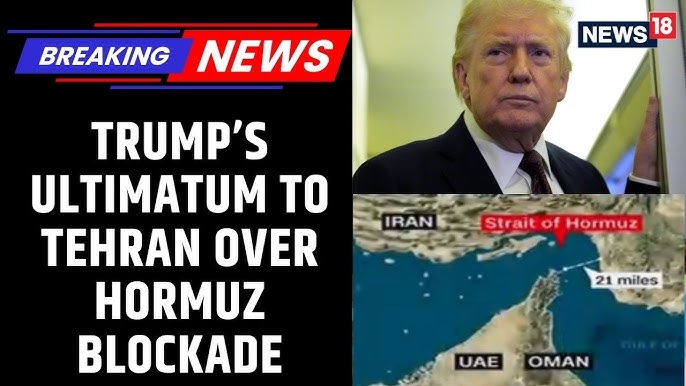
In March 2026, tensions in the Middle East escalated dramatically when U.S. President, Donald Trump, issued a 48-hour ultimatum to Iran demanding the full reopening of the Strait of Hormuz, one of the world’s most critical maritime chokepoints. The crisis forms part of a broader conflict involving the United States, Iran, and Israel, and has triggered global economic, political, and military repercussions.
Background to the Crisis
Strategic Importance of the Strait of Hormuz
The Strait of Hormuz is a narrow waterway connecting the Persian Gulf to the Arabian Sea.
It is:
- Responsible for about 20% of global oil shipments
- A vital route for energy exports from countries like Saudi Arabia, Iraq, UAE, and Kuwait
- A geopolitical chokepoint long associated with U.S.–Iran tensions
Any disruption to this route has immediate consequences for global energy markets and supply chains.
Origins of the 2026 Conflict
The current crisis stems from:
- A U.S.–Israel military campaign against Iran beginning February 2026
- Iranian retaliation, including missile strikes and maritime threats
- Iran’s move to restrict or effectively close the Strait of Hormuz to certain vessels
Iran claims it is targeting only “hostile” nations’ ships, while the U.S. and its allies view the action as a de facto blockade.

Trump’s 48-Hour Ultimatum
The Announcement
On March 22, 2026, Trump declared that:
- Iran must fully reopen the Strait within 48 hours
- Failure to comply would result in U.S. strikes on Iranian power plants
- The attacks would begin with “the biggest one first”
This marked a sharp escalation from earlier suggestions that the U.S. might scale down military operations.
Strategic Objectives of the Ultimatum
The ultimatum reflects several U.S. goals:
- Restore global oil flow and stabilise energy markets
- Assert U.S. military dominance in the region
- Pressure Iran into de-escalation without prolonged naval conflict
- Signal resolve to allies and adversaries
Iran’s Response
Iran responded strongly and defiantly:
- Warned it would completely close the Strait if attacked
-
Threatened retaliation against:
- U.S. assets
- Energy infrastructure in allied countries
- Declared it would show “zero restraint” in response to U.S. strikes
Iran’s Revolutionary Guards also warned that companies linked to the U.S. could be targeted.
Current Situation in the Strait
Shipping and Maritime Impact
- Shipping traffic has plunged by up to 95%
- Around 20,000 seafarers stranded in the region
- Many vessels avoiding the area due to security risks
Military Activity
- U.S. has launched operations targeting Iranian naval assets
-
Iran has deployed:
- Naval mines
- Missiles and drones
- Risk of direct naval confrontation remains high
Global Economic Impact
Oil Market Disruptions
- Oil prices surged above $105–$112 per barrel
- Increased shipping insurance costs
- Threats to energy security, especially in Asia and Europe
Broader Economic Effects
- Stock market volatility globally
- Rising fuel prices in import-dependent countries
- Potential inflationary pressures worldwide
International Reactions
Western and Allied Responses
- Calls for freedom of navigation
- Consideration of multinational naval escorts
- Some countries (e.g., Japan, European states), exploring intervention options
Diplomatic Concerns
- UN and global leaders urging de-escalation
- Fear of a wider regional war involving Gulf states
- Concerns over attacks on critical infrastructure
Risk of Escalation
The situation is considered highly volatile due to:
- Direct U.S.–Iran confrontation risk
-
Possibility of:
- Attacks on oil facilities across the Gulf
- Expansion into neighboring countries
- Involvement of proxy groups (e.g., regional militias)
A miscalculation could trigger a full-scale regional war.
Strategic and Geopolitical Implications
For the United States
- Reinforces role as global security guarantor
- Tests military and diplomatic limits
- Risks long-term entanglement in another Middle East conflict
For Iran
- Demonstrates leverage via control of key chokepoints
- Faces risk of severe infrastructure damage
- Seeks to deter U.S. aggression through escalation threats
For the World
- Highlights vulnerability of global energy supply chains
- Reinforces importance of alternative routes and energy diversification
- Raises long-term questions about maritime security
Conclusion
Trump’s 48-hour ultimatum to Iran over the Strait of Hormuz represents one of the most dangerous flashpoints in recent geopolitical history.
The crisis combines:
- Military confrontation
- Energy security threats
- Global economic instability
With both sides issuing severe threats and little sign of compromise, the situation remains on a knife-edge. The outcome of this standoff will likely shape not only the Middle East’s future but also the stability of the global economy.
