


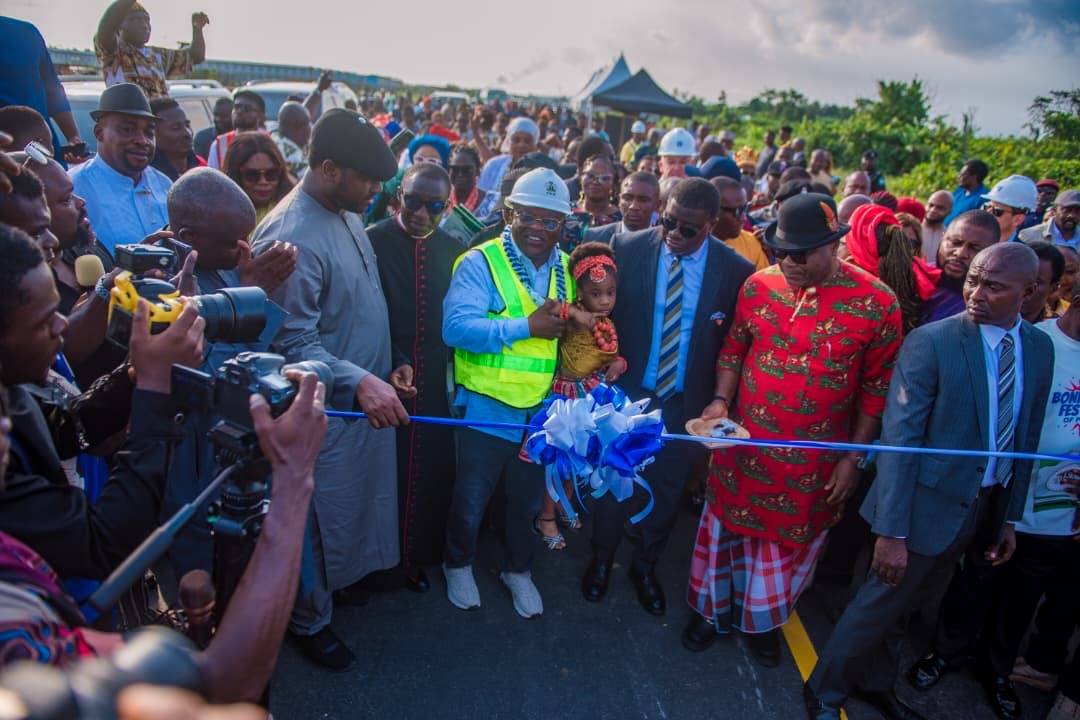
President Bola Ahmed Tinubu has inaugurated the temporary opening of the 37.9-kilometre Bodo-Bonny Road in Rivers State—an achievement widely celebrated as a historic breakthrough for the people of Bonny Kingdom, Bodo, and broader Ogoni communities.
The opening marks the end of decades of hardship defined by dangerous river travel and expensive helicopter trips that residents relied on to access Bonny Island, the home of Nigeria LNG (NLNG), and other multi-billion-dollar oil and gas installations.
The road, first awarded on December 11, 2014, but later abandoned, was revived on October 20, 2017, under a renewed contract with Julius Berger Nigeria Plc. After reaching 90.98% completion, President Tinubu—represented by the Minister of Works, Senator Dave Umahi—declared the route open for temporary use in a colourful ceremony at both the Bodo and Bonny access points.
“A Dream Come True”: Tinubu Celebrates Milestone Achievement
Speaking through Senator Umahi, President Tinubu described the Bodo-Bonny Road as a “flagship achievement” of his Renewed Hope Agenda.


“The dream of the Bonny Kingdom has come true; the dream of the Bodo Kingdom has come true. No more risky journeys through the busy Bonny River, no more expensive helicopters, no more untold hardships to reach this blessed island.”
The President emphasised that although the road is now passable, restrictions remain in place as construction progresses toward full completion in March 2026.
-
Open only to light vehicles
-
Operational between 7:00 a.m. and 7:00 p.m. daily
-
Heavy-duty trucks, motorcycles and tricycles remain prohibited
Tinubu also commended Julius Berger and, in particular, Project Manager Engineer Tim Nippert, acknowledging his resilience in ensuring consistent project progress despite difficult terrain and earlier setbacks.


“I have made a commendation to Julius Berger, especially Engineer Tim. I think if Engineer Tim was the Managing Director of Julius Berger, we wouldn’t have had all the fights we had in so many places.”
A Road Through Swamps, Creeks and Decades of Challenges
The Bodo-Bonny Road—featuring 11 bridges—is Nigeria’s first federal road connecting the mainland directly to Bonny Island. Beyond its political significance, the project represents a major engineering feat: a route carved through mangrove swamps, tidal waterways, and marshlands that had defied previous attempts for generations.
According to Julius Berger’s Project Manager, 35km of the dual carriageway are already fully motorable, with the final segments scheduled for completion in the first quarter of 2026.
The project is expected to transform not only social life but also logistics in Nigeria’s energy industry, reducing dependence on risky marine travel and costly helicopter shuttles that once defined access to the island.

Commendations, Requests and Renewed Hopes
In his remarks, Tinubu called on the Rivers State Government to provide 20 plots of land each in Bodo and Bonny for the construction of trailer parks, warning that indiscriminate parking by trucks would accelerate road damage and threaten its longevity.
The event drew praise from key stakeholders:
Senator Barinada Mpigi, Chairman of the Senate Committee on Works
He poured encomiums on the President for his commitment to the Ogoni people and pledged continued legislative support for the administration’s infrastructure efforts.
Governor Siminalayi Fubara, represented by Dr. Benibo Anabraba, SSG
Fubara expressed gratitude for Tinubu’s intervention that rescued the project from abandonment.
“This is the temporary opening of the Bonny-Bodo Road, but Mr. President, it is a permanent joy for the people of Bonny, Bodo and Rivers State. Like Oliver Twist, we will ask for more.”
A New Dawn for Bonny and the Niger Delta
Beyond its structural and economic significance, the temporary opening of the Bodo-Bonny Road symbolises relief from generations of isolation. For Bonny Island—an industrial hub cut off from the mainland except by treacherous waterways—the road brings safer, cheaper, and more reliable transportation.
For local businesses, workers, and families, it marks the beginning of easier movement, increased commerce, and faster access to essential services.
Once fully completed in 2026, the road is expected to integrate seamlessly into wider Niger Delta road networks, further boosting regional development and strengthening the nation’s economic backbone.
In many ways, the moment is indeed what President Tinubu called it: the fulfilment of a long-awaited dream for the Bonny and Bodo peoples—a permanent joy after decades of hardship.