


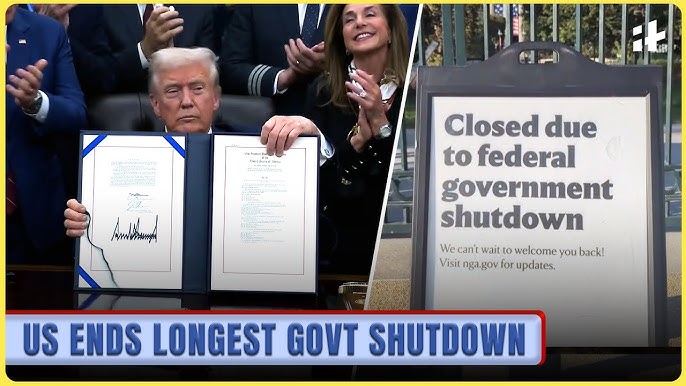
In a dramatic turn in Washington, President Donald Trump signed a bill on Wednesday night ending the longest federal government shutdown in U.S. history, bringing to close, a 43‑day impasse that had gripped the country.
The Shutdown and Its End
-
The shutdown began when federal agency funding lapsed on October 1, 2025, and Congress failed to agree on a continuing resolution and full appropriations.
-
It broke the previous record for U.S. government shutdowns, topping 43 days.
-
Early on Wednesday evening, the United States House of Representatives passed the bill by a vote of 222‑209 (six Democrats joined Republicans), after the United States Senate had passed it earlier.

-
Trump signed the measure in the Oval Office, highlighting the disruption caused and lambasting the opposition.
Key Provisions of the Bill
The bill provides several immediate and medium‑term effects:
-
It funds most of the federal government at existing levels through January 30, 2026.
-
It gives full‑year appropriations for certain agencies: e.g., the Department of Agriculture, military construction and veterans affairs, the legislative branch.
-
It restores pay and re‑hires: federal employees who were furloughed or forced to work without pay will receive back pay.
-
The bill ensures that the Supplemental Nutrition Assistance Program (SNAP), remains funded through September 2026, securing benefits for roughly 40 million Americans.
-
However, the measure does not include extension of the Affordable Care Act (ACA), premium subsidies — a key demand from Democrats — though the Senate pledged to hold a vote on the matter in December.
Impact and Reactions
Disruption & Relief:
The shutdown caused significant disruption: thousands of federal workers were unpaid, air traffic control and airports strained, food banks faced higher demand, and many services were halted or delayed.
With the funding restored, agencies will begin ramping up operations again, though some services may take time to fully recover.
Political Fallout:
-
Trump used the signing event to shift blame onto Democrats, calling the shutdown “extortion” and urging voters not to forget it.
-
Democrats pushed back, arguing that their key health‑care subsidy demand was ignored. With no guarantee of that being resolved, another showdown may arise.
-
Polls suggested Americans were almost evenly split in blame: 50 % blamed Republicans, 47 % blamed Democrats.
Economic Cost:
The shutdown’s cost to the economy is still being tallied, but the longer the hiatus, the higher the toll on productivity, services, and public trust.
Why It Mattered
This shutdown highlights several structural challenges in U.S. federal budgeting and governance:
-
The risk of continuing resolutions and short‑term funding as dodges rather than long‑term appropriations.
-
The reliance on partisan leverage — in this case around health‑care subsidy policy — to drive or block funding, which leaves critical services vulnerable.
-
How federal workers, state‑local partners, and ordinary citizens bear the consequences of political gridlock.
-
The urgency of restoring service delivery (e.g., air travel safety, food assistance), once the government reopens, and how delays can compound.
Looking Ahead
While the Immediate Showdown is Over, Several Issues Remain:
-
Will Congress follow through and extend ACA subsidies before they expire? If not, the risk of another shutdown looms.
-
Will full functionality of agencies — many of which saw furloughs, hiring freezes, and operational setbacks — return smoothly, or will lingering effects remain for months?
-
Will the funding deal prompt discussions about structural reform of the budget process, or will the same patterns repeat?
-
How will this event play politically, both for Trump, Republicans and Democrats heading into the 2026 mid‑terms?
Conclusion
With the stroke of his pen, President Trump effectively ended a 43‑day stalemate that shuttered big parts of the federal government and disrupted millions of Americans’ lives. While the relief is immediate — federal agencies reopening, paychecks returning, services resuming — the broader questions of policy, budgeting, partisan strategy and institutional resilience remain.
As Trump declared, “This is no way to run a country.” The coming months will test whether lessons have been learned — or whether the pause is only temporary before the next clash.
