


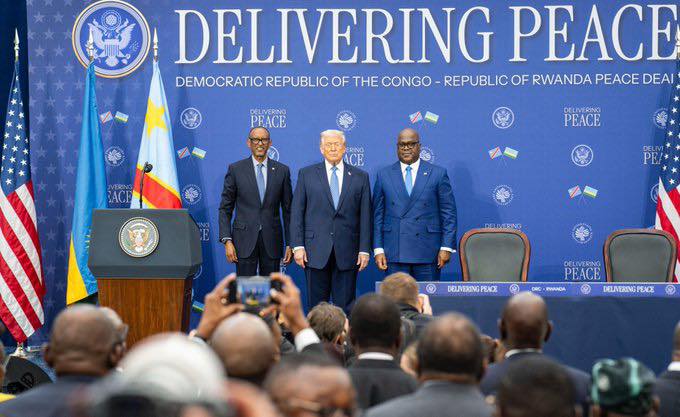
Washington, D.C. — The United States has announced a new visa restriction policy targeting individuals accused of undermining peace and stability in the Great Lakes region of Africa, with several senior officials from Rwanda expected to be affected. The announcement was made in a press statement issued by U.S. Secretary of State, Marco Rubio, who warned that continued interference in eastern Democratic Republic of the Congo threatens regional security and economic progress.
The policy is designed to penalise those believed to be responsible for fueling violence in eastern Congo, particularly through support for the armed group known as March 23 Movement (commonly referred to as M23).
Washington alleges that certain Rwandan officials have continued to assist the rebel movement, exacerbating instability in the mineral-rich region.
Visa Restrictions and Legal Basis
According to the State Department, the visa restrictions are being imposed under Section 212(a)(3)(C) of the Immigration and Nationality Act, which allows the Secretary of State to deny entry to individuals whose presence in the United States could have “potentially serious adverse foreign policy consequences.”


Under the policy, targeted individuals will be deemed ineligible to enter the United States. In some cases, the restrictions may also extend to immediate family members of those sanctioned.
Officials did not publicly release the names of the Rwandan officials affected by the new measures.
Washington Accords at the Center of Dispute
The visa restrictions are tied to what the United States says are violations of the Washington Accords on Eastern DRC Peace Process, a diplomatic framework aimed at ending decades of violence in eastern Congo. The agreement outlines responsibilities for multiple parties in the conflict, including both Rwanda and the Congolese government.
The United States is urging full compliance with the accords. In the statement, Secretary Rubio said the Congolese government must move swiftly to dismantle the militant group Democratic Forces for the Liberation of Rwanda (FDLR), which Rwanda has long cited as a security threat operating from within Congolese territory.
At the same time, Washington is calling on Rwanda to withdraw its troops and military equipment from the Democratic Republic of the Congo.
“The United States expects all parties to the Washington Accords to fully implement their commitments,” the statement said. “Only then will the immense economic potential of the Great Lakes region be realised.”
Ongoing Conflict in Eastern Congo
Eastern Congo has been plagued by armed conflict for more than two decades, involving dozens of militias, regional forces, and foreign-backed rebel movements. The resurgence of the M23 insurgency in recent years has significantly escalated tensions between Congo and Rwanda.
Kinshasa has repeatedly accused Kigali of supporting M23 fighters, a claim Rwanda denies. Rwanda, in turn, accuses Congo of failing to address the presence of the FDLR, a group linked to perpetrators of the Rwandan Genocide.
The fighting has displaced millions of civilians and triggered a humanitarian crisis across eastern provinces such as North Kivu.
U.S. Warning of Further Consequences
Secretary Rubio warned that individuals who obstruct efforts toward a sustainable peace in the region will continue to face consequences.
“Those responsible for, complicit in, or directly or indirectly engaged in undermining peace in the Great Lakes region will be held accountable,” he said.
The move signals a tougher diplomatic stance by Washington toward actors seen as prolonging one of Africa’s most complex and long-running conflicts.
Regional and Economic Implications
Analysts say the visa restrictions could increase pressure on political and military elites involved in the conflict while reinforcing U.S. diplomatic efforts to stabilise the region.
The Great Lakes region, which includes Rwanda, Congo, Uganda, and Burundi, holds vast deposits of critical minerals such as cobalt, coltan, and gold—resources vital to global electronics and clean-energy supply chains.
U.S. officials argue that lasting peace could unlock major economic opportunities for the region, but only if armed groups are dismantled and cross-border interference ends.
For now, Washington says the new visa policy is intended as a clear signal: those who undermine peace in the Great Lakes region risk international isolation and diplomatic consequences.