

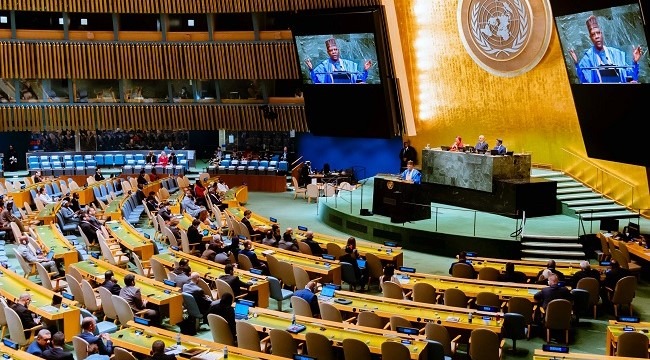
President Bola Tinubu has delivered a strongly worded reform policy proposal to the United Nations, warning that the global body must embrace sweeping restructurings or face growing irrelevance.
Tinubu criticized the organization’s record, pointing to ongoing human suffering in regions like the Middle East as “stains on our collective humanity.”
The President emphasized that the UN’s credibility is being undermined by the gulf between its words and deeds. “When we speak of nuclear disarmament, the proliferation of small weapons, Security Council reform, fair access to trade and finance, and the conflicts and human suffering across the world, we must recognise the truth. These are stains on our collective humanity,” he stated.
Tinubu outlined four key reform demands, starting with Nigeria’s call for permanent UN Security Council membership. “Nigeria must have a permanent seat at the UN Security Council. This should take place as part of a wider process of institutional reform. The United Nations will recover its relevance only when it reflects the world as it is, not as it was,” he said.

The President emphasized Nigeria’s transformation from a colony to a sovereign nation of over 236 million people, projected to be the third most populous country in the world. “We say, without stuttering and without doubt, that a two-state solution remains the most dignified path to lasting peace for the people of Palestine,” he declared.
Tinubu expressed deep frustration with the pace of international progress on critical issues, including nuclear disarmament and Security Council reform. He also proposed radical reforms to the global financial system, calling for new mechanisms to address the sovereign debt crisis plaguing developing nations.
The President emphasized the need for urgent action to promote debt relief, not as an act of charity but as a clear path to peace and prosperity that benefits everyone. “I am calling for a new and binding mechanism to manage sovereign debt, a sort of International Court of Justice for money, that will allow emerging economies to escape the economic straitjacket of primary production of unprocessed exports,” he said.
Tinubu positioned Africa’s natural resources as central to future global stability, emphasizing the need for African control over strategic minerals. “Africa has in abundance the critical minerals that will drive the technologies of the future,” he said. “Investment in exploration, development and processing of these minerals, in Africa, will diversify supply to the international market, reduce tensions between major economies and help shape the architecture for peace and prosperity.”
The President called for closing the digital divide, referencing the UN Secretary-General’s vision that “A.I. must stand for ‘Africa Included’.” “I am calling for a new dialogue, to ensure we promote the best of the opportunities that are arising and promote the level of access that allows emerging economies more robustly, to close a wealth and knowledge gap that is in no one’s interest,” he stated.
The President positioned Nigeria’s economic reforms as a model for resilience, despite the difficult reality facing its citizens. “The government has taken difficult but necessary steps to restructure our economy and remove distortions, including subsidies and currency controls that benefited the few at the expense of the many,” he explained.
